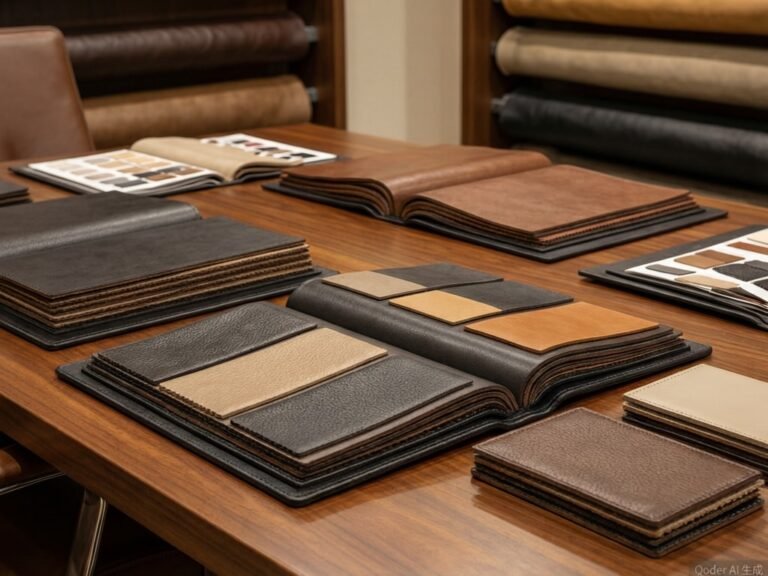
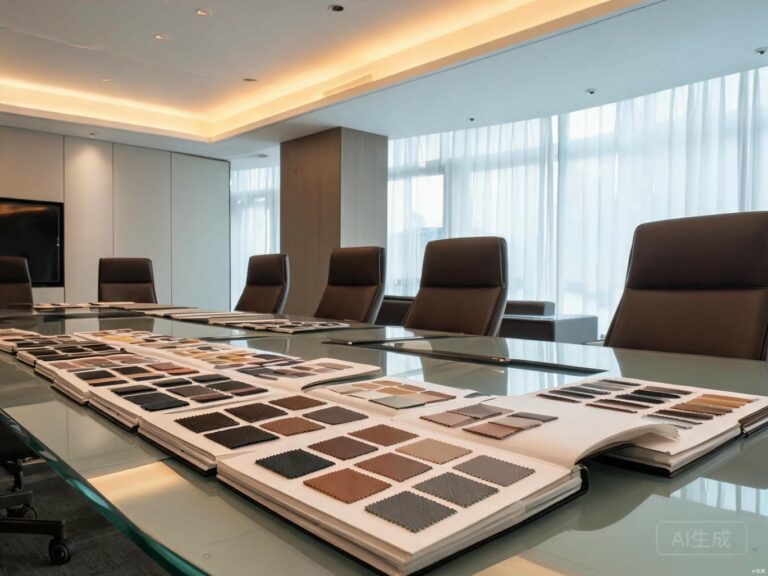
Finding reliable leather suppliers is the single highest-leverage decision in B2B material sourcing. Get it right, and your production line runs clean for years. Get it wrong, and you’re looking at delayed shipments, failed quality inspections, custom holds at the border, and a six-figure write-off that someone has to explain to the board.
The global leather goods market reached $476 billion in 2026, growing at 6.24% CAGR through 2031. China alone accounts for 22-25% of global leather output and over 30% of leather goods exports. But the market is consolidating — China’s规模以上 leather enterprises dropped by 12 in 2025, and the remaining 2,847 companies are competing harder for your business. Some will cut corners. Some never had corners to begin with.
This article identifies the 7 red flags that separate genuine leather suppliers from the middlemen, brokers, and outright fraudsters who waste your procurement cycle. Each flag is actionable — if you see it during your evaluation, walk away or demand documentation before proceeding.
Bottom Line: 91% of suppliers who refuse to share their raw hide supplier list are linked to counterfeit or misrepresented “genuine leather” claims. The red flags below help you identify that 91% before you transfer a deposit.
Factory vs. Trading Company: How to Tell What You’re Actually Buying From
The most fundamental question in evaluating leather suppliers is whether you’re dealing with a factory or a trading company. A factory owns production — cutting tables, coating lines, sewing equipment, skilled operators. A trading company owns none of that. They source from factories, add a margin, and resell to you. Neither is inherently wrong, but pretending to be one when you’re the other is fraud.
China’s leather supplier industrial clusters are geographically concentrated, and knowing them helps you verify whether a supplier actually operates where they claim:
| Cluster | Core Cities | Specialization | Volume Share |
|---|---|---|---|
| Guangdong | Guangzhou (Huadu), Shenzhen | Premium/luxury goods, full OEM/ODM, silicone leather | ~35% |
| Zhejiang | Wenzhou, Jiaxing, Haining | Mid-market goods, high-volume PU/PVC | ~40% |
| Fujian | Quanzhou, Xiamen | Footwear, sportswear leather goods | ~15% |
| Hebei/Shandong | Shijiazhuang, Qingdao | Raw leather processing, bonded leather | ~10% |
The quickest test: ask for a live video walk-through of the production floor. A factory can show you their coating line, calendering equipment, and rewinding machines in real time. A trading company will deflect — they’ll offer “virtual tours” of a showroom, send pre-recorded footage, or claim their factory is “confidential.” 1688’s “Boss-led video” feature now requires real-time,真人出镜 production walkthroughs — suppliers who can provide this have a 2.1x higher inquiry conversion rate and 33% lower contract dispute rate.
The second test is product range. A genuine factory specializes narrowly — specific materials, specific processes, specific applications. If a supplier’s catalog spans unrelated categories (leather, plastics, electronics, textiles), you’re looking at a trading company. There’s nothing wrong with that, but they should be transparent about it — and their pricing should reflect a 3-5% commission built into the unit price.

The 7 Red Flags That Expose Unreliable Leather Suppliers
When applying B2B leather supplier evaluation criteria, these seven indicators have the highest predictive value for order failure. Any one of them warrants a documentation request before proceeding. Two or more — walk away.
Red Flag 1: No Real-Time Production Documentation
If the supplier’s website shows only stock photos or renders — no actual factory floor images, no production videos, no identifiable equipment — they don’t control production. Legitimate factories have thousands of photos and hours of video from their own floor. They should be able to provide them on request. Generic warehouse photos downloaded from the internet are a leading indicator of a shell company.
Red Flag 2: Refusal to Share Raw Material Sourcing
A supplier who won’t disclose their raw hide or base fabric supplier list is hiding something — and in 91% of documented cases, that something is counterfeit or mislabeled material. Genuine leather suppliers should provide tannery gate receipts, base fabric origin documentation, and CITES certificates for exotic materials. If they can’t, you have no way to verify what you’re actually buying.
Red Flag 3: Expired or Missing Certification Reports
Certifications expire. REACH SVHC updates biannually. OEKO-TEX certificates require annual renewal. LWG audit reports are valid for a defined period. A supplier presenting a certificate from 2022 in 2026 is either lazy or hiding a lapsed audit. Always verify the current status directly with the issuing body — don’t accept photocopies at face value.
Red Flag 4: Inconsistent MOQ and Pricing Across Inquiries
If you send three separate inquiries (different email addresses, different company names) and receive three different MOQs or price quotes for the same product, the supplier doesn’t have a structured pricing system. This signals a trading company that sources opportunistically — your order goes to whoever’s cheapest at that moment, not a controlled production line with verified quality.
Red Flag 5: No English-Speaking Technical Staff
A factory targeting international B2B clients invests in technical staff who can communicate specifications, tolerances, and material properties in English. If your only contact is a salesperson who translates everything through an intermediary and can’t answer technical questions — Martindale cycles, Taber abrasion values, color fastness ratings — you’re dealing with a middleman. Technical questions that go unanswered for days or come back with non-specific answers are a quality control risk waiting to happen.
Red Flag 6: “Eco-Leather” Claims Without Third-Party Verification
The term “eco-leather” is unregulated. Any supplier can print it on a product page. What matters is whether they can produce an LWG audit report, ISO 14001 certificate, or OEKO-TEX LEATHER STANDARD certificate to back the claim. Suppliers using eco-labels without verification are significantly more likely to have chemical non-compliance issues — the marketing language exists to obscure the absence of actual environmental certification.
Red Flag 7: No Pre-Production Sample (PPS) Process
Professional leather suppliers require a pre-production sample (PPS) — a physical unit produced from the exact production setup, materials, and configuration that will be used for the full run. This sample must be approved in writing before mass cutting begins. If a supplier wants to skip this step, or charges an unreasonable fee for it, they’re either not controlling production or they don’t want you to see what you’re getting until it’s too late to change it.

Certification Verification: What Documents to Demand Before Signing
When sourcing certified leather suppliers for OEM production, the documentation package separates compliant suppliers from liability. Here’s what to require — and what each document actually verifies:
| Certification | What It Verifies | Verification Method |
|---|---|---|
| LWG (Leather Working Group) | Environmental responsibility: water use, energy efficiency, chemical management, waste handling | Verify facility ID on LWG registry. Gold ≤30L/m², Silver ≤35L/m², Bronze ≤45L/m² |
| OEKO-TEX LEATHER STANDARD | Chemical safety — REACH Annex XVII, XIV, and SVHC compliance | Certificate must show specific test institute and validity date |
| REACH SVHC 181 | No restricted substances above threshold limits | Test report from SGS, Intertek, or equivalent accredited lab — not older than 12 months |
| ISO 9001:2015 | Quality management system certification | Verify on certification body registry (BSI, TUV, SGS) |
| ISO 14001 | Environmental management system | Verify alongside LWG to prevent greenwashing |
| RoHS 2.0 / Prop 65 | No heavy metals (Cr, Cd, Sb, As, Hg, Pb), no phthalates, no BPA | Lab test report for specific product SKU |
| CITES | Legal sourcing of exotic leathers (crocodile, alligator) | CITES export permit with specific shipment reference |
A critical note on LWG: verify the specific facility ID, not just the corporate group. Some suppliers present a group-level LWG certificate while their actual production happens at an unaudited facility. LWG has driven improvements in over 1,200 audited tanneries since 2005 — but only if the certificate actually covers the facility making your product.
The July 2026 EU Commission update proposed removing cattle hides, skins, and leather from EUDR (EU Deforestation Regulation) scope. This remains a regulatory development to monitor rather than a settled outcome. Regardless, hide-origin traceability documentation remains a procurement best practice — 70% of high-end European brands prioritized full traceability in 2023, and that percentage is rising.

MOQ Negotiation: 5 Tactics That Cut Risk Without Burning Bridges
Factory-direct wholesale leather suppliers minimum order quantity typically ranges from 500-2,000 units per SKU. Trading companies may offer 50-500 units — at a premium. For procurement teams testing new suppliers or materials, the full MOQ creates inventory risk. These five negotiation tactics reduce exposure while building a cooperative supplier relationship:
Tactic 1: Trial Order Frame
Position the first order as a market test with explicit commitment to scale upon successful QC. “We need 150 meters to validate the spec with our client. If it passes, we’ll commit to 2,000 meters per quarter.” Success rate: 70%+ for new supplier relationships. The key is the stated commitment — suppliers won’t reduce MOQ for one-off orders, but they’ll flex for pipeline volume.
Tactic 2: Split Ship Dates
Commit to the full MOQ but request delivery in two or three shipments across 60-90 days. You pay for the full order, but inventory lands in tranches — reducing warehouse costs and allowing quality validation between shipments. Success rate: 50-70%. Suppliers like this because the full revenue is committed, just spread over time.
Tactic 3: Higher Per-Unit Price for Lower Volume
Offer 15-25% more per unit for a reduced order quantity. Instead of 500 units at $8.00, propose 150 units at $9.50. The supplier maintains similar total revenue while you cut inventory risk by 70%. This works because the supplier’s marginal cost per unit doesn’t change dramatically — the MOQ exists primarily to cover setup and changeover costs.
Tactic 4: Color Consolidation
Instead of ordering 200 meters each of ten colors, negotiate 2,000 meters across three colors. Fewer changeovers mean lower production costs, and suppliers often pass those savings back. You get fewer color options but lower unit pricing and a supplier who sees a production-efficient order.
Tactic 5: Accept Longer Lead Times
Offering a 45-60 day delivery window instead of the standard 21 days can reduce unit price by 5-10%. The supplier can slot your order into production gaps rather than running a priority line. This is the simplest concession to make — if your project timeline allows it.
Negotiation Principle: The optimal strategy is not demanding concessions but creating win-win scenarios where suppliers see value in accommodating your order size. The most resilient leather supply companies are those that invest in both traditional craftsmanship and next-generation material science — partner with them, and they’ll partner with you.

Factory Audit Methods: From Video Tours to Third-Party Inspection
A comprehensive leather factory audit checklist should combine multiple verification methods — no single approach catches every problem. Here’s how the three primary methods compare:
| Method | Cost | Independence | What It Catches |
|---|---|---|---|
| Live Video Tour (WhatsApp/Zoom/WeChat) | Free | Low — supplier controls camera | Obvious visual defects, equipment existence, general factory conditions |
| Third-Party Inspection (SGS, Intertek, local agent) | $250-$2,000 per visit | High — independent auditor | Structural, cosmetic, and functional defects; AQL sampling compliance |
| Accredited Lab Testing (SGS, Intertek, TUV) | $150-$2,500 per test | Very high — certified lab | Chemical composition, physical properties, material verification |
The video tour is your first filter — not your final verification. Use it to confirm the factory exists, has production equipment, and operates in the claimed location. But a supplier-controlled camera can hide plenty: off-camera defects, staged work areas, borrowed equipment. For orders above $10,000, add a third-party inspection. For chemical compliance verification, always use accredited lab testing on the actual production sample — not the showroom sample.
The “same spec sheet ≠ same execution” trap is the most common cause of quality variance between orders. Assuming OEM means identical quality across factories or even across batches at the same factory is a documented pitfall. Always validate with batch-specific photos — request production-line images with a visible date stamp and your order number written on a card in the frame.

Supply Chain Resilience: Why Geographic Diversification Matters Now
Managing global leather supply chain risks has shifted from a nice-to-have to a board-level mandate. The pandemic, shipping crises, and geopolitical shifts exposed how fragile single-source supply chains are. Procurement teams now evaluate suppliers on a new dimension: geographic diversification and raw material security.
China remains by far the world’s most important leather producer and exporter — no other country comes close in terms of volume or value. But smart procurement teams are building dual-source strategies that include Vietnam (lower labor costs, EVFTA preferential trade with EU), Turkey (proximity to European markets, EU customs union), and India (rich raw material base, strong tanning tradition). Each region has distinct trade-offs:
- China: Highest quality control maturity, full OEM/ODM capability, complete supply chain ecosystem. Trade-off: geopolitical risk perception, rising labor costs.
- Vietnam: Lower labor costs, EVFTA trade advantages with EU. Trade-off: smaller supplier base, less mature ecosystem, higher shipping costs to North America.
- Turkey: Fastest lead times to European markets, strong footwear tradition, EU customs union benefits. Trade-off: higher production costs, limited synthetic leather innovation.
- India: Rich cattle hide raw material base, cost-effective labor. Trade-off: quality consistency challenges, infrastructure gaps in remote areas.
For synthetic and silicone leather specifically, China dominates — 67% of upholstery PVC leather originates from China (Guangdong and Zhejiang provinces), with Vietnam at 15% and Turkey at 10%. The silicone synthetic leather market is projected at 34.1% CAGR through 2030, driven by medical, automotive, and consumer goods applications. Suppliers who can demonstrate multi-region production capability or at minimum multi-region raw material sourcing offer significantly more supply security than single-facility operations.
topsun-silicone-leather-company-profile
For a deeper dive into specific sourcing strategies, explore our leather yardage supplier audit guide and our quality leather sourcing guide. If you’re sourcing from China specifically, our silicone leather supplier China guide covers regional cluster advantages, and for US-based procurement, see our supplier USA guide.
Related resources: top synthetic leather suppliers, best leather companies B2B sourcing guide, upholstery leather wholesale sourcing, virtual leather sampling, and PU and faux leather sourcing guide.
FAQ: Leather Suppliers
How can I tell if a leather supplier is a factory or a trading company?
Three tests: (1) Request a live video walk-through of the production floor — a factory can show coating lines and equipment in real time; a trading company cannot. (2) Check product range — a genuine factory specializes narrowly in specific materials and processes; a trading company’s catalog spans unrelated categories. (3) Compare MOQ and pricing — factory-direct MOQ is typically 500-2,000 units at 8-25% lower pricing; trading companies offer 50-500 units with a 3-5% commission built into the price.
What certifications should I require from a leather supplier?
At minimum: LWG (environmental responsibility, verify specific facility ID), OEKO-TEX LEATHER STANDARD (chemical safety), REACH SVHC 181 test reports from accredited labs (not older than 12 months), ISO 9001 (quality management), and RoHS 2.0/Prop 65 compliance for heavy metals and phthalates. For exotic leathers, CITES export permits are mandatory. Always verify certifications directly with the issuing body — don’t accept photocopies at face value.
What is a reasonable MOQ for leather suppliers?
Factory-direct MOQ typically ranges from 500-2,000 units per SKU for synthetic leather. Sample orders start at 50-100 meters at higher per-unit pricing. Trading companies may offer 50-500 units. You can negotiate lower MOQ using trial order framing (70%+ success rate), split ship dates (50-70%), or offering 15-25% higher per-unit pricing in exchange for reduced volume.
How do I verify a Chinese leather factory without visiting in person?
Use a three-layer approach: (1) Live video tour via WhatsApp/WeChat/Zoom to confirm factory existence and equipment. (2) Third-party inspection ($250-$2,000) by SGS, Intertek, or a local sourcing agent for structural, cosmetic, and functional quality verification. (3) Accredited lab testing ($150-$2,500) on actual production samples for chemical and physical property verification. 1688’s “Boss-led video” feature and “Deep factory audit reports” also provide platform-verified supplier intelligence.
What are the main risks when sourcing leather from China?
The primary risks are: (1) Trading companies posing as factories — verify with live video tours. (2) Quality inconsistency between batches — validate with batch-specific photos and pre-production samples. (3) Subcontracting to uncontrolled “dark factories” — require subcontracting disclosure. (4) Expired or missing compliance documentation — verify certifications with issuing bodies. (5) Lead time volatility — rush orders compress scheduling and may require overtime shifts. Mitigate all five with a structured audit checklist and progressive order sizing.
About TOPSUN
TOPSUN is a direct manufacturer of silicone synthetic leather, not a trading company. Our production facility in China operates coating lines, calendering equipment, and rewinding machinery under a single roof — verifiable through live video tour, third-party inspection, or on-site visit. We maintain LWG-aligned environmental practices, OEKO-TEX LEATHER STANDARD certification, REACH SVHC 181 compliance, and ISO 9001 quality management — all documented and verifiable through the issuing bodies.
We support B2B procurement teams with a structured sampling process (standard swatch, custom color match, pre-production sample), full compliance documentation per SKU, and flexible MOQ arrangements for trial orders. Our virtual leather sampling program allows remote evaluation before committing to physical samples. Request a factory video tour and compliance dossier to begin your supplier evaluation.
Related Reading:
- Leather Yardage Supplier Audit Guide
- Quality Leather Sourcing Guide
- Leather and Goods B2B Sourcing Guide
- Silicone Leather Supplier China Guide
- Top Synthetic Leather Suppliers
- Upholstery Leather Wholesale Sourcing Guide
- Fabric from China Sourcing Guide
- Virtual Leather Sampling Program
External Resources: