The quotation arrives in your inbox: fabric from China, $3.20 per meter, MOQ 1,000 meters, 30% deposit. Looks competitive. But that number doesn’t include the tariff code classification, the REACH compliance testing, the pre-shipment inspection, or the three weeks your quality team will spend debating color consistency across batches. The real cost of sourcing fabric from China isn’t on the invoice — it’s buried in the trade-offs between material types, compliance requirements, and supplier capabilities that only surface after the deposit is paid.
The Fabric From China Sourcing Landscape
China produces over 60% of the world’s synthetic leather, with more than 80% of national capacity concentrated in Zhejiang, Jiangsu, and Guangdong provinces. That dominance makes fabric from China sourcing guide information essential reading for any B2B procurement team — but the landscape has shifted dramatically in recent years.

Finished leather rolls ready for export — color range and batch consistency are critical evaluation criteria for B2B buyers.
Environmental regulations have tightened across all three provinces. Factories that failed to upgrade wastewater treatment or VOC emissions systems have closed. The survivors are larger, more automated, and increasingly specialized — they focus on specific end markets like automotive, medical, or marine rather than trying to serve everyone. This consolidation means fewer suppliers but higher baseline quality, provided you know how to identify the right partner.
The implication for buyers: the days of finding a cheap factory on a B2B marketplace and placing a trial order are effectively over. Certification is now the barrier to entry. OEM buyers expect REACH, RoHS, and ISO 9001 as baseline requirements, not premium add-ons. If your supplier can’t produce current documentation, your shipment won’t clear customs in the EU or US — regardless of how good the price looks.
Material Trade-Offs: When Silicone Beats PU and PVC
The material you specify drives everything downstream — compliance burden, warranty exposure, product lifespan, and ultimately total landed cost. When sourcing silicone leather fabric from China, the decision matrix looks different from conventional PU or PVC procurement.

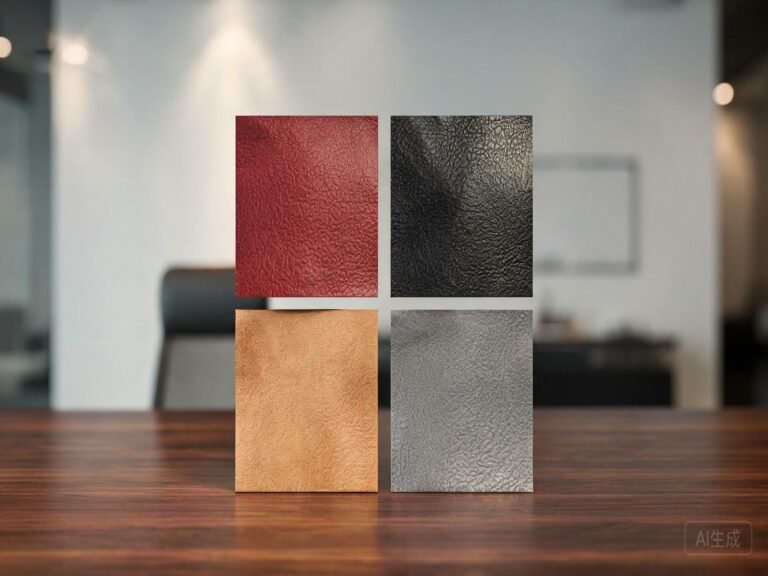
Color and finish options available from Chinese silicone leather manufacturers — custom matching requires ΔE ≤ 2.0 consistency.
PVC fabric from China remains the cheapest option — typically $1.50–$2.50 per meter FOB — but carries the heaviest compliance burden. Phthalate plasticizers, restricted under EU REACH and California Prop 65, are still used in budget PVC formulations. If your product touches these regulations, PVC essentially requires full chemical testing per shipment to verify compliance. That testing costs $500–$2,000 per batch and adds 2–3 weeks to your timeline.
PU fabric sits in the mid-range at $2.80–$4.50 per meter. Solvent-based PU uses DMF as a carrier, which leaves residual VOCs that require emissions management and documentation. Water-based PU eliminates the DMF issue but historically delivered 15–20% lower Martindale abrasion results — a gap that’s closing as Chinese manufacturers invest in improved water-based formulations.
Silicone leather occupies the premium tier at $5.00–$8.00 per meter — 15–25% above high-grade PU. But the compliance math flips: silicone contains no plasticizers, no phthalates, and no DMF. It passes REACH, Prop 65, and ISO 10993 without additional chemical testing per shipment. For buyers serving regulated markets — automotive, medical, children’s products — that testing savings alone can offset the unit price premium within the first production run. Learn more about silicone leather material properties to understand why the premium delivers value.
| Fabric Type | Typical MOQ | FOB Price/m | Lead Time | Compliance Complexity | Best For |
|---|---|---|---|---|---|
| PVC / Vinyl | 500–1,000m | $1.50–$2.50 | 2–3 weeks | High (phthalate testing per batch) | Budget items, waterproof goods |
| PU leather | 1,000–2,000m | $2.80–$4.50 | 3–4 weeks | Moderate (DMF/VOC documentation) | Furniture, footwear, bags |
| Silicone leather | 500–1,500m | $5.00–$8.00 | 3–5 weeks | Low (inherently compliant) | Automotive, medical, premium |
| Microfiber | 1,000–3,000m | $4.00–$7.00 | 4–6 weeks | Moderate (depends on coating) | Automotive trim, performance gear |

Polyurethane leather manufacturing in China — the production environment directly affects material quality and compliance outcomes.
Compliance Requirements That Determine Market Access
Fabric import from China requirements vary by destination market and end application — but the three regulatory frameworks that block the most shipments are EU REACH, US California Prop 65, and application-specific certifications like ISO 10993 for medical products.
The EU REACH regulation restricts 235+ Substances of Very High Concern (SVHCs). For synthetic leather, the critical substances are DMF (used in solvent-based PU), phthalates (used in PVC), and certain heavy metals in pigments. Every shipment entering the EU requires a declaration of conformity — and customs authorities are increasingly requesting test reports, not just supplier declarations.
Sourcing tip: In our experience exporting silicone leather to 30+ countries, the single most common compliance failure isn’t the leather itself — it’s the backing fabric or adhesive. Always request full material disclosure for every layer of the composite, not just the surface coating. A compliant surface over a non-compliant backing still fails REACH.
For the US market, California Prop 65 lists approximately 900 chemicals known to cause cancer or reproductive toxicity. The law applies to any product sold in California — which effectively means any product distributed in the US, since most companies won’t maintain separate California-specific inventory. PVC fabric containing restricted phthalates requires a Prop 65 warning label, which most brands consider unacceptable for their products.
Application-specific certifications add another layer. Automotive interiors require FMVSS 302 flame retardancy. Medical products need ISO 10993 biocompatibility. Children’s products require EN 71 or ASTM F963 compliance. Silicone leather passes all of these natively — its chemistry is inherently flame-resistant, biocompatible, and free of restricted substances. PU and PVC require additive treatments to meet the same standards, and those additives themselves may require compliance documentation.

Durability testing of faux leather furniture — compliance and performance documentation must be validated before the first production order.
Evaluating Fabric From China Suppliers: Beyond the Quotation
China fabric supplier evaluation requires looking past the unit price to five factors that determine whether the partnership will actually work in production. Skip any of these and you’re gambling with your supply chain.

Material softness and fold behavior — a quality indicator that separates premium silicone leather from budget PU alternatives.
- Production transparency: Can the supplier walk you through their facility on a video call? Do they know their daily output per line? Suppliers who dodge factory tours are typically trading companies, not manufacturers — and they can’t control quality they don’t produce. See our factory production overview for what a transparent operation looks like.
- Certificate validity: Request certificate numbers and verify them with the issuing body. We’ve seen photocopied ISO certificates dated three years past expiration. SGS, Intertek, and TÜV all offer online verification — use it.
- Batch consistency: Request samples from three different production batches. Color variation beyond ΔE ≤ 2.0 indicates poor process control that will create visible mismatch in your assembled products. For custom colors, ask how many meters of setup waste the factory runs before achieving stable output.
- Pre-shipment inspection support: Does the supplier accommodate third-party inspection (SGS, Bureau Veritas) before container loading? Reputable manufacturers welcome this — they’d rather catch issues at their dock than after the goods arrive at yours.
- Communication and documentation: How quickly does the supplier respond to technical questions? Do they provide test reports proactively, or do you have to chase them? Communication quality in the sampling phase predicts communication quality in production — if it’s slow now, it won’t improve after you’ve paid the deposit.
One practical framework from our experience: before placing the first production order, request a 90-minute factory audit focused on three areas — the coating line (to verify production capability), the QC station (to verify testing protocols), and the warehousing area (to verify batch tracking and packaging standards). You can learn more about our evaluation criteria in our leather manufacturer evaluation guide.
Eco-certifications overview — compliance documentation that every fabric from China shipment should include.
What certifications should I require when importing fabric from China?
At minimum, require REACH (for EU-bound shipments), California Prop 65 compliance (for US distribution), and ISO 9001 (for quality management). For automotive applications, add FMVSS 302 flame retardancy. For medical products, require ISO 10993 biocompatibility. For children’s products, request EN 71 or ASTM F963. Always verify certificate validity directly with the issuing organization — don’t accept PDF copies at face value, as expired or forged certificates are a known problem in the industry.
Is silicone leather fabric more expensive to source from China than PU?
On unit price, yes — silicone leather costs 15–25% more than high-grade PU. On total landed cost, the gap narrows significantly. Silicone leather requires no per-batch chemical compliance testing (saving $500–$2,000 per shipment), carries lower warranty claim rates due to superior durability, and needs replacement less frequently (3–5 years vs 1–3 years for PU). For regulated markets like automotive or medical, silicone leather is often the only material that passes all compliance requirements without additive treatments — making the “comparison” moot.
About TOPSUN
TOPSUN operates as a China-based silicone leather manufacturer serving international B2B buyers who need fabric solutions with documented compliance, consistent quality, and transparent pricing from quote to delivery. Our export capabilities include REACH and California Prop 65 documentation for every shipment, ISO 10993 biocompatibility certification for medical-grade fabric, and direct shipping from our Guangdong production facility with full pre-shipment inspection support.
With 12+ years of export experience and eight production lines producing over 2,000 tons annually, we’ve shipped silicone leather to buyers across 30+ countries — from automotive OEMs in Germany to medical device manufacturers in the United States. Our engineering team handles custom color matching, texture development, and application-specific formulation, with 3–5 day sampling turnaround for qualified inquiries.