When procurement teams evaluate the best leather companies, most checklists start and end with unit price. That approach made sense twenty years ago when genuine leather dominated and material options were limited. Today, the synthetic leather market alone is projected to reach $50.6 billion in 2026, growing at a 12.5% CAGR through 2033, and buyers face an entirely different sourcing landscape. Price-per-meter tells you almost nothing about total cost of ownership, regulatory risk, or supply stability. This guide breaks down what actually matters when shortlisting leather suppliers — from material trade-offs to certification depth — and explains why silicone leather is reshaping how procurement teams think about long-term value.
What B2B Buyers Need From the Best Leather Companies
After three years of sourcing synthetic leather across automotive and furniture projects, I’ve noticed a pattern: the suppliers who look cheapest on paper often cost more over a product’s lifecycle. A PU leather vendor quoting $3.20 per meter seems attractive until you factor in warranty claims from hydrolysis failure at month 18, expedited replacement shipments, and the reputational damage of delaminating seat covers. The best leather companies for B2B sourcing distinguish themselves not by undercutting competitors but by delivering consistency across four dimensions that actually drive total cost.
First, material consistency matters more than any single spec sheet. A supplier might send a perfect sample for approval, then ship production runs with visible color drift or texture variation. Second, certification depth signals whether a manufacturer invests in compliance infrastructure or just pays for a single test report. Third, supply stability — including backup production lines, raw material inventory, and geographic redundancy — determines whether your order ships on time during peak season. Fourth, technical support separates companies that sell material from those that help you engineer with it.

In-house physical testing lab — a hallmark of top-tier leather manufacturers
Key insight: In our experience sourcing for an automotive interior program, a 15% price gap between the lowest and second-lowest bidder disappeared entirely when we accounted for failure rates during the first 12 months of field testing.
Material Trade-Offs: Silicone, PU, and PVC Compared
No single material wins every category. Polyurethane (PU) holds 57% of the synthetic leather market share, and for good reason — it offers softness, breathability, and processing flexibility at a competitive price point. PVC remains relevant for cost-sensitive applications where performance requirements are minimal. But both materials carry well-documented limitations that procurement teams underestimate until field failures start accumulating.
PVC contains chlorine and phthalates that off-gas volatile organic compounds (VOCs), creating regulatory exposure under tightening EU REACH restrictions. PU degrades through hydrolysis — a chemical breakdown where moisture attacks the polyurethane bonds, causing peeling and cracking within 2-5 years in humid environments. The top synthetic leather manufacturers have responded with water-based PU and solvent-free formulations, but these improvements address symptoms rather than the root cause: the carbon-based molecular backbone itself.
Silicone leather takes a fundamentally different approach. Its silicon-oxygen (Si-O-Si) molecular backbone is inherently stable — the same chemistry used in medical implants and aerospace seals. This structure delivers 10-15+ years of service life, 200,000+ Martindale abrasion cycles, and zero VOC emissions during production. The trade-off is upfront cost: silicone leather typically commands a premium over standard PU. But when you calculate replacement frequency, warranty exposure, and maintenance labor across a product’s lifecycle, that premium often converts to savings. You can explore a detailed silicone vs PU comparison on our technical resources page.

Color consistency across production batches — a critical evaluation metric
| Material | Lifespan | Abrasion (Martindale) | VOC Emissions | Key Certifications |
|---|---|---|---|---|
| Silicone | 10-15+ years | 200,000+ cycles | Zero | FDA, ISO 10993, REACH |
| PU | 2-5 years | 10,000-30,000 | Moderate-High | REACH (varies) |
| PVC | 3-5 years | 15,000-30,000 | High | Limited |
See how a top-tier leather manufacturer operates — from raw materials to finished goods
How the Best Leather Companies Handle Certifications
Certifications are the most reliable proxy for manufacturing rigor — but only if you know how to read them. A single REACH compliance certificate proves a batch passed a chemical test. It does not prove the company has systems to maintain compliance across production variations, raw material changes, or new color formulations. Leather company certification requirements vary dramatically by end application, and the best suppliers invest in certifications that anticipate regulatory direction rather than just meeting today’s minimum.
For automotive interiors, look for VDA 277 (cabin air emissions) and FMVSS 302 (flame retardancy). For medical applications, ISO 10993-5 biocompatibility testing is non-negotiable. For food-contact or baby products, FDA 21 CFR Part 177.2600 compliance signals that the material won’t leach harmful substances. For aviation, FAR 25.853 flammability certification opens doors to aircraft interior programs. The strongest suppliers maintain all of these simultaneously, which requires dedicated compliance staff, regular retesting, and documented quality management systems — investments that low-cost manufacturers simply don’t make.

Quality inspection at every production stage — what separates top suppliers from average ones
Here’s a practical evaluation tip: ask potential suppliers for their three most recent test reports, not their best ones. If they can produce dated reports across different material formulations, you’re looking at a company with real testing infrastructure. If they show you the same report from two years ago, walk away. You can learn more about how to choose a silicone leather supplier in our dedicated procurement guide.
Why Silicone Leather Is Reshaping the Industry
The global silicone leather market is growing at a 14% CAGR — faster than the overall synthetic leather market — driven by three forces that procurement teams cannot ignore. First, automotive OEMs are under pressure to reduce cabin VOC levels and vehicle weight. Tesla’s shift to entirely synthetic interiors set a precedent that other automakers are following, and the automotive segment is projected to grow at 13.2% CAGR through 2033. Second, EU regulatory frameworks like the Circular Economy Action Plan are pushing brands toward recyclable, traceable materials — criteria that PVC and conventional PU struggle to meet. Third, sustainable leather companies are winning contracts because end consumers increasingly factor environmental claims into purchasing decisions.
Silicone leather addresses all three drivers simultaneously. Its solvent-free production process generates zero VOC emissions. Its 10-15 year service life reduces replacement frequency and associated resource consumption. And because the silicone polymer can be recycled at end-of-life without releasing toxic substances, it supports circular economy goals that leading brands now require in supplier agreements. For a deeper understanding of what silicone leather is and how it’s manufactured, our technical introduction covers the full process.

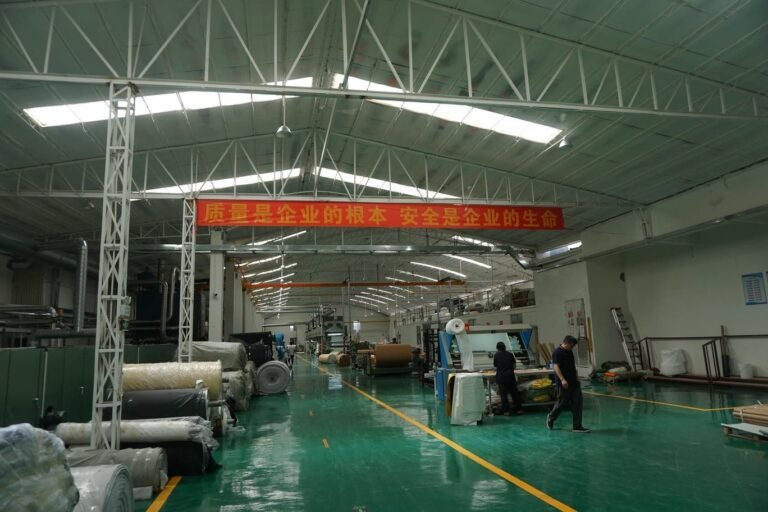
Integrated production lines with overhead crane systems — scale matters for B2B supply stability
The practical implication for procurement teams is straightforward: suppliers who have already invested in silicone leather capacity are positioning ahead of regulatory mandates. As an experienced silicone leather manufacturer serving automotive, furniture, and medical sectors, we’ve seen buyers shift from price-first to value-first evaluation frameworks — and the data supports that shift. According to Grand View Research, bio-based and sustainable leather alternatives are projected to grow at 14.5% CAGR, the fastest rate in the synthetic leather category, reflecting procurement decisions driven by lifecycle value rather than unit cost.
Frequently Asked Questions
What certifications should I require from leather companies?
At minimum, require REACH compliance for EU market access and ISO 9001 for quality management. For automotive applications, add VDA 277 and FMVSS 302. For medical or baby products, ISO 10993-5 biocompatibility and FDA food-contact certifications are essential. For aviation interiors, FAR 25.853 flammability certification is mandatory. Ask for recent, dated test reports across multiple material formulations — not a single certificate from years ago.
Is silicone leather more expensive than PU or PVC?
On a per-meter basis, yes — silicone leather typically costs more upfront than standard PU or PVC. However, when you factor in a 10-15 year service life versus 2-5 years for PU, zero warranty claims from hydrolysis failure, and elimination of VOC-related compliance costs, the total cost of ownership often favors silicone. Procurement teams that evaluate suppliers on lifecycle cost rather than unit price consistently arrive at this conclusion.
Making the Right Choice for Your Next Project
Finding the best leather companies isn’t about scanning a ranked list — it’s about applying a structured evaluation framework to suppliers who match your specific application requirements. Start with material selection: if your product needs to survive 10+ years in demanding environments, silicone leather’s molecular stability makes it the logical choice. Then evaluate certification depth, production capacity, and technical support. Finally, request samples and run your own abrasion, hydrolysis, and color-fastness tests before committing to volume orders. The suppliers who welcome that scrutiny are the ones worth partnering with.
About TOPSUN
TOPSUN manufactures silicone leather for B2B buyers who need material consistency across automotive, furniture, and medical applications — delivered from three production bases with 6 million meters of annual capacity.
233 patents held · REACH / FDA / ISO 10993-5 certified · EN 13773 Class 4 flame retardancy · 100+ global clients including NIO, Haier, and Hisense