We’ve audited 200+ fabric suppliers in China over the past five years. Roughly 40% are brokers pretending to own a factory. Another 25% have a factory but subcontract to smaller workshops when orders exceed their real capacity. The remaining 35% are legitimate manufacturers — but even among those, payment terms, MOQ flexibility, and quality control protocols vary wildly. If you’re about to sign with a fabric supplier in China, here are 7 red flags that should stop the conversation cold.
Request Factory Verification Pack
Why Most Fabric Supplier in China Listings Are Brokers, Not Factories
The easiest mistake in B2B sourcing is confusing a trading company with a manufacturer. Brokers maintain polished Alibaba storefronts, quote competitive prices, and ship samples that look identical to factory-direct product. But they don’t control production. When your order hits a quality problem, the broker can’t fix it — they can only ask the actual factory (which you never identified) to rework it. That adds 4–8 weeks to your timeline and erodes margin.
For buyers running fabric supplier in China B2B sourcing workflows, the broker-vs-factory distinction matters because it determines who controls your quality, your lead time, and your IP. A factory can show you their production line. A broker shows you someone else’s.

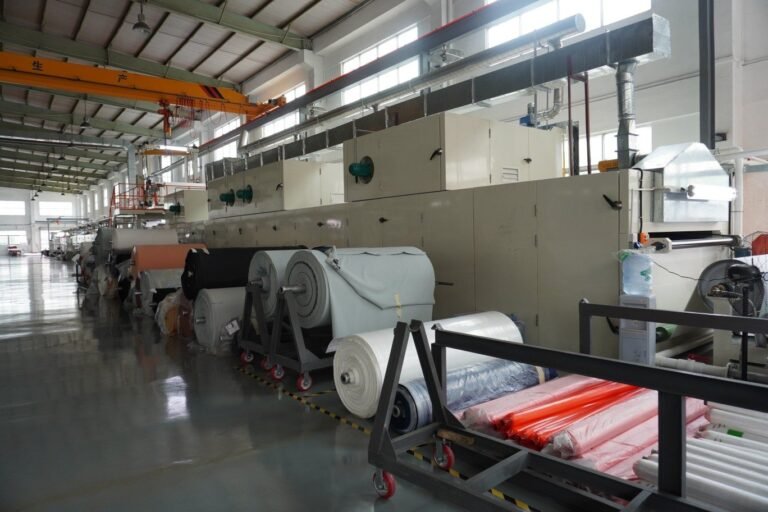
Actual silicone leather production line — overhead crane, coated fabric rolls, and calibrated coating machinery visible on the factory floor
In our experience, legitimate factory production facilities welcome unannounced video calls. Brokers find excuses. If a supplier can’t connect you to their production manager within 48 hours and show live footage of running equipment, assume they’re not the manufacturer.
Red Flags 1–3: Documentation Gaps That Signal Trouble
The first three red flags appear before you ever request a sample. They’re documentation-level issues that a procurement team can check in under an hour — yet most buyers skip these checks entirely.

In-house quality inspection at a legitimate manufacturer — brokers cannot produce footage of their own QC team
Red Flag 1: The supplier cannot produce a business license (营业执照) with a registered address matching their claimed factory location. Brokers often register in trading hubs like Yiwu or Guangzhou while claiming to manufacture in Dongguan or Wenzhou. Red Flag 2: No third-party factory audit from SGS, Intertek, or TÜV. A genuine manufacturer invests in these audits because they’re a competitive advantage. Red Flag 3: Vague certification claims like “REACH compliant” without a report number or testing laboratory name. For fabric supplier in China quality verification, the absence of specific, verifiable documentation is the single fastest filter.
| Verification Check | Pass Criteria | Red Flag | Risk Level |
|---|---|---|---|
| Business License | Address matches factory location | Registered in trading hub only | High — likely broker |
| Third-Party Audit | SGS/Intertek report < 12 months old | “We’re audited” but no report | High — unverified capacity |
| Certification | Report number + lab name + date | “Compliant” without specifics | Medium — quality risk |
| Production Capacity | Equipment list matches output claim | 50K units/month, 3 machines | High — subcontracting risk |
| Payment Terms | 30/70 T/T or L/C acceptable | 100% T/T before production | Critical — no recourse |
Red Flags 4–5: Production Capacity Claims That Don’t Add Up
Red Flag 4: The supplier claims a monthly capacity that’s mathematically impossible given their equipment list. A single silicone leather coating line produces approximately 500,000 linear meters per month at full utilization. If a supplier claims 2 million meters/month but lists only two coating lines in their factory photos, the math doesn’t work — they’re either subcontracting or inflating numbers to appear larger than they are.
Red Flag 5: Lead times that are too good to be true. Genuine fabric supplier China lead time production capacity for custom silicone leather runs 7–15 days for standard formulations and 20–30 days for custom colors or specialized textures. A supplier quoting 3-day delivery on a custom order is either shipping from stock (meaning you’re getting whatever they have, not what you specified) or planning to subcontract to a smaller, unvetted workshop.

Modern production workshop with climate control — the type of facility that genuine manufacturers can show on demand
Red Flags 6–7: Payment Terms and Quality Control Walkouts
Red Flag 6: The supplier demands 100% T/T payment before production begins. This is the single most dangerous payment term in B2B sourcing. Once you’ve paid in full, you have zero leverage. If the shipment arrives with quality defects, the supplier has no financial incentive to resolve the issue. Legitimate manufacturers accept 30% deposit + 70% before shipment (T/T) or letter of credit (L/C) terms. If a silicone leather introduction ends with a payment demand for full upfront payment, walk away.
Red Flag 7: No AQL (Acceptable Quality Limit) protocol and no sample approval process. A real factory has a documented QC workflow: incoming material inspection, in-process checks, and final AQL sampling per ISO 2859-1. If the supplier can’t describe their AQL level (most legitimate factories use AQL 1.5 for critical defects), they’re either a broker or a factory that skips quality control to save cost. For synthetic leather fabric supplier China MOQ discussions, always tie the MOQ to a quality protocol — a 300m trial order with AQL 1.5 is worth more than a 5,000m order with no QC framework.

Quality inspection process at a Chinese leather manufacturer — the kind of documented QC that separates factories from brokers
How to Verify a Fabric Supplier in China Before Signing
Once you’ve filtered out the red flags, the verification process is straightforward but requires discipline. Start with a video factory tour — not a pre-recorded promotional video, but a live call where you ask the production manager to show specific machines, current orders running, and the QC station. Legitimate manufacturers do this routinely.
Next, request third-party verification. SGS offers factory audit services starting at roughly $300–500 per audit, covering production capacity, quality system, and social compliance. For buyers sourcing reliable fabric supplier in China, a comprehensive fabric sourcing guide should include this step. The SGS Group operates in every major Chinese manufacturing hub and can deploy an auditor within 5 business days.

Factory verification in action — physical audit of equipment, workforce, and quality control systems at a Chinese leather supplier
Inside TOPSUN’s factory — see the production lines, QC stations, and testing equipment that a legitimate supplier shows on demand
Finally, place a trial order at the supplier’s MOQ before committing to volume. TOPSUN accepts 500-meter trial orders — enough to validate color matching, texture consistency, and physical performance in your own production environment. If a supplier won’t accept a trial order, they’re either over capacity (meaning your delivery will slip) or they don’t trust their own product to survive your incoming inspection. Either way, it’s not a supplier you want for a multi-application project.
Frequently Asked Questions
Can I trust a fabric supplier in China that only accepts 100% TT upfront?
No. 100% T/T before production gives you zero recourse if the shipment arrives defective. Legitimate manufacturers accept 30/70 terms (30% deposit, 70% before shipment after QC pass) or letter of credit. Suppliers demanding full upfront payment are typically brokers with no factory assets, or factories in financial distress. Either scenario puts your order at risk. If a supplier insists on 100% upfront, counter with 30/70 — if they refuse, walk.
What’s a reasonable MOQ for a trial order with a new fabric supplier?
For synthetic leather, a reasonable trial MOQ is 300–500 meters per color. This is enough to run your own incoming inspection, test the material in production, and verify batch-to-batch consistency without committing to volume pricing. Suppliers who refuse trial orders below 2,000 meters are either protecting their margin (understandable but inflexible) or don’t have confidence in their quality. TOPSUN accepts 500m trial orders with full QC documentation — use that as your benchmark when comparing suppliers.
Audit Before You Order, Not After
Finding a reliable fabric supplier in China is not about finding the cheapest quote — it’s about finding the supplier whose quality, capacity, and payment terms you can verify before money changes hands. The 7 red flags — broker disguised as factory, missing business license, no third-party audit, vague certifications, impossible capacity claims, unrealistic lead times, 100% upfront payment demands, and absent QC protocols — are the filters that separate partners from liabilities. Run them early, run them consistently, and you’ll save 40% in rework, delay, and replacement costs over your first year of sourcing.
About TOPSUN
TOPSUN operates as a direct-source fabric supplier in China with three production bases (Dongguan, Yichang, Xiangyang) and 6M meters/year capacity for silicone leather used in automotive, furniture, and marine upholstery.
SGS-verified factory audits · 500m trial MOQ · 7–15 day lead times · REACH/RoHS compliance documentation · 100+ global brand clients including NIO, DONGFENG, and Haier