A furniture brand’s €180,000 upholstery order sat in EU customs for six weeks last year — not because the leather looked wrong, but because the wholesale supplier could not produce a valid restricted-substances test report. The brand burned through emergency inventory and missed its retail launch window. That setback is exactly what a disciplined upholstery leather wholesale sourcing process is built to prevent. This guide compares the three main sourcing paths, lays out a sample validation protocol you can run before signing off, and breaks down the contract terms that separate protected buyers from exposed ones.
Download Wholesale Sourcing Checklist
The Upholstery Leather Wholesale Landscape in 2026
The upholstery leather wholesale market is mid-shift. For years, buyers chased the lowest per-meter price and accepted whatever compliance documentation came with it. That calculus has changed. Retailers and OEMs now face tighter chemical regulations — REACH amendments, California Proposition 65 updates, and growing retailer-driven restricted-substances lists — that make undocumented leather a liability, not a bargain.
The synthetic leather market is projected to grow steadily through 2030. Demand spans furniture and sofa applications, automotive interiors, and commercial seating. Within that growth, silicone-coated and eco-compliant materials are taking share from conventional PU — our silicone vs PU comparison explains why — because they clear chemical thresholds that older chemistries cannot.
For buyers tracking upholstery leather wholesale market trends, the question is no longer just “who is cheapest?” but “who can prove compliance at scale?” A supplier quoting $4.20/m with full REACH and RoHS documentation is often a safer wholesale partner than one quoting $3.60/m with a photocopied test certificate. The price gap narrows fast when you factor in customs holds, rework, and brand-damaging recalls.

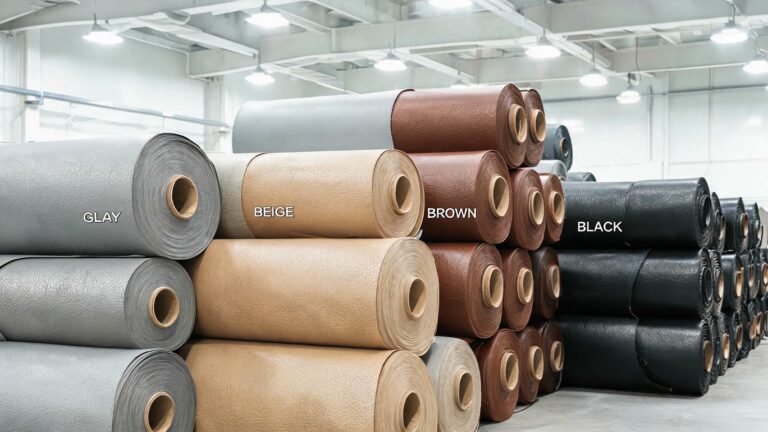
Finished silicone leather rolls staged in the warehouse, ready for wholesale container loading.
Global Sourcing Paths: Factory Direct vs Trading Company
Most upholstery leather wholesale suppliers fall into three categories, each with distinct trade-offs. Choosing the right path depends on your volume, internal technical capability, and how much supply-chain control you need.
| Sourcing Path | Upfront Cost | Compliance Transparency | Lead Time Control | Best For |
|---|---|---|---|---|
| Factory Direct | Lowest unit cost | High (direct lab access) | Strong | Volume buyers with technical teams |
| Trading Company | 5–15% markup | Variable | Limited | Small-batch, multi-product sourcing |
| Contract Manufacturer / OEM | Mid-range | High (contractual) | Strong | Brands wanting cut-and-sewn goods |
Factory-direct sourcing gives you the best unit price and direct access to the factory production line for custom development. The catch is that you carry the compliance burden — your team must verify test reports and audit the facility. Trading companies simplify multi-product sourcing and handle logistics, but they add a markup and can obscure the actual manufacturer’s quality controls.
Contract manufacturers sit in between: they take responsibility for converting leather into finished upholstery, which is ideal if you want cut-and-sewn components rather than raw rolls. For a deeper comparison of evaluation criteria, see our leather supplier sourcing guide. The right path among upholstery leather wholesale suppliers depends on your internal capabilities — factory direct rewards a technical team, while a trading company’s flexibility suits smaller brands testing a new category.

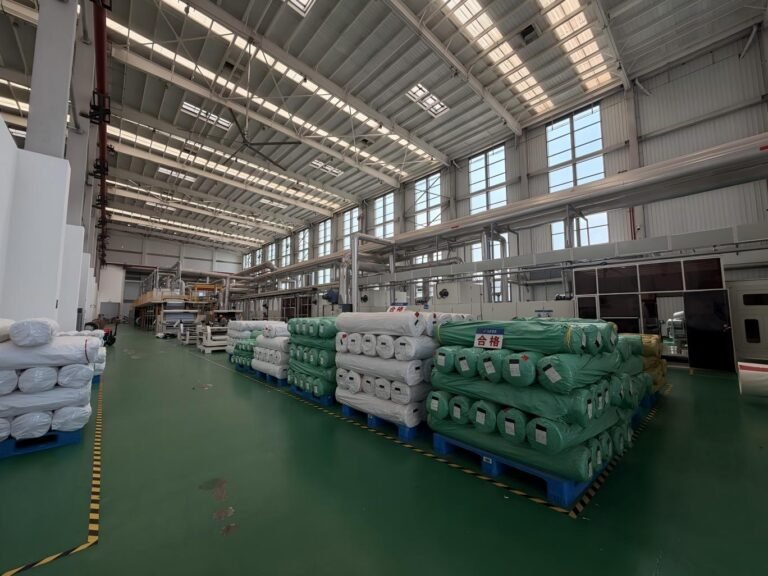
Evaluating a wholesale leather supplier requires on-site verification, not just a catalog.
Sample Validation Protocols That Catch Defects Early
Sample validation is where most wholesale sourcing mistakes happen — and where they are cheapest to fix. A structured upholstery leather sample validation protocol catches problems before you commit to a 5,000-meter production run. Three layers matter:
- Visual and tactile check — color consistency against your approved standard (Delta E ≤ 1.5), texture uniformity, and hand-feel at different temperatures. In our lab, we have seen samples that looked perfect on a desk but felt stiff and plasticky after an hour at 40 °C — a sign of low-grade plasticizer.
- Physical testing — Martindale abrasion (target ≥ 30,000 cycles for commercial furniture), tear strength, flex resistance, and colorfastness. These numbers predict real-world performance over years of use, not just showroom appeal. Cross-check results against your quality inspection standards.
- Chemical verification — request full REACH SVHC, RoHS, and EN 71 Part 3 reports for children’s channels. One of our furniture clients cut rejection rates by 40% after requiring third-party chemical reports on every sample, not just the first batch.
The full protocol takes two to three weeks and a few hundred dollars in lab fees. Compare that to a customs hold or product recall — the return on validation is obvious.

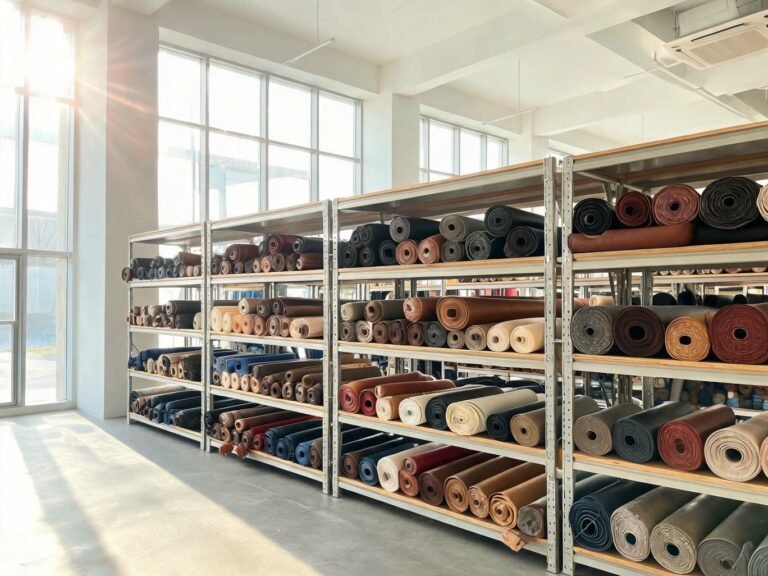
A full-color swatch rack lets buyers validate color and texture before committing to volume.
Negotiating Upholstery Leather Wholesale Contracts
Once samples pass validation, the contract is your safety net. Too many buyers focus on unit price and leave the protective clauses to a generic template. The terms below are where wholesale leverage actually lives — especially when upholstery leather MOQ and pricing structures are on the table.
- MOQ and trial orders — negotiate a trial-order MOQ at 20–30% of the standard minimum. Standard MOQs for silicone upholstery leather start at 500–1,000 meters, but flexible suppliers accommodate smaller trials. Frame it as a qualification run: full volume follows if the trial meets spec.
- Quality tolerance clause — specify acceptable defect rates (commonly ≤ 2% for Grade A material) and the remedy: replacement, credit, or rework. Without this, you absorb every defect.
- Lead time and penalty — lock in a maximum lead time (25–30 days for standard colors) with a liquidated-damages clause. A 1% per week penalty for late delivery keeps suppliers honest.
- IP and exclusivity — if you commissioned a custom color or embossing pattern, write exclusivity into the contract. Without it, your supplier can sell your development to a competitor the next week.
See how production capacity and quality controls scale for wholesale contract manufacturing orders.

Kraft-paper-wrapped rolls staged for a wholesale shipment — contract terms should cover packaging and labeling specs.
Frequently Asked Questions
Is factory-direct always cheaper than a trading company for upholstery leather wholesale?
Not necessarily. Factory-direct offers the lowest unit cost, but trading companies sometimes aggregate volume across buyers to negotiate better terms, or stock standard colors that eliminate your minimum-order and lead-time burden. For small-batch or multi-material orders, the trading-company premium can be offset by lower internal sourcing costs.
What test reports should I require before approving an upholstery leather wholesale sample?
At minimum: REACH SVHC (full substance list), RoHS, Martindale abrasion, tear strength, and colorfastness (ISO 105-B02 for light, ISO 105-X12 for rubbing). If you sell into the EU or children’s products, add EN 71 Part 3 and Proposition 65. Require third-party lab reports, not supplier self-declarations.
Can I negotiate a lower MOQ for a trial upholstery leather wholesale order?
Yes, and you should. Most silicone leather manufacturers accept trial orders at 150–300 meters for new accounts, even when their standard MOQ is 500+ meters. Frame it as a qualification run: you commit to full volume if the trial meets spec. Suppliers rarely refuse this structure because it locks in a future order.
Upholstery leather wholesale sourcing rewards buyers who treat compliance, validation, and contract terms as non-negotiable — not afterthoughts. The suppliers worth your volume are the ones who can prove their chemistry, stand behind their samples, and sign contracts that hold up when something goes wrong. Build your process around those three pillars, and the unit price takes care of itself.
Request Wholesale Sample Pack with Test Reports

Wholesale upholstery leather applied to commercial sofa production — the end result of a disciplined sourcing process.
About TOPSUN
TOPSUN supplies upholstery-grade silicone leather to wholesale buyers across furniture, automotive, and commercial seating programs, with full-lot traceability from coating line to container.
Every wholesale order ships with REACH, RoHS, and abrasion test reports matched to your PO, supported by a 3-million-meter annual coating capacity and an in-house lab that validates samples before mass production begins.