A product development engineer at a medical device company was tasked with replacing genuine leather on examination tables with a synthetic alternative. Three suppliers sent samples labeled “fake leather material” — and all three performed differently in testing. One cracked after 30 days of hospital-grade disinfectant exposure. One off-gassed volatile organic compounds above the facility’s indoor air threshold within 72 hours of installation. One maintained its properties through every test. The difference wasn’t quality control or manufacturing precision. It was fundamental polymer chemistry. When you specify fake leather material by chemistry rather than by appearance or price, you control the outcome. Here are the five chemistry specifications that determine whether your product lasts 2 years or 10.
Request Material Chemistry Datasheet
What “Fake Leather Material” Actually Means
The term “fake leather” covers four fundamentally different material chemistries that share a visual similarity but almost nothing else. PU (polyurethane) leather coats a fabric base with a flexible polyurethane layer. PVC (polyvinyl chloride) leather uses chlorinated polymers softened with plasticizers. Microfiber leather bonds ultra-fine polyester fibers with a PU coating for a structure that mimics genuine hide. Silicone leather uses platinum-cured siloxane polymers on a textile substrate — the only option with no carbon-carbon backbone that can degrade.
Each chemistry produces different degradation pathways, different regulatory profiles, and different service lives. A spec sheet that says “fake leather material” without identifying the polymer type is meaningless — it’s like specifying “metal” without distinguishing between steel and aluminum. The complete guide to fake leather types breaks down how each material performs in real-world applications.

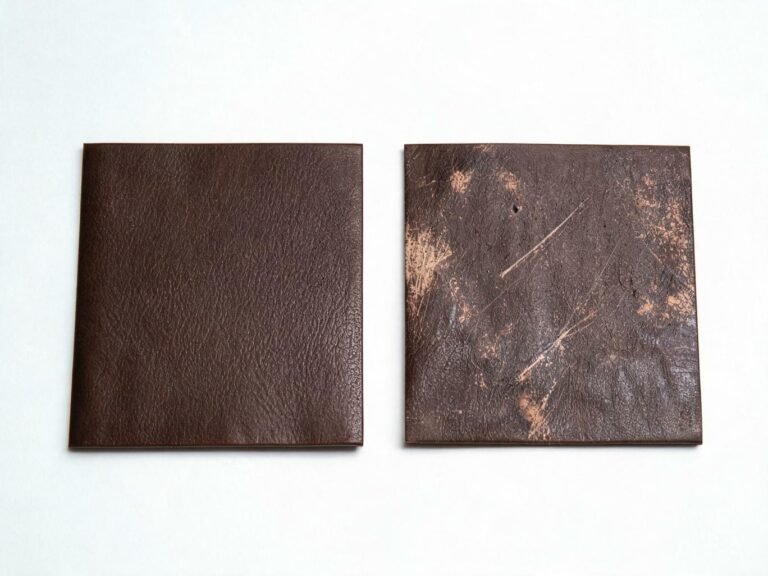
Production process flow chart shows how different polymer chemistries create fundamentally different fake leather materials.
Spec 1: Polymer Base Chemistry
The polymer backbone is the single most important variable in fake leather performance. Polyurethane relies on ester linkages (R-COO-R’) in its chain — bonds that react with water molecules. Polyvinyl chloride uses a chlorinated carbon chain that releases chlorine under UV exposure. Silicone’s siloxane bonds (Si-O-Si) are chemically inert: they resist hydrolysis, UV degradation, and thermal breakdown because the silicon-oxygen bond energy (452 kJ/mol) exceeds the carbon-carbon bond energy (348 kJ/mol).
This is not a marginal difference. It determines whether your material degrades through hydrolysis (PU), through chlorine off-gassing (PVC), or not at all (silicone). When a supplier sends a “fake leather material” sample, the first question should be: what is the polymer backbone? The synthetic leather vs PU leather comparison documents these structural differences in detail.
Spec 2: Plasticizer Dependency
Plasticizers are the softening agents that make PU and PVC leather flexible. Without them, both materials would be rigid. Over time, plasticizers migrate to the surface and evaporate — a process accelerated by heat, UV, and repeated cleaning. As plasticizer content drops, the material stiffens, and cracking begins. This is the mechanism behind the familiar “peeling pleather” failure: it’s not wear, it’s chemical depletion.
Phthalate-based plasticizers migrate fastest and carry the highest regulatory risk under REACH and California Proposition 65. Even “non-phthalate” alternatives like DOTP still migrate — just more slowly. Silicone leather requires no plasticizers at all. Its flexibility comes from the inherent properties of the siloxane polymer chain, not from additives that can leach out. A spec sheet should state the plasticizer type, the migration test method, and the result. If it says “plasticizer-free,” that’s silicone — and it’s the only chemistry where that claim is true.

Physical testing laboratory equipment quantifies polymer stability, plasticizer migration, and mechanical degradation across material types.
Spec 3: Hydrolysis Resistance
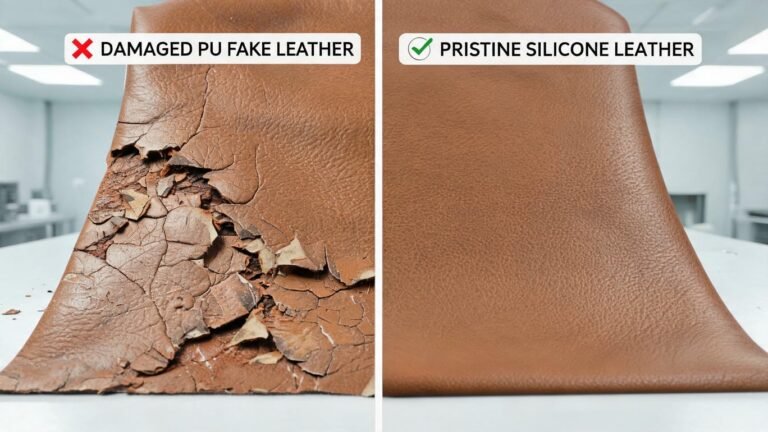
Hydrolysis is the chemical breakdown of ester bonds in PU leather when exposed to moisture. In controlled testing at 70°C and 95% relative humidity, standard PU shows visible surface degradation within 7–14 days. In real-world conditions — humid climates, sweat contact, repeated cleaning with aqueous solutions — the same process unfolds over 18–36 months. The material becomes brittle, loses adhesion to the base fabric, and peels.
Silicone leather has no ester bonds. Its siloxane backbone is chemically inert to water. In the same 70°C / 95% RH test, TOPSUN’s silicone leather shows zero degradation after 42 days — six times longer than PU’s failure point. For products used in humid environments, medical settings, or applications requiring frequent liquid cleaning, this spec alone determines whether the material lasts 2 years or 10. The polyurethane fake leather analysis provides specific hydrolysis test data.

Cross-section comparison reveals how polymer structure differences translate to dramatically different degradation pathways.
Spec 4: UV Stability
UV radiation breaks polymer chains. The speed depends on the bond energy and the presence of UV stabilizers. Standard PU leather shows visible degradation after 200–300 hours of QUV accelerated weathering (ASTM D4329). PVC degrades even faster — chlorine radicals form under UV, attacking the polymer chain from within. Both materials rely on UV stabilizer additives that deplete over time.
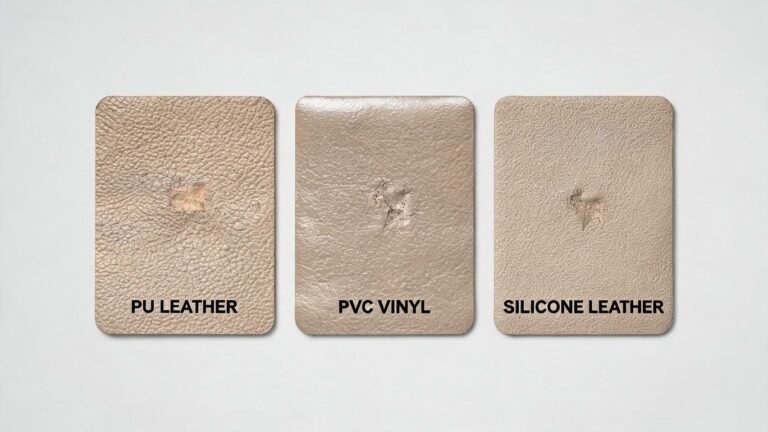
Material comparison testing demonstrates UV, abrasion, and chemical resistance differences across fake leather types.
Silicone’s Si-O bond is inherently UV-stable — it doesn’t require stabilizer additives to resist light degradation. Our testing shows above 95% color retention after 1,000 hours of QUV exposure. The material doesn’t fade, yellow, or embrittle. For any product with sun exposure — automotive interiors, outdoor furniture, window-adjacent seating — the UV stability spec predicts field performance more accurately than any other single parameter. The vegan leather durability benchmarks provide comparative UV data across material categories.

Material swatch wall shows the range of colors and textures available across different fake leather polymer chemistries.
Spec 5: VOC Emissions and Certification Profile
Volatile organic compounds are the invisible specification that catches buyers off guard. PU leather manufacturing uses solvents (DMF, MEK, toluene) that can remain in the material and off-gas over time. PVC emits chlorine-containing compounds. Independent lab testing shows that up to 68% of non-certified aftermarket synthetic leather covers exceed WHO-recommended indoor air VOC thresholds within the first 72 hours.
A spec sheet should state the material’s VOC test results and certification profile. Look for: REACH compliance (restricts 200+ hazardous substances), RoHS (heavy metals), OEKO-TEX STANDARD 100 (human ecological safety), California Proposition 65, and FDA food-contact approval where relevant. TOPSUN’s silicone leather carries all of these certifications with zero VOC emissions — it’s manufactured without solvents, plasticizers, or heavy metal additives. The difference between a material that meets certification minimums and one that is inherently clean by chemistry is the difference between passing a test and eliminating the risk. The PU vs faux leather specification guide details the certification requirements by market.
Chemistry Comparison: PU vs PVC vs Microfiber vs Silicone
When you compare fake leather materials by chemistry rather than by appearance, the performance hierarchy becomes clear. Here is how the four main types stack up on the five specs that determine real product lifespan:
| Chemistry Spec | PU Leather | PVC Leather | Microfiber Leather | Silicone Leather |
|---|---|---|---|---|
| Polymer Backbone | Ester linkages | Chlorinated chain | Polyester + PU | Siloxane (Si-O-Si) |
| Plasticizer Dependency | Yes (phthalate/non-phthalate) | Yes (high load) | Moderate | None |
| Hydrolysis Risk | High (7–14 days) | Low (inherent) | Moderate (PU coating) | Zero (42+ days) |
| UV Stability (QUV hours) | 200–300 hrs | 100–200 hrs | 300–500 hrs | 1,000+ hrs |
| VOC Emissions | Moderate (solvent residue) | High (chlorine) | Low–moderate | Zero VOC |
| Expected Service Life | 2–5 years | 1–4 years | 5–8 years | 8–10+ years |

Each material type serves different applications — but only silicone eliminates the degradation pathways inherent in PU and PVC chemistry.
About TOPSUN
TOPSUN produces silicone leather for manufacturers and product developers who need a fake leather material engineered by chemistry, not by appearance. Our siloxane polymer backbone delivers inherent hydrolysis resistance, UV stability, and zero VOC emissions without relying on additives that deplete over time. Every batch ships with a material chemistry datasheet documenting polymer type, plasticizer-free verification, hydrolysis test results (42+ days at 70°C / 95% RH), UV stability data (1,000+ hours QUV at 95%+ color retention), and full certification documentation including REACH, RoHS, OEKO-TEX STANDARD 100, California Proposition 65, and FDA food-contact approval. We supply silicone leather rolls to medical device manufacturers, automotive interior suppliers, furniture brands, and consumer electronics companies that need their fake leather material to perform identically on day 3,650 as on day one.
Request Material Chemistry Datasheet
Frequently Asked Questions
What is the safest fake leather material for direct skin contact?
Silicone leather is the safest option for direct skin contact. It contains no plasticizers, no solvent residues, and no heavy metal additives. It holds OEKO-TEX STANDARD 100 certification (which restricts 200+ hazardous substances), ISO 10993-5 biocompatibility certification for medical device surfaces, and FDA food-contact approval. PU leather can off-gas residual solvents (DMF, MEK), and PVC leather can leach phthalate plasticizers — both are unsuitable for prolonged skin-contact applications without extensive third-party testing.
How do I test fake leather material for VOC emissions?
The standard method is chamber emission testing per ISO 16000-9 or VDA 278 (for automotive interiors), which measures VOC and formaldehyde emissions under controlled temperature and humidity over a defined period. For quick screening, request the supplier’s REACH compliance certificate and OEKO-TEX STANDARD 100 test report. If the material is silicone leather, the VOC result should be effectively zero. If it’s PU or PVC, ask for the specific VOC test numbers — “low VOC” without data is not a specification.
Specify by chemistry, not by appearance. Request our silicone leather material samples with full chemistry datasheet, hydrolysis data, and certification documentation. Get samples →