Here’s a scenario that plays out in procurement departments every week: a buyer requests quotes for “faux leather” from three suppliers. Supplier A quotes PU-coated fabric. Supplier B quotes PVC with a leather grain embossing. Supplier C quotes microfiber leather. All three label their product “faux leather” on the spec sheet — and the buyer assumes they’re comparing like-for-like materials. They are not. The difference between PU and faux leather isn’t a distinction between two materials. It’s the difference between a category and a specific member of that category. Understanding this hierarchy is the first step toward specifying materials that actually meet your performance, compliance, and budget requirements.
Request Material Identification Samples
Faux Leather Is a Category, Not a Material
The single most common misconception in synthetic leather procurement is treating “faux leather” as a specific material with defined properties. It isn’t. Faux leather (also called artificial leather, synthetic leather, or vegan leather) is an umbrella term for any non-animal material designed to mimic the appearance and function of genuine leather. The category includes at least four chemically distinct material families, each with radically different performance characteristics, regulatory profiles, and price points.
When a B2B buyer asks a supplier for “faux leather” without specifying the polymer system, the supplier will quote whatever they have in stock — which may or may not be appropriate for the intended application. This is how PVC leather ends up in automotive interiors where PU was specified, or how solvent-based PU gets used in baby products where only silicone or water-based materials should be considered. The terminology gap isn’t academic — it directly causes material mis-specification.

Cross-section comparison of different faux leather types — each has a fundamentally different polymer structure
The Four Major Types of Faux Leather Explained
To understand the difference between PU and faux leather, you need to see the full taxonomy. Here are the four primary faux leather categories that dominate the B2B market:
1. PU (Polyurethane) leather is the most common type of faux leather. A liquid polyurethane coating is applied to a fabric substrate (typically polyester or cotton), then embossed with a leather grain pattern. PU leather comes in two sub-types: solvent-based (which uses DMF and other solvents, producing VOCs) and water-based (which uses water as the carrier, producing fewer emissions but with lower durability). PU leather accounts for roughly 60% of the global faux leather market by volume due to its balance of softness, cost, and versatility. For deeper technical analysis, see our silicone vs PU leather comparison page.
2. PVC (Polyvinyl chloride) leather is the second most common faux leather type. PVC resin is plasticized (usually with phthalates) and calendered or coated onto fabric backing. PVC is cheaper than PU, more water-resistant, and easier to clean — but it’s stiffer, off-gasses VOCs throughout its life, and cracks as plasticizers evaporate. PVC leather is heavily used in contract furniture, medical upholstery, and budget automotive trim. The regulatory landscape around phthalates in PVC is tightening globally, which we’ve covered in our analysis of vinyl upholstery fabric compliance issues.
3. Microfiber leather is a premium faux leather where a non-woven microfiber base (ultra-fine polyester fibers) is impregnated with PU resin. The result is a material that structurally mimics the dermal layer of genuine leather — not just the surface appearance. Microfiber leather offers superior tear strength, breathability, and abrasion resistance compared to standard PU-coated fabric. It’s commonly specified for automotive seating, premium footwear, and high-end furniture where the performance gap between standard PU and genuine leather needs to be bridged.
4. Silicone leather is the newest category — liquid silicone rubber is coated onto fabric substrate in a solvent-free process. Unlike PU and PVC, silicone leather contains no plasticizers, no solvents, and no volatile organic compounds. Its Si-O-Si polymer backbone is inherently resistant to hydrolysis, UV, and thermal degradation — the three failure modes that limit PU and PVC lifespan. Silicone leather is increasingly specified for furniture, automotive, medical, and baby product applications where regulatory compliance and longevity are non-negotiable.
The hierarchy: Faux leather = the category. PU leather = one member of the category. PVC leather = another member. Microfiber leather = a PU-based premium variant. Silicone leather = the newest member. When you specify “faux leather” without naming the polymer system, you’re leaving the material choice to the supplier.

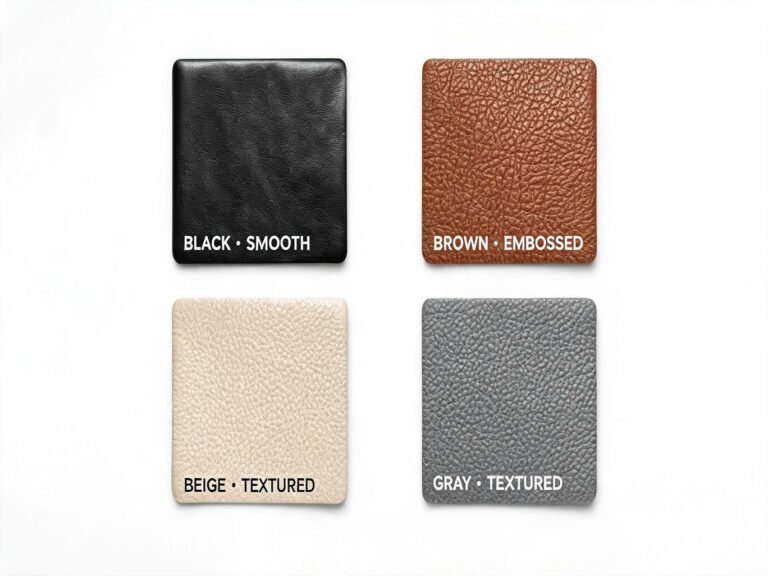
Faux leather swatches — identical appearance across PU, PVC, microfiber, and silicone types masks dramatically different performance
PU vs PVC vs Microfiber vs Silicone: Side-by-Side Comparison
Now that the category hierarchy is clear, let’s compare the four faux leather types across the metrics that matter most to B2B procurement teams. The table below summarizes data from our internal testing lab and supplier qualification records:
| Property | PU Leather | PVC Leather | Microfiber Leather | Silicone Leather |
|---|---|---|---|---|
| Polymer base | Polyurethane | Polyvinyl chloride | PU + microfiber | Silicone rubber |
| Martindale abrasion | 25,000-50,000 | 20,000-40,000 | 50,000-100,000 | 200,000+ |
| VOC emissions | Moderate (solvent) / Low (water) | High (phthalates) | Moderate | Zero |
| Hydrolysis resistance | Poor (solvent) / Fair (water) | Good | Fair | Excellent |
| UV stability | Fair (yellows 3-5 yr) | Poor (yellows 2-3 yr) | Fair | Excellent (10+ yr) |
| Cost per sq. meter | $3-8 | $2-6 | $8-15 | $10-20 |
| REACH compliant | Yes (most grades) | Restricted (phthalates) | Yes | Yes + FDA + PAHs |
| Expected lifespan | 4-7 years | 3-5 years | 6-10 years | 10-15+ years |
The price-per-meter gap between PVC ($2-6) and silicone leather ($10-20) looks significant — but when you divide that cost by expected service life, silicone leather’s cost-per-year is competitive with or better than PVC. A PVC sofa leather that lasts 4 years at $4/meter costs $1.00/meter/year. A silicone leather that lasts 12 years at $15/meter costs $1.25/meter/year — a 25% premium for a material that won’t crack, off-gas, or trigger warranty claims. In our experience qualifying suppliers across Asia and Europe, we’ve found that suppliers who cannot clearly identify their polymer system on a technical data sheet are almost always shipping PVC or low-grade bonded leather regardless of what the product label claims.
Material comparison video — watch how different faux leather types perform under identical abrasion, waterproofing, and flexibility tests
Why the Terminology Confusion Exists — and How to Avoid It
The confusion between “PU leather” and “faux leather” has three root causes. First, PU is the dominant faux leather type by market share — when most people encounter faux leather products, they’re touching PU. This creates a natural but incorrect assumption that PU and faux leather are synonymous. Second, many suppliers and retailers deliberately use the vague term “faux leather” on product labels and spec sheets because it’s consumer-friendly and avoids the negative associations some buyers have with “PVC” or “vinyl.” Third, the term “vegan leather” has entered the market as a marketing label that further muddies the waters — it tells you the material is animal-free but says nothing about what it’s actually made of.
For B2B procurement teams, the solution is to specify the polymer system explicitly in every RFQ and spec sheet. Instead of requesting “faux leather,” request “solvent-based PU leather” or “silicone-coated leather” or “microfiber PU leather.” This forces suppliers to quote the exact material you need and eliminates the ambiguity that leads to mis-specification. Our procurement guide on sofa material leather selection provides additional framework for material specification in furniture manufacturing.

Multi-color leather swatch rack — visually identical samples that represent fundamentally different polymer systems

Tensile strength testing — the same test reveals dramatic performance gaps between PU, PVC, and silicone faux leather
“Vegan Leather” Adds Another Layer of Confusion
The term “vegan leather” has surged in marketing materials over the past five years, and it adds another layer to the terminology problem. Vegan leather simply means the material contains no animal-derived inputs — but it tells you nothing about the polymer system. A “vegan leather” handbag could be made from PU, PVC, microfiber, silicone, or even plant-based materials like apple peel or mushroom mycelium. These materials have wildly different durability, cleanability, and environmental profiles.
For B2B buyers, “vegan leather” is a marketing claim, not a material specification. If a supplier quotes “vegan leather” without identifying the polymer system, ask directly: “Is this PU, PVC, microfiber, silicone, or plant-based?” The answer determines whether the material will last 3 years or 15, whether it off-gasses VOCs or is emission-free, and whether it complies with REACH, FDA, or specific automotive standards.
Procurement tip: Create an internal material specification template that requires the polymer system, coating type (solvent/water/solvent-free), substrate composition, and relevant certifications for every faux leather quote. This eliminates 90% of the terminology confusion at the source.
Frequently Asked Questions
Is PU leather the same as faux leather?
No. Faux leather is the umbrella category for all non-animal leather alternatives, while PU leather is one specific type within that category. All PU leather is faux leather, but not all faux leather is PU. Faux leather also includes PVC leather, microfiber leather, silicone leather, and plant-based alternatives. When a product label says “faux leather” without specifying the polymer, it could be any of these — and the performance difference between them is dramatic.
Which is better: PU leather or PVC faux leather?
PU leather is generally superior to PVC for most applications. PU is softer, more breathable, and ages more gracefully than PVC. PVC is cheaper and more water-resistant but stiffens and cracks as phthalate plasticizers evaporate, and it faces tightening REACH and Prop 65 regulation around phthalate content. However, both PU and PVC are inferior to silicone leather, which avoids the hydrolysis failure of PU and the plasticizer migration of PVC entirely.
How can I tell what type of faux leather a supplier is offering?
Request a technical data sheet (TDS) that specifies the polymer system, not just a product catalog. The TDS should list the coating material (PU, PVC, silicone), the solvent system (solvent-based, water-based, solvent-free), the substrate composition, and relevant test certifications (Martindale cycles, VOC test results, REACH compliance). If the supplier cannot provide a TDS with this level of detail, that itself is a red flag about their quality control systems. Our certifications page shows the documentation standard B2B buyers should expect.
Stop Specifying “Faux Leather” — Start Specifying the Polymer
The difference between PU and faux leather isn’t a subtlety — it’s the difference between a category and a material. Every time a procurement team writes “faux leather” on an RFQ without naming the polymer system, they’re handing the material decision to the supplier and hoping for the best. In a market where PVC costs $2/meter and silicone costs $15/meter, and where the two materials have nothing in common except surface appearance, that’s a risk no B2B buyer should accept.
The path forward is simple: specify the polymer, specify the solvent system, require a technical data sheet, and test samples before committing to volume. Among all faux leather types, silicone leather stands out as the only option that combines zero VOCs, 200,000+ cycle abrasion resistance, full hydrolysis resistance, and 10-15+ year lifespan — all in a solvent-free, REACH/FDA/PAHs-compliant package. The EU REACH regulation framework increasingly mandates this level of material transparency, making polymer-specific specification not just best practice but regulatory necessity. When you’re ready to evaluate it alongside your current PU or PVC supplier, we’ll send you side-by-side samples for your own testing.
Request Side-by-Side Sample Comparison
About TOPSUN
TOPSUN manufactures solvent-free silicone leather — the highest-performance member of the faux leather family — for B2B clients in automotive, furniture, medical, and consumer goods industries across 30+ countries. Our production process uses no solvents, no plasticizers, and no animal-derived inputs, delivering a material that outperforms PU, PVC, and microfiber leather across every meaningful durability and compliance metric.
ISO 10993 certified, REACH compliant, FDA food-contact safe. Full technical data sheets, Martindale test reports, and VOC analysis available for qualified B2B inquiries. Custom color, texture, and substrate engineering for OEM/ODM projects.