The global synthetic leather fabric market exceeded $40 billion in 2025, yet 70% of B2B procurement specifications still default to the cheapest available material without understanding the four-tier hierarchy that determines actual lifespan. PVC at $1.50–3.50/m² fails in 2–3 years. PU at $2.50–6.00/m² fails in 3–7 years from hydrolysis. Microfiber at $6–15/m² lasts 8–12 years. Silicone at $12–20/m² lasts 10+ years with zero VOC emissions. The cost gap between tiers is 8× — but the lifespan gap is 5×. When you calculate total cost of ownership, the cheapest material is often the most expensive. Here’s the hierarchy every sourcing decision should be based on.
PU leather accounts for 52% of the synthetic leather market as the default choice for fashion and indoor upholstery. But market dominance doesn’t equal performance optimization. Understanding the difference between synthetic leather types requires looking past price-per-meter to the five specifications that actually predict how long the material survives in your application.
Request Material Comparison Kit

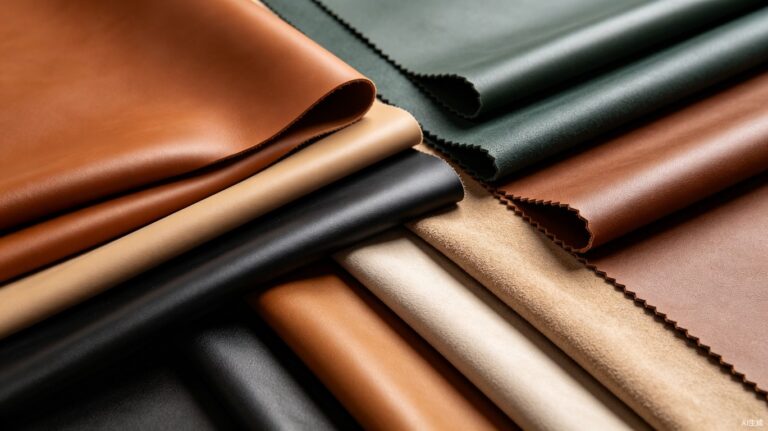
Cross-section structure comparison — the base fabric and coating chemistry determine 80% of material lifespan
The 4-Tier Synthetic Leather Fabric Hierarchy
Synthetic leather fabric isn’t a single material — it’s a category spanning four chemically distinct types, each with different performance ceilings. Sourcing decisions that treat “synthetic leather” as one material produce unpredictable results. Here’s the hierarchy from commodity to premium:
| Tier | Material | Cost/m² | Martindale | Service Life | Key Weakness |
|---|---|---|---|---|---|
| 1 — Commodity | PVC Leather | $1.50–3.50 | 15,000–30,000 | 2–3 years | Phthalate off-gassing, cracks at low temp |
| 2 — Standard | PU Leather | $2.50–6.00 | 30,000–80,000 | 3–7 years | Hydrolysis — urethane bond cleavage |
| 3 — Premium | Microfiber Leather | $6.00–15.00 | 100,000–150,000 | 8–12 years | Still PU-based — eventual hydrolysis |
| 4 — Next-Gen | Silicone Leather | $12–20 | 200,000+ | 10+ years | Higher upfront cost |
The hierarchy reveals a pattern: each tier roughly doubles in Martindale abrasion resistance and service life while costing 2× more per square meter. But the TCO crossover point — where the more expensive material becomes cheaper over its lifespan — occurs between Tier 2 and Tier 3 for most applications. A $4/m² PU cover replaced every 5 years costs $24/m² over 30 years. A $15/m² microfiber cover lasting 10 years costs $45/m² over the same period but eliminates 3 replacement cycles, rework labor, and warranty claims.

Production floor — the coating chemistry applied here determines which tier the final product occupies
5 Specs That Predict Synthetic Leather Lifespan
When evaluating synthetic leather market materials, most buyers check thickness, color, and texture — then negotiate price. The specifications that actually determine whether the material lasts 2 years or 10 are rarely on the spec sheet. Here are the five you must request:
1. Martindale Abrasion (ISO 12947-2)
The single best predictor of surface wear-through. PVC: 15,000–30,000 cycles. Standard PU: 30,000–80,000. Microfiber: 100,000–150,000. Silicone: 200,000+. For high-traffic applications (sofa, automotive, public seating), specify minimum 50,000 cycles. For contract/commercial use, demand 100,000+.
2. Hydrolysis Resistance (ISO 11507 or ASTM D4755)
The #1 failure mode for PU-based synthetics. Urethane linkages in the polymer backbone are cleaved by water molecules over time — faster at elevated temperature and humidity. Standard PU shows visible peeling in 3–7 years; in tropical climates, 2–3 years. Hydrolysis-resistant PU (using polycarbonate diols) extends this to 7–10 years but costs 40–60% more. Silicone leather is hydrolysis-proof by chemistry — the Si-O bond is inherently water-stable.
3. Flex Resistance (ISO 5402)
Determines crack resistance at fold lines and hinges. PVC: 15,000–25,000 cycles (fails early at seams). PU: 30,000–50,000. Microfiber: 50,000–80,000. Silicone: 100,000+. For upholstered furniture and automotive seating where the material flexes constantly, specify ≥ 50,000 cycles minimum.
4. UV / Light Fastness (ISO 105-B06)
Color stability under sunlight and artificial lighting. PVC and standard PU typically achieve Grade 4–5 (good). But UV exposure degrades the polymer itself — not just the color. UV causes PVC to become brittle and PU to accelerate hydrolysis. Silicone leather is UV-stable at 1,000+ hours with no polymer degradation.
5. VOC Emission (ISO 16000-6)
Increasingly critical for automotive (VDA 277), furniture (EU E1), and indoor air quality compliance. PVC emits plasticizer vapors. PU emits residual solvents and DMF. Silicone leather emits ≤ 10 μg/m³ TVOC — effectively zero. For any product with human contact or enclosed environments, this specification is no longer optional.
PVC vs PU vs Microfiber vs Silicone: Total Cost of Ownership
Understanding the types of synthetic leather requires more than comparing price tags. The true cost includes replacement cycles, warranty claims, labor for rework, and brand damage from premature failure. Here’s the 10-year TCO for a 1,000 m² furniture upholstery project:
| Factor (10-yr, 1000 m²) | PVC | PU | Microfiber | Silicone |
|---|---|---|---|---|
| Material Cost (initial) | $2,500 | $4,250 | $10,500 | $16,000 |
| Replacements in 10 yrs | 3–4 | 1–2 | 0–1 | 0 |
| Replacement Material Cost | $7,500–10,000 | $4,250–8,500 | $0–10,500 | $0 |
| Rework Labor (est.) | $15,000 | $8,000 | $4,000 | $0 |
| Warranty Claims (est.) | $8,000 | $5,000 | $2,000 | $500 |
| 10-Year Total Cost | $33,000–35,500 | $21,500–25,750 | $16,500–27,000 | $16,500 |
The TCO inversion is striking. PVC — the cheapest at $2.50/m² — becomes the most expensive option over 10 years at $33,000–35,500. Silicone leather — the most expensive upfront at $16/m² — ties microfiber as the lowest 10-year total at $16,500. For applications where replacement is costly or brand-critical (contract furniture, automotive interiors, yachts), the TCO gap widens further because rework labor and warranty costs scale with product value.

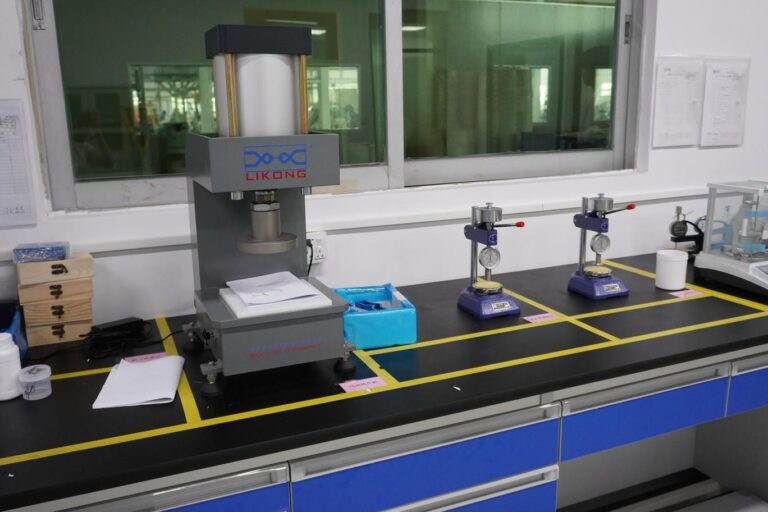
Martindale abrasion testing — the spec that separates 15,000-cycle PVC from 200,000-cycle silicone
The Hydrolysis Problem: Why 70% of Synthetic Leather Fails Prematurely
Hydrolysis is the chemical process where water molecules cleave the urethane bonds in PU-based synthetic leather. It’s not a surface defect — it’s a structural breakdown of the polymer chain. The material doesn’t wear out; it disintegrates from within. This single failure mode accounts for the majority of synthetic leather warranty claims across furniture, automotive, and fashion applications.
The mechanism: moisture from ambient humidity penetrates the PU coating and attacks the ester bonds in standard polyester-PU. The reaction accelerates above 25°C and above 60% RH. In tropical, marine, or high-humidity environments, even premium PU fails in 2–3 years. Hydrolysis-resistant PU formulations exist — they substitute polycarbonate diols for polyester diols, creating carbonate bonds that resist water attack. But these formulations cost 40–60% more and still eventually degrade; they only delay the inevitable.
Silicone leather solves this by chemistry, not formulation. The Si-O backbone bond in silicone polymers is inherently water-stable — the same chemistry used in outdoor sealants and medical implants that withstand decades of moisture exposure. No hydrolysis means no delamination, no peeling, no embrittlement from humidity. This is why silicone leather achieves 10+ year service life even in tropical and marine environments where premium PU fails in 3.
Application Decision Guide: Which Tier for Which Use Case
Different applications have different cost-performance sweet spots. Use this decision guide to match material tier to your use case:
| Application | Recommended Tier | Why |
|---|---|---|
| Budget fashion accessories | Tier 2 — PU | Short product lifecycle (1–2 seasons); softness matters more than longevity |
| Residential furniture | Tier 3 — Microfiber | 7–10 year consumer expectation; cost-performance balance |
| Automotive interiors | Tier 3 or 4 | Heat, UV, humidity exposure; VOC compliance; 10-year design life |
| Marine / outdoor | Tier 4 — Silicone | Salt spray, UV, humidity — only silicone survives 10+ years |
| Medical / healthcare | Tier 4 — Silicone | ISO 10993 biocompatibility; bleach-safe cleaning; zero VOC |
| Children’s products | Tier 4 — Silicone | EN 71 toy safety; non-toxic; hypoallergenic |
| Contract / hospitality | Tier 3 or 4 | High-traffic wear; cleaning chemical exposure; warranty risk |
About TOPSUN: TOPSUN manufactures Tier 4 silicone leather — the highest tier of synthetic leather fabric. Our solvent-free dry coating process produces material with 200,000+ Martindale abrasion cycles, 100,000+ flex cycles, inherent hydrolysis resistance, and zero VOC emissions (ISO 16000-6: ≤ 10 μg/m³). With 100+ textures, unlimited Pantone-matched colors (Delta E ≤ 1.0), thicknesses from 0.23–2.0 mm, and certifications including ISO 10993-5, REACH, FDA 21 CFR 177.2600, and EN 13773 Class 4, we serve automotive, furniture, medical, marine, and consumer goods manufacturers worldwide. Production capacity: 500,000+ m/month across three facilities. MOQ: 500 meters. Lead time: 7–15 days.
Material comparison — see the structural difference between PVC, PU, microfiber, and silicone leather
Request Tier 4 Samples
Get TCO Analysis
Download Spec Sheet
Frequently Asked Questions
What is the most durable synthetic leather fabric?
Silicone leather is the most durable synthetic leather, achieving 200,000+ Martindale abrasion cycles, 100,000+ flex cycles, and 10+ year service life. Unlike PU-based synthetics (including microfiber), silicone is inherently hydrolysis-resistant due to its Si-O polymer backbone, meaning it won’t degrade from moisture exposure over time.
Is synthetic leather fabric cheaper than genuine leather?
Yes, at all tiers. PVC ($1.50–3.50/m²) and PU ($2.50–6.00/m²) are significantly cheaper than genuine leather ($20–45/m²). Microfiber ($6–15/m²) approaches the lower end of genuine leather pricing. Silicone leather ($12–20/m²) costs less than mid-grade genuine leather while matching or exceeding its durability. The true cost advantage depends on calculating total cost of ownership over the product’s expected lifespan.
How long does synthetic leather fabric last?
Lifespan varies dramatically by tier: PVC lasts 2–3 years, PU lasts 3–7 years (depending on humidity exposure), microfiber lasts 8–12 years, and silicone leather lasts 10+ years. The primary failure mode for PU-based materials is hydrolysis — moisture chemically degrades the urethane bonds. Silicone leather is immune to hydrolysis by chemistry.
Which synthetic leather is best for furniture upholstery?
For residential furniture, microfiber leather (Tier 3) offers the best cost-performance balance at 8–12 year lifespan. For contract/commercial furniture, specify silicone leather (Tier 4) for its 200,000+ Martindale cycles, chemical resistance to cleaning agents, and zero VOC emissions. Avoid PVC for any furniture application — its 2–3 year lifespan and phthalate off-gassing make it unsuitable for indoor use.