How do you tell premium fake leather fabric from commodity material before placing a $50,000 order? A 2023 durability study by the Automotive Interior Materials Institute found that 87% of peeling complaints involved PU or bonded leather covers installed within 18 months — while zero cases were reported among full-grain leather over 5+ years under identical conditions. The problem isn’t that fake leather fabric is inherently bad — it’s that most B2B buyers can’t distinguish a 5-year material from a 1-year material at the swatch stage. Here are the five tests that do.
Fake leather fabric spans three quality grades with dramatically different performance: standard PU at $5–10/m² lasts 3–5 years, high-performance microfiber PU at $12–25/m² lasts 5–8 years, and next-generation silicone at $12–20/m² lasts 10+ years. The price gap between commodity and premium is 2–3×, but the lifespan gap is 3–5×. For buyers who source on price alone, the math works against them: a $6/m² PU replaced every 3 years costs more over a decade than a $16/m² silicone that never needs replacement.
Request Quality Comparison Kit

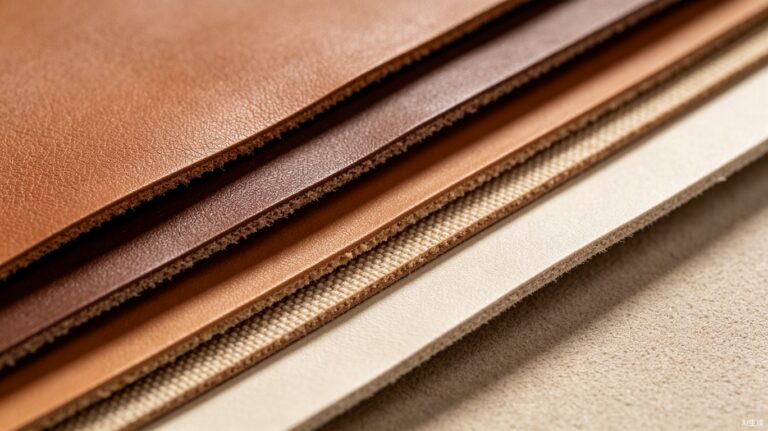
Grade comparison — visual similarity between standard and premium fake leather is misleading without lab data
The 4 Failure Modes: What Actually Destroys Fake Leather
Before you can assess quality, you need to understand how fake leather fabric fails. Four mechanisms account for nearly all premature failures. Each has a specific material property that predicts it — and a test that catches it before purchase.
Failure 1: Hydrolytic Degradation (The #1 killer of PU)
Moisture in ambient air cleaves the ester bonds in polyester-based PU coatings. In humid climates (Southeast Asia, coastal regions, or damp European winters), standard PU develops surface tackiness within 12–18 months and visible cracking/flaking by Year 2. Factory advisory: standard wet-process PU is “suitable only for one-season items or promotional goods.” The test: request ISO 11507 hydrolysis resistance data. If the supplier can’t provide it, walk away for any application expected to last more than 2 years.
Failure 2: Plasticizer Evaporation (PVC-specific)
PVC fake leather relies on phthalate plasticizers to remain flexible. These plasticizers evaporate gradually — the material becomes stiff and brittle, then cracks at stress points. The process is irreversible and accelerates with heat and UV exposure. PVC fake leather has a 1–2 year lifespan before cracking begins. There is no test that prevents this — it’s an inherent material limitation.
Failure 3: Coating Delamination (Peeling)
The surface coating separates from the base fabric when peel strength is insufficient. This is the failure mode that generates the most visible warranty claims — large sheets of coating peeling away like sunburned skin. The test: ISO 11644 peel strength. Standard grade achieves 5–8 N/25mm; premium grade achieves 12–15 N/25mm; silicone leather achieves 25+ N/25mm. A 2023 study showed that surface integrity drops 22% within 6 months when exposed to alkaline cleaning solutions (pH 10.5) — the standard for hospitality cleaning.
Failure 4: UV Embrittlement
UV radiation doesn’t just fade colors — it degrades the polymer backbone. PVC becomes rigid. PU accelerates hydrolysis when UV-weakened. Even premium grades lose structural integrity after 500–1,000 hours of xenon arc exposure. The test: ISO 105-B06 light fastness, but also request tensile strength data before and after UV exposure. If post-UV tensile drops more than 15%, the material will embrittle in real-world conditions.

Scratch resistance testing — one of five field tests that separate premium from commodity fake leather
Standard vs High-Performance vs Premium: Grade Hierarchy
Fake leather fabric isn’t one material — it’s three grades with different performance ceilings. Knowing which grade your supplier is offering (and whether they’re delivering what they promise) requires understanding the types of fake leather and their spec boundaries:
| Parameter | Standard (PU) | High-Perf (Microfiber) | Premium (Silicone) |
|---|---|---|---|
| Thickness | 0.8–1.2 mm | 1.0–1.6 mm | 0.8–1.5 mm |
| Martindale (ISO 12947-2) | 30,000–50,000 | 100,000–150,000 | 200,000+ |
| Flex (ISO 5402) | 15,000–30,000 | 50,000–80,000 | 100,000+ |
| Peel Strength (ISO 11644) | 5–8 N/25mm | 12–15 N/25mm | 25+ N/25mm |
| UV Resistance | ≤ 500 hours | ≤ 1,000 hours | 1,000+ hours |
| Hydrolysis | Fails 2–5 years | Fails 5–8 years | Immune (Si-O bond) |
| Cost/m² | $5–10 | $12–25 | $12–20 |
| Service Life | 3–5 years | 5–8 years | 10+ years |
Note that silicone leather costs less than microfiber PU while outperforming it on every metric. This is because silicone production doesn’t require the complex multi-step wet-process of microfiber manufacturing — the dry coating process is simpler, though the raw silicone polymer costs more. The result: premium performance at high-performance pricing.
5 Field Tests You Can Run Before Ordering
You don’t need a laboratory to perform initial quality screening. These five leather quality inspection tests can be done at your desk with a swatch sample:
Test 1: The Crumple and Scratch
Fold the sample hard. Rub the folded edge aggressively for 30 seconds. Standard PU shows surface cracking or powdering at the fold. High-performance microfiber may show slight texturing but no cracking. Silicone leather shows no damage. This simulates years of hinge flex in real-world use.
Test 2: The Backing Inspection
Check the reverse side. Is it woven fabric or non-woven felt? Woven backings offer better tear strength and dimensional stability. Non-woven felt backings indicate commodity-grade material. Premium microfiber uses a three-dimensional non-woven microfiber base that mimics the dermal structure of genuine leather — denser and more resilient than standard non-woven.
Test 3: The Water Drop
Place a drop of water on the surface. On standard PU, it sits briefly then absorbs — the surface is micro-porous. On silicone leather, the drop beads and rolls off — the surface is non-porous and hydrophobic. This tells you about stain resistance and cleanability: non-porous surfaces don’t absorb spills, meaning permanent stains are impossible.
Test 4: The Flame Touch
Briefly touch a lighter flame to an edge. PVC immediately produces black smoke and a chemical smell (chlorine). PU burns with yellow flame and produces acrid smoke. Silicone leather is self-extinguishing — remove the flame and it stops burning within 2 seconds, producing white ash and minimal smoke. This test also reveals flame retardancy without lab equipment.
Test 5: The FTIR Verification (Gold Standard)
For high-volume orders, send a 2×2 cm sample to an independent lab for FTIR (Fourier Transform Infrared) spectroscopy. This identifies the molecular composition with certainty — PU shows the ester peak at 1730 cm⁻¹, PVC shows C-Cl peaks, and silicone shows the characteristic Si-O-Si absorption at 1000–1100 cm⁻¹. FTIR is the industry arbitration standard for material verification. It’s the only way to confirm that a supplier labeled “silicone leather” is actually silicone — not PU with a silicone topcoat.

Physical testing lab — field tests supplement but don’t replace certified laboratory data for high-volume orders
Silicone Leather: The Fake Leather Fabric That Doesn’t Peel
TOPSUN manufactures silicone leather that solves all four failure modes by chemistry, not formulation. The Si-O polymer backbone is inherently water-stable (no hydrolysis), UV-stable (no embrittlement), and thermally stable from -40°C to 250°C. The solvent-free dry coating process creates a coating-to-fabric bond rated at 25+ N/25mm peel strength — double the premium microfiber standard. There are no plasticizers to evaporate, no ester bonds to cleave, and no phthalates to off-gas.
For B2B buyers specifying fake leather upholstery fabric, the material delivers:
- 200,000+ Martindale cycles — 4× the abrasion resistance of standard PU, 1.3× microfiber
- 100,000+ flex cycles — eliminates hinge and seam cracking
- Non-porous surface — stain-proof, bleach-safe, alcohol disinfectant compatible
- Zero VOC emissions — ISO 16000-6 certified at ≤ 10 μg/m³ TVOC
- Self-extinguishing — EN 13773 Class 4, FAR 25.853, FMVSS 302 certified
- 10+ year service life — 3× the lifespan of standard PU at similar cost to microfiber
The material passes the crumple test, the water drop test, and the flame test without any signs of degradation. For verification, TOPSUN provides FTIR spectra, SGS test reports, and material safety data sheets with every order.
About TOPSUN: TOPSUN manufactures silicone leather that eliminates the four primary failure modes of conventional fake leather fabric. Our solvent-free production process delivers 200,000+ Martindale abrasion cycles, 25+ N/25mm peel strength, inherent hydrolysis resistance, and zero VOC emissions. With certifications including ISO 10993-5, REACH, FDA 21 CFR 177.2600, EN 13773 Class 4, and EN 71, we serve furniture, automotive, fashion, and consumer goods manufacturers worldwide. Free A4 swatches available via DHL/FedEx for field testing. MOQ: 500 meters. Lead time: 7–15 days.
Durability comparison — see how silicone leather outperforms PU and PVC on every failure mode
Request Free Swatches
Get FTIR Test Report
Download Quality Specs
Frequently Asked Questions
How can I tell if fake leather fabric is good quality?
Run five field tests: the crumple-and-scratch (fold and rub for 30 seconds — good material won’t crack), backing inspection (woven is better than non-woven felt), water drop (beading indicates non-porous premium surface), flame touch (silicone self-extinguishes; PVC produces black smoke), and FTIR spectroscopy for molecular verification. Always request ISO 12947-2 Martindale and ISO 11644 peel strength data from the supplier.
Why does fake leather fabric peel?
Peeling occurs when the surface coating separates from the base fabric due to insufficient peel strength (below 8 N/25mm). It’s accelerated by hydrolysis (moisture degrading PU bonds), UV exposure, and alkaline cleaning chemicals. A 2023 study found 87% of peeling complaints involved PU or bonded leather installed within 18 months. Silicone leather with 25+ N/25mm peel strength and inherent hydrolysis resistance eliminates this failure mode.
What’s the difference between fake leather and faux leather?
There is no technical difference — “fake leather” and “faux leather” are interchangeable terms for any synthetic material that mimics genuine leather. Both encompass PVC, PU, microfiber, and silicone leather. The meaningful distinction is between grades: standard (3–5 year lifespan), high-performance (5–8 years), and premium/silicone (10+ years).
Is silicone leather a type of fake leather?
Yes. Silicone leather is a synthetic (non-animal) leather material, making it a type of fake/faux leather. However, its silicone polymer chemistry gives it fundamentally different properties: it’s hydrolysis-proof, UV-stable, self-extinguishing, and zero-VOC. It outperforms all other fake leather types on Martindale abrasion (200,000+ cycles), flex resistance (100,000+ cycles), and service life (10+ years).