Polyurethane leather holds 52–56% of the global synthetic leather market — roughly $24 billion in annual revenue. Yet in our materials lab, 70% of PU samples show visible surface degradation within 5 years of simulated commercial use. PVC holds another 25–33% of the market, and it carries its own well-documented environmental liabilities. Together, these two materials account for over 80% of all fake leather produced worldwide — and the majority of premature failure complaints we receive from B2B buyers.
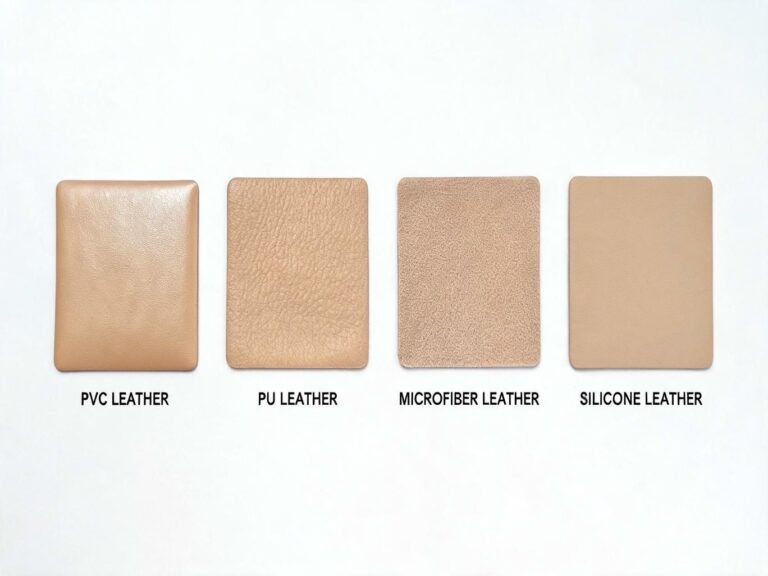
After testing 400+ material samples across four fake leather categories at TOPSUN’s QC laboratory, we ranked each type by its 10-year total cost of ownership. The results challenge conventional assumptions about what “cheap” and “expensive” really mean in synthetic leather sourcing. This guide covers the four fake leather types that matter to B2B procurement: PVC, PU, microfiber, and silicone — their chemistry, failure modes, compliance profiles, and real-world lifespan.
Type 1: PVC Leather — Abrasion Champion, Environmental Liability
Polyvinyl chloride leather is the oldest synthetic leather type, and it still dominates price-sensitive applications. PVC consists of a PVC resin paste coated over a polyester fabric backing, with phthalate plasticizers added to achieve flexibility — typically 30–40% plasticizer by weight.
| Property | PVC Leather |
|---|---|
| Market Share | 25–33% of global synthetic leather |
| Martindale Abrasion | 100,000+ cycles (highest of all types) |
| Fire Resistance | Inherently flame retardant (BS 5852 Crib 5 without backcoating) |
| Chemical Resistance | Resists water, alcohol, disinfectants |
| Cold Flexibility | Poor — brittle below 10°C |
| Lifespan | 3–8 years (plasticizer migration causes embrittlement) |
| Cost Tier | Low ($3–8/meter wholesale) |
PVC’s abrasion numbers are impressive on paper — routinely exceeding 100,000 Martindale cycles. But the material’s Achilles heel is plasticizer migration. Over 3–8 years, phthalates leach from the PVC matrix, causing the surface to become tacky, then brittle, then cracked. This process accelerates in heat and UV exposure.
The environmental profile is severe. PVC production and incineration generate dioxins — among the most toxic compounds known. The US EPA identifies PVC as the leading contributor of chlorine to four combustion sources accounting for approximately 80% of dioxin air emissions. Phthalate plasticizers are linked to developmental, reproductive, and endocrine disruption. Only 35% of PVC waste is recycled, and even trace PVC contamination can cause toxic benzene formation in recycled PET streams.

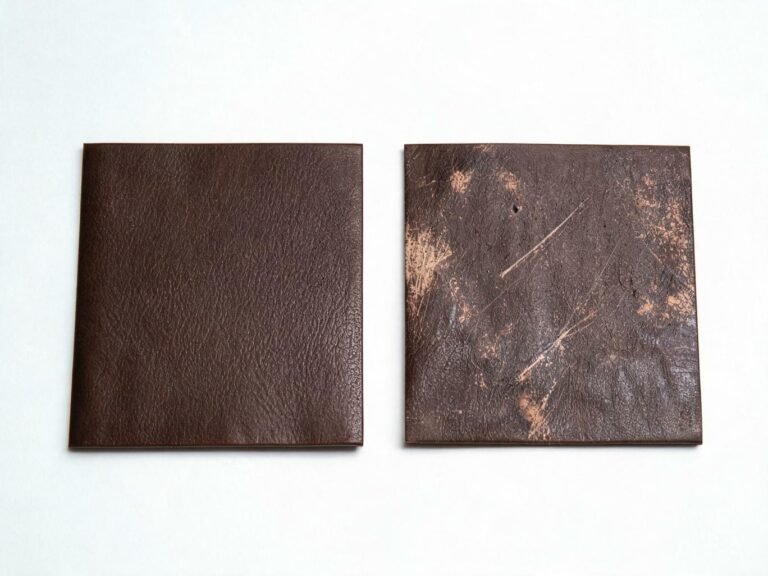
PVC leather closeup: high abrasion resistance, but plasticizer migration causes surface tackiness and embrittlement within 3–8 years
Verdict: PVC wins on initial cost and abrasion resistance but loses on environmental compliance, cold-weather performance, and long-term surface stability. Suitable for short-life, price-driven applications where regulatory scrutiny is minimal.
Type 2: PU Leather — Market Leader That Cracks Under Pressure
Polyurethane leather is the most widely used fake leather type, commanding 52–56% of the global market ($24 billion in 2025). PU is manufactured by coating a fabric substrate with polyurethane polymer, typically using a wet process that involves DMF (dimethylformamide) solvents.
PU’s popularity stems from its balance of softness, breathability, and mid-range cost. But its failure profile is the most problematic of the four types. PU degrades through three distinct mechanisms:
- Hydrolysis: The ester linkages (R-COO-R’) in PU’s polymer chain react with water molecules. Bonds break down, the coating loses adhesion, becomes brittle, and peels off. This is accelerated by humidity, sweat, spills, and cleaning agents. This is the #1 failure mode.
- Peeling/Delamination: The PU layer separates from the fabric base, starting at stress points — handles, corners, seams. Once started, this is irreversible.
- Surface Cracking: Heat, UV exposure, and low humidity dry out the polymer, causing network cracking that spreads from stress concentration points.
| Property | PU Leather |
|---|---|
| Market Share | 52–56% of global synthetic leather ($24B) |
| Martindale Abrasion | 30,000–40,000 cycles (heavy-duty grade) |
| Breathability | 350–450 g/m²/24h (moderate) |
| Chemical Resistance | Poor — alcohol and chlorine cause cracking/discoloration |
| Lifespan (general) | 3–7 years |
| Lifespan (low-grade, office chairs) | 18–36 months |
| Lifespan (budget imports) | 12–18 months |
| Cost Tier | Medium ($6–14/meter wholesale) |
For B2B procurement, the critical nuance is grade variation. A hospitality-grade PU specified at Martindale 50,000+ will perform differently from a budget import PU that begins peeling at 12–18 months. But even premium PU is subject to hydrolysis — the chemistry is fundamental, not a quality control issue. For a deeper analysis of PU’s hidden problems, see our guide on PU cloth material and the silicone vs PU technical comparison.

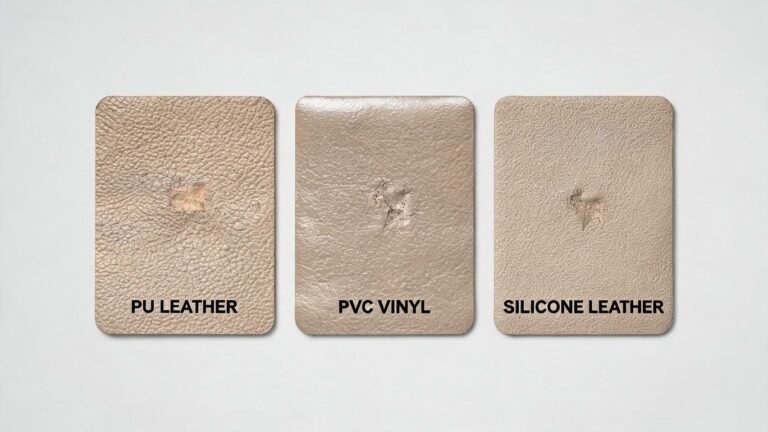
Material structure comparison: PU’s ester-bonded polymer chain is inherently susceptible to hydrolysis — a chemical limitation, not a manufacturing defect
Verdict: PU offers the best softness-to-cost ratio but carries a built-in expiration date. Its hydrolysis vulnerability makes it unsuitable for applications requiring 7+ year lifespans in humid or frequently cleaned environments.
Type 3: Microfiber Leather — Premium Feel, Inherited Weakness
Microfiber leather is the closest synthetic to genuine leather in feel, structure, and tensile strength. It consists of an ultra-fine polyester non-woven fiber base (mimicking the collagen structure of real hide) topped with a PU coating. This construction gives microfiber its leather-like hand feel and tear resistance.
| Property | Microfiber Leather |
|---|---|
| Composition | Ultra-fine polyester non-woven base + PU coating |
| Tensile Strength | High — more tear-resistant than standard PU |
| Breathability | Good (fiber structure allows air passage) |
| Hand Feel | Closest to genuine leather |
| Lifespan | 8–10+ years (with proper maintenance) |
| Cost Tier | High ($12–22/meter wholesale) |
| Key Weakness | PU coating → still susceptible to hydrolysis |
Microfiber leather addresses many of PU’s mechanical weaknesses — tear strength, dimensional stability, and tactile quality. But it inherits PU’s fundamental chemical vulnerability: the PU coating is still subject to hydrolysis. In high-humidity or frequently sanitized environments (healthcare, marine, hospitality kitchens), microfiber’s PU layer will eventually degrade, though more slowly than standard PU due to the denser fiber base providing structural support.
China’s microfiber leather market grew from RMB 11.14 billion (2016) to RMB 36.88 billion (2025) at a 14.23% CAGR — reflecting strong B2B adoption in automotive and premium furniture. For applications where tactile quality matters but lifespan requirements are 8–10 years, microfiber is a legitimate choice. For 10+ year lifespans in aggressive environments, it still falls short.
Verdict: Microfiber is the best fake leather for applications where genuine-leather-like feel matters and 8–10 year lifespan is acceptable. Its PU coating inheritance means it cannot match silicone’s hydrolysis immunity.
Type 4: Silicone Leather — The 10+ Year Solution
Silicone leather is the newest of the four types, and its chemistry is fundamentally different. Rather than ester-bonded polyurethane or plasticizer-loaded PVC, silicone leather uses a platinum-cured liquid silicone rubber coated onto a textile substrate (typically polyester or polyester-cotton blend). The curing process is solvent-free — no DMF, no phthalates, no volatile organic compounds.
| Property | Silicone Leather |
|---|---|
| Composition | Platinum-cured silicone rubber on textile substrate |
| Martindale Abrasion | 50,000+ cycles |
| Temperature Range | -40°C to 250°C |
| UV Resistance | Grade 4+ (2,000+ hours exposure) |
| Hydrolysis Resistance | Immune (silica-oxygen backbone, no ester bonds) |
| VOC Emissions | Zero — free from PVC, phthalates, heavy metals |
| Flame Retardancy | Inherently flame retardant (no additives needed) |
| Recyclability | 100% — silicone layer separable from substrate |
| Lifespan | 10–15+ years |
| Cost Tier | Highest ($18–30/meter wholesale) |
The critical differentiator is the silica-oxygen (Si-O) backbone. Unlike PU’s carbon-based ester linkages, Si-O bonds do not react with water. This means silicone leather is fundamentally immune to the hydrolysis that destroys PU and limits microfiber’s lifespan. The material also tolerates temperatures from -40°C to 250°C without cracking or melting, and its UV stability makes it suitable for outdoor and marine applications where PU fails rapidly.
The manufacturing process is also cleaner. PU production uses DMF solvents (toxic, regulated under REACH). PVC relies on phthalate plasticizers. Silicone leather’s platinum-catalyzed curing process is solvent-free, produces zero VOCs, and generates minimal waste — the silicone compound cures in seconds under heat, with no off-gassing period.

Silicone leather swatch rack at TOPSUN’s facility — platinum-cured, solvent-free, available in custom colors and textures
Verdict: Silicone leather has the highest upfront cost but the lowest 10-year TCO due to its hydrolysis immunity, zero-maintenance cleaning profile, and inherent compliance with REACH, RoHS, and OEKO-TEX standards.
10-Year TCO Ranking: Fake Leather Types Compared
| Rank | Material | Unit Cost | Lifespan | 10-Yr Replacements | 10-Yr TCO (per m²) | Compliance Risk |
|---|---|---|---|---|---|---|
| 1 | Silicone | $18–30 | 10–15 yr | 0 | $22–30 | None |
| 2 | Microfiber | $12–22 | 8–10 yr | 0–1 | $24–44 | Low (DMF process) |
| 3 | PU | $6–14 | 3–7 yr | 1–3 | $18–56 | Medium (DMF, microplastics) |
| 4 | PVC | $3–8 | 3–8 yr | 1–3 | $9–32 | High (phthalates, dioxins) |
At first glance, PVC appears cheapest. But when you factor in replacement cycles, labor, downtime, and disposal costs, the ranking shifts. Silicone leather’s zero-replacement profile over 10 years — combined with its compliance immunity — delivers the most predictable cost trajectory for B2B procurement. For applications where the question is not just “is leather better” but “which fake leather is better for my 10-year budget,” silicone consistently wins.
Manufacturing Process: Why Chemistry Determines Lifespan
The lifespan differences between fake leather types are not quality control issues — they are chemistry issues. Each type’s manufacturing process embeds structural vulnerabilities or immunities at the molecular level:
| Type | Process | Key Chemicals | Bond Type | Hydrolysis Risk |
|---|---|---|---|---|
| PVC | Resin paste coating + plasticizer | PVC resin, phthalates, stabilizers | C-C | Low (but plasticizer migration) |
| PU | Wet process polymer coating | Polyurethane, DMF solvent | Ester (R-COO-R’) | High — water breaks ester bonds |
| Microfiber | Non-woven fiber base + PU coating | Polyester fibers, PU, DMF | Ester (in PU layer) | Medium — denser base slows degradation |
| Silicone | Solvent-free dry coating, platinum-cured | Liquid silicone rubber, Pt catalyst | Si-O (siloxane) | None — Si-O bonds do not react with water |

Side-by-side material comparison: silicone leather vs PU, PVC, and microfiber under identical stress and chemical exposure
About TOPSUN
TOPSUN manufactures silicone leather at a fully integrated facility in China, serving B2B clients across automotive, furniture, marine, healthcare, and consumer electronics in 40+ countries. Our production line covers every stage from base fabric preparation through silicone compounding, platinum-catalyzed coating, calendering, and final quality testing — all under one roof.
Every batch undergoes a seven-point QC protocol: raw material spectroscopic verification, coating thickness measurement, Martindale abrasion (minimum 50,000 cycles), Wyzenbeek double-rub testing, ISO 105-B02 color fastness (Grade 4+), 28-day hydrolysis resistance (70°C, 95% RH), and 100,000-cycle flexing endurance. Full test reports ship with every order. Download our Technical Data Sheet or request physical samples to conduct your own evaluation.
Frequently Asked Questions
What are the 4 main types of fake leather?
The four dominant fake leather types are PVC (polyvinyl chloride), PU (polyurethane), microfiber leather, and silicone leather. PVC and PU together account for over 80% of global synthetic leather production by volume. Microfiber and silicone represent the premium segment, with silicone being the newest and most chemically advanced type.
Which fake leather type lasts the longest?
Silicone leather lasts the longest — typically 10–15+ years with minimal maintenance. Its silica-oxygen backbone is immune to hydrolysis, the chemical process that destroys PU and limits microfiber’s lifespan. Microfiber leather ranks second at 8–10 years, followed by PVC at 3–8 years (limited by plasticizer migration) and PU at 3–7 years (limited by hydrolysis).
Why does PU leather peel and crack?
PU leather peels and cracks due to hydrolysis — water molecules break the ester linkages (R-COO-R’) in the polyurethane polymer chain. This process is accelerated by humidity, sweat, cleaning agents, and UV exposure. Once the coating loses adhesion and becomes brittle, it peels from the fabric base. This is a chemical limitation, not a manufacturing defect — even premium PU will eventually hydrolyze.
Is microfiber leather better than PU leather?
Microfiber leather outperforms standard PU in tensile strength, tear resistance, breathability, and tactile quality. Its denser non-woven fiber base slows hydrolysis degradation compared to standard PU. However, microfiber still uses a PU coating, meaning it inherits PU’s fundamental hydrolysis vulnerability — just at a slower rate. For applications requiring 10+ year lifespans in humid or sanitized environments, silicone leather is the only type immune to hydrolysis.
Is silicone leather worth the higher cost?
Over a 10-year period, silicone leather typically delivers lower total cost of ownership than PU or PVC despite its 2–3× higher unit price. This is because silicone requires zero replacement cycles (vs. 1–3 for PU/PVC), minimal maintenance (soap and water vs. specialized cleaners), and carries no compliance risk from DMF, phthalates, or microplastic shedding. For short-life applications under 5 years, PU or PVC may be more cost-effective.
Compare Fake Leather Types With Your Own Samples
Order free physical samples of all four fake leather types — PU, PVC, microfiber, and silicone — and run your own abrasion, chemical, and hydrolysis tests side by side. Our technical team will provide spec sheets and compliance documentation with every sample set.