A procurement team at a US furniture OEM sends RFQs to three companies labeled “US leather company” in their supplier database. The first is a legacy tannery in the Midwest still running chrome tanning lines now under California Proposition 65 scrutiny. The second is a leather goods manufacturer that imports finished PU-coated hides from Southeast Asia and re-brands them as “American-made.” The third is a distributor marking up imported PVC faux leather with no tannery of its own. All three carry the same “US leather company” label — but deliver entirely different material chemistry, compliance profiles, and durability outcomes. For procurement teams evaluating leather manufacturers in the USA, the label alone reveals nothing about what material they actually produce.
The US Leather Company Landscape: Three Distinct Categories
Not every “US leather company” is a tannery. The US leather industry comprises three fundamentally different business types, and procurement teams that conflate them end up with mismatched material specifications. The US leather market reached $60.32 billion in 2026 with a 6.42% CAGR through 2034, but that headline number obscures a fragmented supply chain where the label “US leather company” can mean anything from a full-scale tannery to a warehouse reselling imported PVC.
Type 1: Operating Tanneries. These companies process raw animal hides through tanning, finishing, and coloring. The US leather tanning market was valued at $2.4 billion in 2025, with chrome tanning commanding 78% market share due to faster processing and softer hand-feel. However, only 60-70% of chromium used during tanning binds to the leather — the remaining 30-40% discharges into wastewater. California’s 2025 regulatory action banning new hexavalent chromium facilities has put US tanneries on notice that chrome tanning’s days are numbered in key markets. For B2B buyers evaluating leather supply chain resilience in 2026, this regulatory trajectory is a critical sourcing risk.

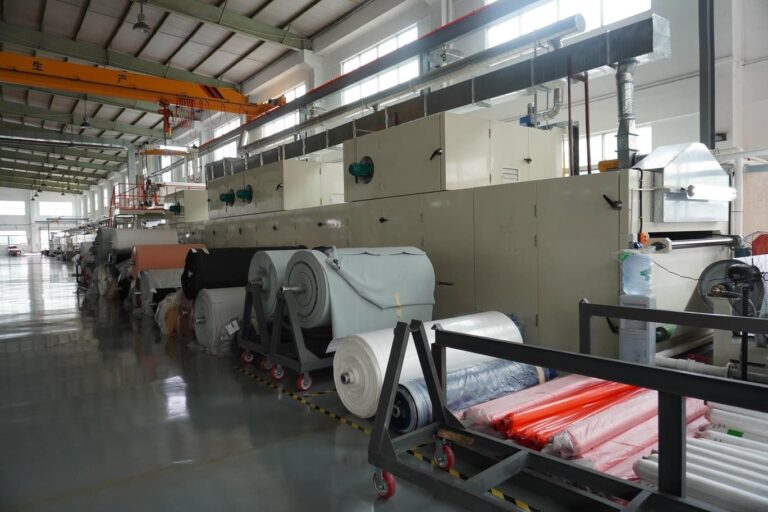
Factory production line — the scale that most US leather companies cannot match
Type 2: Goods Manufacturers. Companies like Horween Leather Co., Frank Clegg Leatherworks, and Shinola represent the pinnacle of American leather craftsmanship. However, these are finished-goods producers — they make wallets, belts, and bags, not rolled upholstery material at the volume B2B furniture, automotive, or healthcare OEMs require. A procurement team sourcing 50,000 meters of upholstery leather cannot buy from a company that makes 200 wallets per month. The leather goods manufacturing guide covers the scale gap between craft producers and industrial supply.
Type 3: Distributors and Importers. The Leather Goods and Luggage Manufacturing industry includes 5,161 businesses in the US — but the majority are distributors and importers, not manufacturers. They purchase finished synthetic leather from overseas factories, warehouse it domestically, and sell it with “US company” branding. The material is often PU or PVC leather with Martindale ratings of 25,000-40,000 cycles — far below commercial durability requirements. For a deeper analysis, see our 2026 leather industry trends report.
The Compliance Gap: Why “US Leather Company” No Longer Guarantees Safety
A US address does not equal US compliance. Procurement teams evaluating a US leather company must verify four compliance dimensions that traditional leather suppliers increasingly struggle to meet. The regulatory landscape has shifted dramatically — chrome tanning faces restrictions, VOC emissions are under scrutiny, and supply chain traceability mandates are tightening across all B2B sectors.
Chrome VI restrictions. The EU REACH regulation restricts chromium VI in tanning operations, and US regulatory bodies are following. The EPA regulates leather tanning and finishing under pretreatment standards, but enforcement varies by state. A US leather company using chrome tanning cannot guarantee chromium-free output — the conversion from Cr III to Cr VI can occur post-production under heat and UV exposure. California’s 2025 ban on new hexavalent chromium facilities is accelerating chrome-free adoption, but the majority of US tanneries still rely on chrome chemistry. For B2B buyers exporting to EU markets, this creates direct compliance risk. Our eco-friendly silicone leather overview details how solvent-free manufacturing eliminates this documentation gap.
VOC emissions. Conventional PU and PVC leather manufacturing uses solvent-based coating with 20-40% solvent content. Indoor air quality regulations under EN 717-1 (formaldehyde) and ISO 16000-6 (VOC) are tightening for automotive interiors, healthcare environments, and commercial furniture contracts. A US leather company distributing imported PU leather often lacks VOC test data for specific lots — making it impossible to certify compliance for sensitive applications like medical healthcare interiors.
Supply chain traceability. The EU Green Deal’s deforestation-free supply chain mandates require documentation from raw hide sourcing through finished goods. US leather companies that import finished material from overseas tanneries frequently cannot provide this traceability — creating compliance risk for B2B buyers exporting to EU markets. Silicone leather’s raw material is silicone polymer — a commodity chemical with no agricultural dependency and full traceability from refinery to finished roll.
US Leather Company vs. Silicone Leather: Performance Comparison
When procurement teams move past the “US leather company” label and compare actual material performance, silicone leather delivers measurable advantages across every dimension that matters to B2B specification. The comparison below uses standardized test data — not marketing claims — to show why procurement teams are shifting specifications:

Tensile strength testing — standardized performance data that separates material claims from material facts
| Supplier Type | Material | Martindale | UV (ASTM G154) | VOC / Chemical | Temp Range | Service Life |
|---|---|---|---|---|---|---|
| US Tannery (Chrome) | Genuine leather | 25,000-50,000 | Fades in 2-3 yrs | Cr VI risk; tanning chemicals | -10C to 60C | 5-8 years (with maintenance) |
| US Distributor (Imported PU) | PU coated fabric | 25,000-40,000 | Cracks in 1-2 yrs | Solvent-based; VOC present | -20C to 80C | 3-5 years |
| US Distributor (Imported PVC) | PVC coated fabric | 15,000-30,000 | Cracks in 1-2 yrs | Phthalates; plasticizer migration | -10C to 60C | 2-3 years |
| TOPSUN (Silicone) | Silicone polymer | 200,000+ | 1,000+ hrs (no change) | Zero VOC; REACH/RoHS/FDA | -40C to 250C | 10+ years (zero maintenance) |
The performance gap is not incremental — it is structural. Silicone leather’s Si-O polymer backbone is inherently UV-stable, hydrolysis-proof, and thermally resistant at a chemistry level that no tanning or coating process can replicate. TOPSUN manufactures silicone leather that passes REACH, RoHS, FDA 21 CFR 177.2600, and FMVSS 302 without chemical additives, addressing every compliance gap traditional US leather companies face. Learn more about our High Performance Collection engineered for hospitality, transport, and healthcare OEMs.
One of our US furniture OEM clients was sourcing chrome-tanned leather from a Midwest tannery at $18/ft². After California Proposition 65 compliance review, they discovered the material could not be specified for products shipped to California — home to 12% of their market. They switched to silicone leather at $28/ft² — a higher unit cost that eliminated compliance risk, reduced warranty claims to zero, and removed the 6-year replacement cycle from their P&L.
The Total Cost of Ownership Question
A US leather company quoting $18/ft² for chrome-tanned genuine leather appears cost-competitive against silicone leather at $25-35/ft². But the procurement calculation changes dramatically when total cost of ownership (TCO) replaces unit price. The TCO framework accounts for initial material cost, maintenance, replacement cycles, warranty claims, and compliance risk over the full specification period.
Genuine leather TCO: $18/ft² initial + $4-6/ft² annual maintenance (conditioning, cleaning, repair) + replacement at year 6-8 ($18/ft² + labor) = $52-70/ft² over 10 years. The maintenance alone — conditioning products, specialized cleaning, periodic re-tanning — adds 40-60% to the invoice price over the service life.
Imported PU leather TCO: $6/m initial + replacement at year 3-4 ($6/m + labor + logistics) + warranty claims = $18-24/m over 10 years. For procurement teams calculating the real cost of polyurethane leather fabric, the replacement multiplier erases the initial savings.
Silicone leather TCO: $25-35/ft² initial + $0 maintenance (water-cleanable, non-porous) + zero replacement over 10 years = $25-35/ft² over 10 years. No conditioning, no re-tanning, no coating degradation, no warranty claims. When B2B buyers evaluate a US leather company against this TCO framework, the question shifts from “who is the cheapest US leather supplier?” to “which material specification will survive the full contract term without replacement?” For contract furniture, automotive interiors, and healthcare upholstery where the specification period is 7-10 years, only silicone leather delivers a zero-replacement guarantee. Compare sourcing approaches in our B2B leather company sourcing guide.
Why TOPSUN Serves US B2B Buyers Better Than Traditional US Leather Companies
TOPSUN is not a US leather company — and that is precisely the advantage. As a specialized silicone leather manufacturer with 60,000+ m² production capacity across three facilities and 500,000+ meters monthly output, TOPSUN delivers what no US leather company can: engineered material consistency at industrial scale. Traditional US leather companies face three structural limitations that silicone leather eliminates:

Finished goods warehouse — 500,000+ meters monthly capacity that no single US tannery can match
1. Hide-to-hide variation. Every animal hide is unique — grain density, thickness, color absorption, and scar patterns vary within the same tannery batch. A B2B furniture OEM specifying 500 identical armchairs cannot guarantee visual consistency with genuine leather. Silicone leather delivers Delta E less than or equal to 1.0 color accuracy with 100% batch-to-batch consistency — every roll is identical. For brands that need Pantone-matched color customization, the consistency advantage eliminates the quality control burden that genuine leather imposes.
2. Supply volatility. Cattle hide availability correlates with global meat production cycles, creating unpredictable supply variations and 15-25% price swings. Water scarcity in tanning regions and livestock disease outbreaks further destabilize supply. Silicone leather’s raw material is silicone polymer — commodity chemical supply with stable pricing and no agricultural dependency. The leather hide market pricing analysis documents how hide price volatility disrupts long-term contract pricing.
3. Scalability limits. The US has fewer operating tanneries than at any point in its history. A procurement team needing 500,000 meters of upholstery material for a multi-year contract cannot find a single US leather company with that capacity. TOPSUN’s daily output of 16,000 meters and 7-15 day lead times solve this constraint — with free A4 swatch samples shipped worldwide via DHL/FedEx for evaluation. Request samples through our samples center.
The Procurement Decision Framework
For B2B buyers evaluating whether to source from a US leather company or specify silicone leather, the decision framework is straightforward. The key is matching material specification to application requirements — not to supplier geography.
Choose a US leather company if: Your application requires genuine animal hide for brand positioning (luxury automotive, premium residential furniture), your volume is under 5,000 meters, and you have maintenance protocols in place for conditioning and repair. Genuine leather remains the right choice for applications where tactile authenticity and brand heritage outweigh the maintenance cost and compliance risk.
Choose silicone leather if: Your application demands 200,000+ Martindale cycles (commercial furniture, healthcare, automotive interiors, hospitality), your specification period exceeds 5 years, you need REACH/RoHS/FDA compliance without chrome tanning risk, or your volume exceeds what any single US tannery can produce. Silicone leather is also the right choice when you need automotive interior materials that pass FMVSS 302 and VDA 277 without chemical additives.
Frequently Asked Questions
What should B2B buyers look for in a US leather company?
B2B buyers should verify four factors: whether the company operates its own tannery or imports finished hides, what tanning chemistry is used (chrome vs. chrome-free), compliance documentation for REACH and California Proposition 65, and Martindale abrasion data per ISO 12947-2. A US leather company that cannot provide ISO 12947-2 test results or REACH compliance certificates may be reselling imported material with limited traceability. The single most revealing question to ask: “Can you provide a lot-specific certificate of analysis for the material I’m purchasing?” If the answer is no, the company is likely a distributor, not a manufacturer.
Are US leather companies moving toward sustainable alternatives?
Approximately 25% of US leather manufacturers are investing in chrome recovery and eco-friendly tanning processes, but the majority still rely on chrome tanning at 78% market share. California’s 2025 ban on new hexavalent chromium facilities is accelerating chrome-free adoption. However, even chrome-free tanning still uses significant water, generates chemical waste, and depends on animal hide supply chains with traceability gaps. Silicone leather eliminates tanning chemistry entirely, offering zero VOC, zero heavy metals, and 100% recyclability without the compliance risk traditional US leather companies face. The sustainable leather alternatives guide compares all approaches on a like-for-like basis.
Beyond the “US Leather Company” Label
The US leather market is growing at 6.42% CAGR, but the companies within it are not converging on better material — they are converging on harder compliance. Chrome tanning faces regulatory pressure, imported PU and PVC face VOC and phthalate restrictions, and genuine leather faces supply volatility from agricultural dependency. The “US leather company” label tells procurement teams where a company is registered — not what material it makes, how it performs, or how long it lasts.
Silicone leather is not a US leather company product, but it is the material that US B2B procurement teams increasingly specify when performance, compliance, and total cost of ownership matter more than a domestic address. With 200,000+ Martindale cycles, zero VOC, -40C to 250C thermal tolerance, and 10+ year service life with zero maintenance, TOPSUN silicone leather outperforms every category of US leather company on the metrics that determine specification success. For US-based procurement teams, TOPSUN offers English-language technical support and compatibility with US regulatory frameworks including California Proposition 65, FMVSS 302, and EPA indoor air quality standards.
About TOPSUN
TOPSUN manufactures silicone leather that outperforms every category of US leather company — tanneries, goods manufacturers, and distributors — on Martindale abrasion, UV stability, VOC compliance, and 10-year total cost of ownership for B2B procurement teams in automotive, furniture, and healthcare sectors.
200,000+ Martindale cycles (ISO 12947-2) | Zero VOC (ISO 16000-6) | REACH/RoHS/FDA compliant | -40C to 250C thermal tolerance | Delta E less than or equal to 1.0 batch consistency | 500,000+ m monthly capacity | 7-15 day lead time | Free A4 swatches worldwide