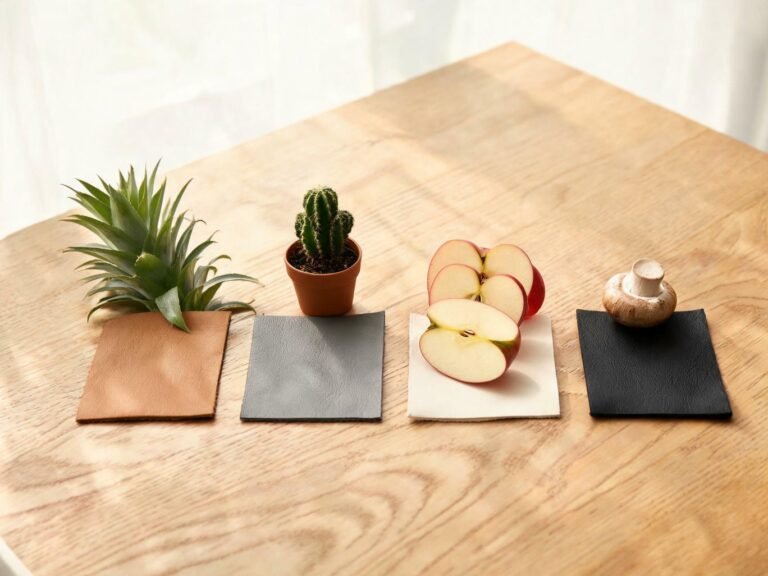
Every leather supplier now claims to be “sustainable.” The word appears on product pages, in pitch decks, and across B2B marketplace listings — often without a single piece of verifiable environmental data behind it. For procurement teams facing ESG mandates from corporate boards, carbon-reduction targets from retail clients, and increasingly strict chemical regulations from the EU and California, the question is no longer whether to source sustainable leather. It is how to distinguish genuinely sustainable material from a marketing label slapped onto a business-as-usual product.
This guide is built for B2B buyers who need to make defensible sourcing decisions. We map every category of sustainable leather, expose the three most common greenwashing claims, list the certifications that actually verify environmental performance, and explain why the most overlooked sustainability metric is the one your suppliers never mention: how long the material lasts before it ends up in a landfill.
By the numbers: 17,000 liters of water produce 1kg of chrome-tanned leather. Bio-leather search interest grew 3,800% in 24 months. Silicone leather lasts 10+ years versus PU’s 2–3 — meaning 4–5× less total material waste over a decade.
Request Sustainability Documentation
What Sustainable Leather Actually Means: The 5-Category Map
There is no single, universally accepted definition of “sustainable leather.” The term is an umbrella covering materials that reduce environmental impact across one or more dimensions: chemical use, water consumption, carbon emissions, animal welfare, biodegradability, or product longevity. The problem is that most suppliers optimize for one dimension while ignoring the others, then market the result as “sustainable” without context.
To make defensible sourcing decisions, B2B buyers need to understand that sustainable leather encompasses five structurally different material categories, each with distinct environmental trade-offs. Here is the map.
| Category | What It Is | Sustainability Advantage | Hidden Environmental Cost |
|---|---|---|---|
| Chrome-Tanned Genuine | Animal hide tanned with chromium(III) salts | Long lifespan (10–30 years); biodegradable | ~17,000L water per kg; chromium wastewater; methane from livestock |
| Vegetable-Tanned | Animal hide tanned with plant tannins | No chromium; biodegradable; natural process | Still requires animal farming; 40% longer tanning = more energy |
| Bio-Based | Mycelium, cactus, pineapple, apple | No animal farming; plant-based; some biodegradable | Limited durability (1–3 years); coating often still PU-based; not scalable |
| Water-Based PU | PU using water as solvent instead of DMF | Reduced VOC emissions vs. solvent-based PU | Still fossil-fuel derived; hydrolysis risk; 2–3 year lifespan |
| Silicone Leather | Silicone (Si-O-Si) coating on fabric substrate | No solvents; negligible VOC; 10+ year lifespan; no plasticizers; food-contact safe | Not biodegradable; higher initial material cost |
The critical insight: no single material wins on every dimension. Genuine leather excels at longevity but fails on water and chemical impact. Bio-based leather eliminates animal farming but cannot yet meet B2B durability requirements. Water-based PU reduces VOCs but still hydrolyzes and ends up in landfills within 3 years. Eco-friendly silicone leather eliminates solvents, plasticizers, and early replacement — but is not biodegradable. The sourcing decision depends on which dimensions matter most for your specific application, market, and ESG framework.

Finished silicone leather rolls ready for B2B shipping — solvent-free production, zero plasticizers
3 Greenwashing Claims That Sound Good but Mean Nothing
After reviewing hundreds of B2B leather supplier spec sheets, we have identified three sustainability claims that are technically true but practically meaningless. Train your procurement team to recognize them.
Myth 1: “Eco-friendly PU leather” — PU leather is a fossil-fuel-derived polyurethane coating. Calling it “eco-friendly” because it contains no animal products is like calling a plastic bag “eco-friendly” because it’s not made of cowhide. PU production requires diisocyanate chemicals, uses DMF solvent in conventional formulations, and the finished material hydrolyzes in 2–3 years — ending up in landfills far faster than genuine leather.
Myth 2: “Recycled leather” without specifying post-consumer vs. pre-consumer content — Most “recycled leather” is actually pre-consumer manufacturing waste bonded with PU adhesive. This is waste recovery, not recycling. The material still contains PU binder (fossil-fuel based) and has significantly lower durability. Ask for the percentage of post-consumer recycled content and the binder composition.
Myth 3: “Biodegradable leather” without specifying conditions and timeframe — A material that biodegrades in industrial composting at 60°C in 90 days will sit intact in a landfill for decades. Ask for the specific biodegradation standard (e.g., EN 13432, ASTM D5511) and the percentage of biodegradation within the test period.
Certifications That Verify Sustainable Leather Claims
Certifications are the audit layer that converts marketing claims into verifiable facts. But not all certifications measure the same things — many measure chemical safety without addressing environmental impact. Here is what B2B buyers need to know about the four certifications that genuinely matter for sustainable leather sourcing.
| Certification | What It Verifies | What It Does NOT Verify | Relevance |
|---|---|---|---|
| LWG | Tannery environmental audit: water, effluent, energy, chemical management | Only applies to genuine leather tanneries; not synthetic or silicone | Gold/Silver/Bronze measures resource efficiency — but base process still uses chromium |
| OEKO-TEX | Chemical safety: restricted substances, heavy metals, formaldehyde | Does not measure environmental impact of production; tests product, not process | Ensures finished product is safe for human contact — but a chemically safe product can still have terrible environmental footprint |
| REACH | EU regulation: registration, evaluation, authorization of chemicals. Bans SVHCs | Compliance is a legal minimum, not a sustainability achievement | Mandatory for EU market access. A baseline, not a differentiator. The European Chemicals Agency (ECHA) administers REACH regulation. |
| ISO 10993-5 | Medical-grade cytotoxicity — verifies material is non-toxic to living cells | Not an environmental certification per se, but demonstrates near-zero chemical toxicity | Materials passing ISO 10993-5 have such low chemical toxicity they’re approved for medical skin contact — the strongest indicator of chemical safety available |
For synthetic and silicone leather, the relevant certification stack is different from genuine leather. TOPSUN silicone leather carries REACH compliance, PAHs certification, FDA food-contact approval, RoHS compliance, and ISO 10993-5 biocompatibility — a combination that verifies both chemical safety and production-process environmental performance. See the full certification profile for silicone leather for details.

Silicone leather achieves full color range without solvent-based dyes or toxic pigments
Why Durability Is the Most Overlooked Sustainability Metric
The sustainability conversation in the leather industry focuses heavily on production inputs — water, chemicals, carbon, animal welfare. But the most environmentally destructive phase of any material’s lifecycle is disposal, and the fastest path to disposal is premature failure. A material that lasts 10 years has fundamentally lower environmental impact than one that lasts 2 years, even if the per-unit production footprint is identical, because the 2-year material must be produced, shipped, and landfilled 5 times to match the same service period.
| Material | Typical Lifespan | Replacements Over 10 Years | Cumulative Waste | Cumulative Footprint |
|---|---|---|---|---|
| Genuine Leather | 10–20 years | 0–1 | 1× material | 1× footprint |
| Solvent-Based PU | 2–3 years | 3–4 | 4–5× material | 4–5× footprint |
| Bio-Based (Cactus/Mycelium) | 1–3 years | 3–9 | 4–10× material | 2–5× footprint |
| Silicone Leather | 10+ years | 0 | 1× material | 1× footprint |
A bio-based leather that biodegrades in 90 days but needs replacement every 18 months generates 5–6× more total material waste and production footprint over a decade than a non-biodegradable silicone leather that lasts 10+ years. Durability is not the enemy of biodegradability — it is the prerequisite for real sustainability.
This is the argument that ESG officers and sustainability procurement teams need to internalize. The most sustainable material is often not the one with the lowest per-unit production footprint — it is the one that avoids production entirely by not needing replacement. TOPSUN silicone leather’s solvent-free production uses no DMF, no toluene, no MEK. The silicone coating is applied via a solvent-free process, reducing VOC emissions to negligible levels. With a Martindale abrasion resistance of 200,000+ cycles and a 10+ year service life, it eliminates 4–5 replacement cycles that PU or bio-based leather would require — reducing cumulative material waste and production footprint by 75–80%.

Full color silicone leather swatch rack — zero solvents, zero plasticizers, zero phthalates
Overview of TOPSUN silicone leather eco-certifications — REACH, ISO 10993-5, FDA, RoHS
6 Questions to Ask Your Sustainable Leather Supplier
When evaluating any leather supplier’s sustainability claims, send these six questions. The answers — or the inability to answer — will tell you everything you need to know.
- “Can you provide an LCA (Life Cycle Assessment) report covering cradle-to-grave environmental impact?” If the supplier has never conducted an LCA, their sustainability claims are unmeasured opinions, not verified data.
- “What is the specific VOC emission level of your production process (ISO 16000-6)?” “Low VOC” is meaningless without numbers. Silicone leather production has negligible VOC emissions because it uses no solvents. PU production typically emits 30–80 g/m² of VOCs.
- “What is the verified service lifespan of your material in the intended application?” The sustainability of a material that lasts 2 years is fundamentally different from one that lasts 10 years. Ask for Martindale abrasion data and hydrolysis test results.
- “Does your material contain plasticizers, phthalates, or PFAS chemicals?” With the EU PFAS restriction expected in 2027, any material containing these chemicals faces regulatory risk. Silicone leather contains none of them.
- “What is the biodegradation pathway of your material at end of life?” If the supplier claims biodegradability, ask for the specific standard (EN 13432, ASTM D5511) and the biodegradation percentage. If they cannot provide it, the claim is aspirational.
- “Can you provide third-party test reports from SGS, Intertek, or TÜV for every certification you claim?” Self-reported certifications are not certifications. Legitimate suppliers provide original test certificates from accredited laboratories.
Frequently Asked Questions
Is silicone leather really more sustainable than bio-based leather?
It depends on the metric. Bio-based leather has lower per-unit production footprint because it uses plant materials. However, current bio-based leathers have 1–3 year lifespans in commercial applications, meaning they require 3–5× more total material and production footprint over a 10-year period compared to silicone leather that lasts the full decade. The most sustainable material is the one that minimizes total lifecycle impact — including replacement frequency, not just per-unit production metrics.
Is silicone leather biodegradable?
No. Silicone is a synthetic polymer that does not biodegrade in landfill or marine environments. This is a genuine sustainability trade-off. However, silicone is non-toxic, does not leach chemicals into soil or water, and its 10+ year lifespan means far less total material enters the waste stream compared to PU that must be replaced 4–5 times. For applications where biodegradability is a hard requirement (single-use packaging), silicone leather is not the right choice. For durable goods, the replacement multiplier makes it the lower-waste option.
What certifications should I look for when sourcing sustainable leather?
For genuine leather: LWG (Gold minimum) for tannery environmental performance, plus OEKO-TEX LEATHER STANDARD for chemical safety. For synthetic/silicone leather: REACH compliance (baseline legal requirement), ISO 10993-5 biocompatibility (chemical safety), FDA food-contact approval, and RoHS. For production-process sustainability: request ISO 16000-6 VOC emission data and an LCA report. No single certification covers all sustainability dimensions — you need a combination.
Source Sustainable Leather With Confidence
Sustainable leather sourcing is not about choosing the material with the most appealing marketing label — it is about demanding verifiable data across multiple environmental dimensions and making procurement decisions based on lifecycle impact, not per-unit cost. The suppliers who can provide LCA reports, third-party test certificates, and honest answers about trade-offs are the ones worth partnering with. For a deeper look at how silicone leather performs across the full sustainability spectrum, see our silicone leather sustainability report and why silicone leather leads on eco-friendly fabrics.
About TOPSUN
TOPSUN manufactures silicone leather that addresses four sustainability dimensions simultaneously — a rare combination in the synthetic leather industry. The solvent-free production process uses no DMF, no toluene, no MEK, and zero plasticizers, while the Si-O-Si molecular backbone delivers 10+ year service life that eliminates 4–5 replacement cycles of waste, emissions, and resource consumption.
ISO 10993-5 biocompatible · REACH compliant · FDA food-contact approved · RoHS compliant · PAHs certified · ISO 16000-6 VOC tested (negligible)