If you’re sourcing leather in the UK, the landscape has shifted dramatically in the past five years. Brexit red tape, the rise of EU Deforestation-free Products Regulation (EUDR), a shrinking domestic tannery base, and the growth of alternative materials have all changed what’s available, what it costs, and how long it takes to get it.
This article is a straight-talking guide for procurement managers and sourcing teams working with — or considering working with — UK leather hide suppliers. We’ll walk through the five types of suppliers you’ll encounter, the real costs and lead times in 2026, the regulatory hurdles that keep procurement teams up at night, and where the market is heading. No marketing fluff. Just the facts you need to make sourcing decisions.
Read Our Quality Leather Sourcing Guide
5 Types of Leather Hide Suppliers in the UK
The UK leather supply chain is more diverse than most buyers realize. You’re not just choosing between “British leather” and “imported leather” — you’re choosing between different supplier types with very different capabilities, pricing, and minimum order quantities.
| Supplier Type | What They Do | MOQ | Best For |
|---|---|---|---|
| UK Tanneries (Direct) | Treat raw hides into finished leather domestically | High (500+ hides) | Large volume, UK-made requirement |
| Wholesale / Stock Suppliers | Hold stock of imported and UK leather; sell by the hide or sq ft | Low (1–10 hides) | Small brands, prototyping, quick turnaround |
| Hide & Skin Merchants | Trade raw salted hides and wet-blue (untanned) leather | Very high (container loads) | Tanneries, large-scale manufacturers |
| Bespoke / Micro-Tanneries | Small-batch tanning, often specialty or vegetable-tanned | Low-medium (10–100 hides) | Premium brands, heritage positioning |
| Import Agents / Brokers | Source leather from Italian, Spanish, or Asian tanneries; handle logistics | Medium-high (100+ hides) | Mid-to-large volume, cost-focused |
The most important thing to understand: the UK has very few production-scale tanneries left. Most of the “UK leather suppliers” you’ll find online are wholesalers or importers — they don’t actually tan the leather in the UK. If “Made in UK” or “British leather” is part of your brand story, verify where the tanning actually happens. “Sourced in the UK” and “tanned in the UK” are very different claims.

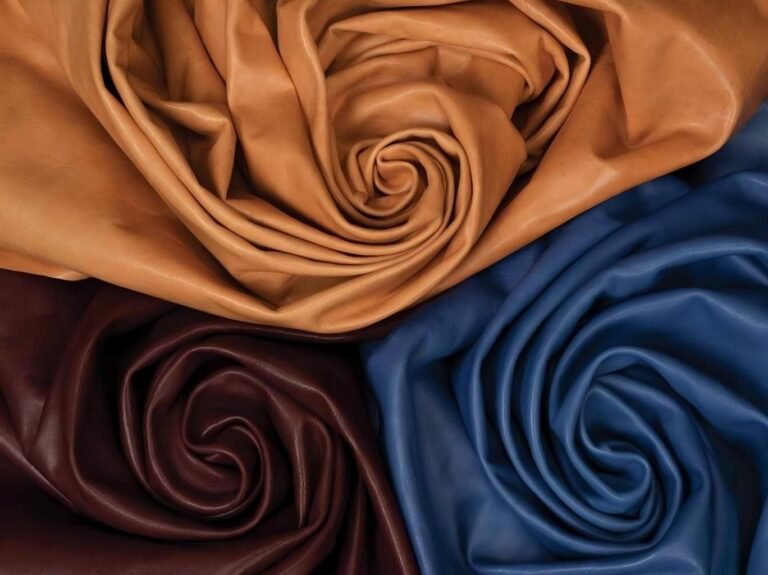
Leather swatch selection — UK suppliers range from small micro-tanneries to large wholesale distributors with imported stock.
Procurement tip: Always ask “where is this leather tanned?” — not just “where are you based?” A UK address doesn’t mean UK-tanned leather.
The Real Cost of UK-Sourced Leather in 2026
If you’re comparing UK suppliers to international ones, make sure you’re comparing total landed cost, not just per-hide price. The headline price from a UK supplier might look higher, but when you factor in shipping, duties, customs clearance, and risk, the gap often narrows.
Here’s what the cost structure looks like for a typical mid-grade top-grain cowhide:
- UK-tanned leather: £35–£65 per hide (£2.50–£5.00 per sq ft) depending on grade and finish. Lead time: 4–8 weeks for stocked items, 10–16 weeks for custom tanning. No import duties, no customs clearance, no shipping from overseas.
- Italian leather (imported to UK): €40–€80 per hide (£34–£68) plus 4–8% import duty (depending on type), VAT, and shipping. Total landed cost: £45–£85 per hide. Lead time: 6–10 weeks for sea freight, 2–3 weeks for air freight (at a premium).
- Asian leather (China/India imported): $15–$40 per hide (£12–£32) plus 4–8% duty, VAT, and shipping. Total landed cost: £20–£50 per hide. Lead time: 8–14 weeks for sea freight. Quality varies enormously — vetting suppliers is essential.
The post-Brexit cost picture is mixed. For UK buyers sourcing from the EU, customs paperwork and potential delays add cost and complexity — but the actual tariff rates on most leather types are zero or low (thanks to the TCA agreement). The bigger issue is time and administrative burden: a shipment that used to take 3 days from Italy now takes 7–10 days and requires additional documentation.
For more on supplier evaluation and cost comparison, our fabric supplier audit checklist covers the full evaluation framework.

Large-scale leather production — UK tannery capacity has declined significantly, with most bulk production now in Italy, Spain, and Asia.
Regulatory Hurdles: EUDR, REACH, and Post-Brexit Compliance
The regulatory environment for leather sourcing has gotten significantly more complex — and this is where many UK buyers are getting caught out. Three regulatory regimes matter most.
EU Deforestation-free Products Regulation (EUDR)
The EUDR, which came into full effect in late 2025, requires companies selling leather (and other agricultural commodities) into the EU market to prove that the leather is not linked to deforestation. For UK suppliers exporting to the EU — which is most of them — this means traceability documentation all the way back to the farm or ranch where the cattle were raised. Hides from Brazil, Paraguay, and other high-deforestation-risk countries are particularly problematic. If your supplier can’t provide due diligence documentation, you could face fines and be barred from the EU market.
UK REACH
After Brexit, the UK established its own REACH framework (UK REACH) separate from EU REACH. This means leather imported into the UK needs to comply with UK REACH chemical restrictions — which aren’t always identical to EU REACH. For now, the lists are broadly aligned, but they’re diverging over time. If you’re sourcing leather from the EU for sale in the UK (or vice versa), you need to check compliance with both regimes. Chromium VI, formaldehyde, and certain azo dyes are the key restricted substances to watch in leather.
Post-Brexit Customs and Rules of Origin
While the UK-EU Trade and Cooperation Agreement (TCA) eliminated most tariffs on leather goods, the rules of origin requirements mean you can’t just ship leather from a non-EU country through the EU to the UK and claim zero duty. The leather has to actually originate in the EU (or UK) to qualify for preferential treatment. If you’re working with UK suppliers who import raw hides from outside the EU and then tan them in the UK, make sure they can provide the correct origin documentation — otherwise you could be hit with unexpected duties.
Understand Leather Certification Requirements

Factory quality inspection — verifying suppliers’ compliance documentation is essential in the post-Brexit, post-EUDR landscape.
Export and certification overview — what you need for UK and EU market access with compliant leather materials.
The Alternative: Synthetic and Silicone Leather Suppliers
An increasing number of UK brands and manufacturers are adding synthetic and silicone leather options to their product lines — not just for vegan positioning, but for practical sourcing reasons as well. Here’s why:
- EUDR doesn’t apply — Since synthetic materials aren’t agricultural commodities, they fall outside the scope of the EU Deforestation Regulation. No farm-level traceability required. For brands selling into the EU, this removes a huge compliance burden.
- Consistent supply and pricing — Leather hide prices and availability fluctuate with livestock cycles, weather, and global demand. Synthetic materials are manufactured, so supply is predictable and pricing is stable. For procurement planning, this is a big advantage.
- Performance advantages — Silicone leather, in particular, offers stain resistance, UV stability, and easy cleaning that genuine leather can’t match. For contract furniture, automotive interiors, and public seating, these performance advantages often drive the specification, not the price.
- Lower minimum order quantities — Many synthetic leather suppliers offer MOQs of just a few hundred meters, compared to several hundred hides for genuine leather tanning. This makes it easier for small brands and new product launches.
This isn’t to say synthetic leather is “better” than genuine leather — they’re different materials for different applications. But if you’re a UK-based buyer struggling with genuine leather supply chain complexity, cost volatility, or compliance requirements, it’s worth evaluating whether silicone leather can meet your needs. For a detailed comparison, see our synthetic leather vs PU leather breakdown.
Market shift: UK furniture and automotive manufacturers increasingly dual-source — genuine leather for premium lines, silicone leather for performance lines. This hedges against supply chain risk while serving both customer segments.
Frequently Asked Questions
Are there still tanneries operating in the UK?
Yes, but far fewer than there used to be. The UK leather industry has been contracting for decades, and there are now only a handful of production-scale tanneries left — mostly specializing in high-end or niche products (vegetable-tanned leather, sheepskin, exotic leathers). There are also a growing number of micro-tanneries serving the craft and premium fashion markets. For large-volume production (furniture, automotive, mass-market fashion), most UK buyers source from Italian, Spanish, or Asian tanneries, either directly or through UK-based importers and wholesalers.
What does LWG certification mean for leather suppliers?
LWG (Leather Working Group) certification is the most widely recognized environmental certification for leather manufacturers. It audits tanneries on water use, energy consumption, chemical management, waste disposal, and traceability. There are three grades: Bronze, Silver, and Gold. If sustainability is important to your brand or your customers, look for LWG-certified suppliers — it’s the closest thing the leather industry has to a standard for environmental performance. Note that LWG certifies tanneries, not traders or wholesalers, so you need to verify which specific tannery your leather comes from.
Navigating UK Leather Sourcing in 2026
Sourcing leather hide suppliers in the UK is more complicated than it used to be. The domestic tannery base is smaller. The regulatory environment — EUDR, UK REACH, post-Brexit customs — adds layers of complexity and risk. And pricing and availability are less predictable than they were five years ago.
But there are also opportunities. UK-based wholesalers and importers offer access to global supply with local service and support. Specialty UK tanneries produce some of the finest leather in the world for premium and heritage brands. And the growing availability of high-performance silicone leather gives buyers a viable alternative that sidesteps many of the supply chain and compliance challenges of genuine leather.
The key is to know what you’re actually buying, who you’re actually buying from, and what the total landed cost and risk are — not just the per-hide price.
Discuss UK Sourcing Alternatives with Our Team
About TOPSUN
TOPSUN supplies silicone leather to UK furniture, automotive, and fashion brands seeking a reliable, compliant alternative to genuine leather — with REACH-certified formulations, stable pricing, and consistent batch quality.
We ship to UK customers from our international logistics center, provide full SDS and compliance documentation, and offer sample evaluation kits with no minimum order for initial testing.