$299.9 billion. That is what the global leather goods market is expected to absorb in 2026. Grand View Research puts the 2025 base at $282.1 billion. Marketing budgets scale with markets like that. Every supplier page, trade-show banner, and datasheet cover is competing for a slice.
Here’s the thing: leather marketing was never built for procurement teams. It was built for consumers. The same words carry different weight at each desk. Vegan, premium, scratch-resistant, eco-friendly: each means something different in a buying decision than on a product page. A consumer forgives a vague claim. A buyer signs a contract on it.
This article prices that gap. We break the four claim families that dominate leather goods marketing. Each is matched to the evidence that verifies it, and to what its failure costs a B2B buyer over five years.
| Claim Family | What the Copy Promises | Evidence That Verifies It | Typical Gap |
|---|---|---|---|
| Sustainability (“vegan”, “eco-friendly”) | Ethical cover, regulatory safety | Named polymer; substantiation per FTC Green Guides | A nickname is not a composition |
| Heritage (“genuine leather”, “Italian tannery”) | Resale value, brand story | Species and tannery declaration, LWG certificate number | “Genuine” hides both grade and species |
| Performance (“scratch-resistant”, “10-year life”) | Fewer warranty claims | Test number plus method standard, e.g. ISO 12947-2 cycles | Adjectives arrive without test reports |
| Price (“lowest $/meter”) | Margin protection this quarter | Replacement rate, cost per service-year | The cheapest quote often wins twice, then loses |
The $299.9 Billion Question Behind Leather Marketing
Growth money tells you where claims will multiply. Grand View Research puts genuine leather at 52.7% of 2025 revenue. Footwear takes 37.3%, and Asia Pacific holds 36.6% of the market. The named demand drivers are premium fashion accessories and luxury branding. Translation for buyers: the industry’s marketing spend chases perceived premium, not measured performance.
That asymmetry is the root of the verification problem. A faux leather manufacturer selling into this market learns one thing fast. A polished page is cheaper to produce than a test report. So the claim density grows faster than the evidence density. In our market tracking, spec sheets improved year over year. The share naming a test method did not move at the same pace.
There is a second, quieter growth story. Alternative surfaces are the fastest-moving claim territory. Every new label arrives as a fresh marketing term before it settles into any agreed definition.

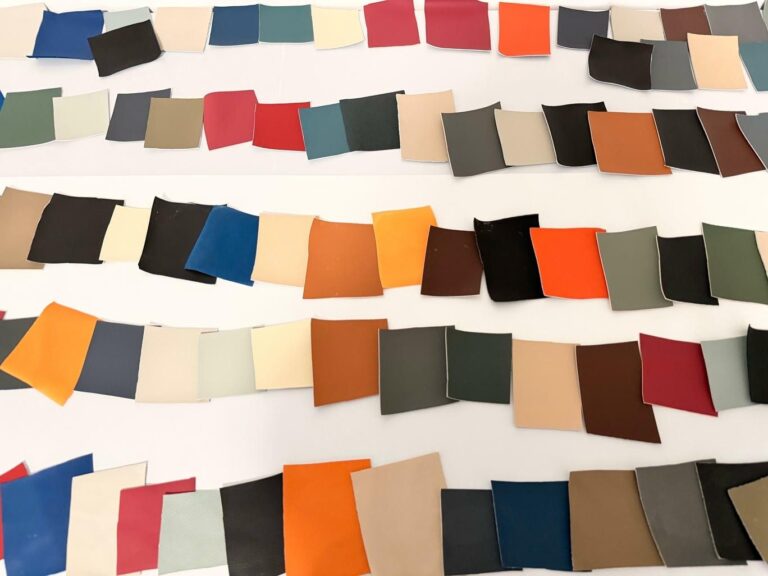
A swatch wall sells color stories. Your RFQ should ask what is under the color.
Watch: where silicone leather demand is growing, and which claims the market actually rewards.
Sustainability Claims: Where Leather Marketing Meets the FTC
Sustainable leather marketing is the fastest-growing claim family and the least regulated in practice. The FTC’s Green Guides (16 CFR Part 260) are plain on the standard. It is deceptive to claim, directly or by implication, that a product offers a general environmental benefit. Qualifications must be clear, prominent, and understandable. What the Guides do not do is stop the claim at the point of sale. They create exposure, not a firewall.
The labeling layer is even looser. As one fashion-marketing compliance guide puts it, “vegan leather” is a shopper nickname, not a fiber. If the upper is polyurethane, the defensible print line is “vegan PU.” A plant oil in the coating does not mint cactus or apple leather. The mill sheet names the class. A brochure says “plant-based.” The buyer hears “renewable content.” That is a claim the paperwork may not support.

Every swatch family on this rack ships with the same question: which claim does the datasheet actually substantiate?
In our own compliance work, we stopped writing “eco-friendly” as a bare adjective years ago. Every environmental claim we make now points to a numbered report. VOC emissions measure non-detect to ISO 16000-6. REACH registration sits under EC 1907/2006. The formulation is phthalate-free. Want to see how that package is structured? Our page on eco-friendly silicone leather certifications lists the tests behind each claim.
Performance Claims: Turning Marketing Adjectives Into Test Numbers
Performance copy is the easiest family to audit, which is why it is the most neglected. Every adjective in a leather marketing line has a test-method twin. The conversion is mechanical:
- “Scratch-resistant” → Martindale cycles, ISO 12947-2. Ours: ≥ 200,000.
- “Flexible” → flexing resistance, ISO 5402. Ours: ≥ 100,000 cycles.
- “Fade-proof” → light fastness, ISO 105-B06. Ours: Class 4.5.
- “Weatherproof” → UV aging, ASTM G154. Ours: 1,500+ hours without cracking.
A supplier who will not name the method is telling you the number does not exist. We have watched RFQs flip this dynamic. Write that spec line into an RFQ: “80,000 Martindale cycles per ISO 12947-2, report attached.” The field of “compliant” bidders shrinks to the ones who actually test. To see where the two coating chemistries separate on these numbers, read our silicone vs PU leather comparison.

“Flame-retardant” means nothing until it means FMVSS 302 or FAR 25.853 with a lab report behind it.
What Unverified Claims Cost: Rebuilding the Five-Year Numbers
Now put a price on buying the copy instead of the evidence. One of our clients, a direct-to-consumer fashion label, launched a “vegan leather” backpack line. It was sourced on price and a polished materials page. Year one looked fine: margins held, the label performed on the product page. By month eighteen, coating peel at the strap anchors pushed returns to double digits. The replacement run cost more than the original savings.
The post-mortem was not exotic. The datasheet said “premium vegan leather.” It named no polymer, no abrasion cycles, no flexing standard. The marketing had been bought at full price; the material had never been specified. B2B leather marketing rewards the claim that sounds decisive and costs nothing to print. Verification is the only counterweight, and it is cheap next to a recall.

The unboxing moment is where marketing claims get audited. The end customer audits at return-counter speed.
Run the same line item two ways and the math is blunt. A verified silicone leather roll costs more per meter than an unverified PU roll. Spread over five years of service, the peel-and-replace cycle flips the ranking. Add returns processing and brand damage, and it flips harder. Claims are free. Their failure mode is not.
The arithmetic is simple enough that any buyer can run it. What separates winning programs is doing it before award, not after the first return batch. That single process change turns leather marketing from a tax into a filter.
Judge Leather Marketing by Evidence, Not Polish
The market will keep growing, and leather marketing will keep getting slicker. Your procurement process is the one place where polish can be discounted and evidence can be priced. Use this table as the gate:
| If the Claim Is | Demand This Evidence | Red Flag That Ends the Bid |
|---|---|---|
| “Vegan” or “eco-friendly” | Named polymer + substantiation mapped to Green Guides logic | Nickname only; plant imagery with no mill sheet |
| “Scratch-resistant” or “long-lasting” | Cycle count + method standard + dated lab report | Adjective with no number, or a number with no method |
| “Lowest price per meter” | Five-year replacement estimate folded into the bid | Quote that dies at the first abrasion question |
Every claim family in modern leather marketing has a verification artifact. Your job is not to disbelieve the marketing. Make every claim pay its way into the contract: a test number, a certificate, or a named polymer.
About TOPSUN
TOPSUN publishes third-party test numbers behind every silicone leather claim, from abrasion cycles to VOC reports, for furniture, automotive, and baby-goods programs.
Three production bases with 6 million meters of annual capacity · ≥ 200,000 Martindale cycles verified to ISO 12947-2 · non-detect VOC emissions per ISO 16000-6 · OEM color and grain development.
Does the FTC Green Guides carry legal force, or is it just advice?
The Guides are interpretive, not a rule with penalties of their own. But the FTC enforces deceptive-claim cases under Section 5 of its Act. The Guides define how it reads environmental claims. An unsubstantiated “eco-friendly” on a US-market product is a live enforcement risk, not a suggestion.
Can a supplier’s marketing budget be used as a proxy for reliability?
No, and it is a negative signal in our experience. Page polish and test discipline are separate budgets. Compare suppliers by proof layers: certificate numbers, dated reports, shipment records. Not by design quality. A modest site with named test methods beats a glossy one with adjectives.
What is the minimum verification before awarding a leather contract?
Ask for three artifacts. First, a named composition or species declaration. Second, one performance report per critical claim, with method standard and date. Third, a sample run on your own line. Anything less is buying the marketing.
References
1. https://www.grandviewresearch.com/industry-anal… — global leather goods market at $299.9B (2026) projected to $538.2B by 2033, 8.7% CAGR; genuine leather 52.7% share (2025)
2. https://www.ecfr.gov/current/title-16/chapter-I… — FTC Green Guides, 16 CFR Part 260: unsubstantiated general environmental benefit claims are deceptive
3. https://www.fisagency.com/intelligence/guides/v… — “vegan leather” is a shopper nickname, not a fiber; PU uppers require “vegan PU” labeling ([2026])