“Green leather material” carries two meanings in B2B procurement, and both are surging simultaneously. The first is literal — green-colored leather for furniture, automotive, and fashion applications. The second is environmental — leather material that’s genuinely sustainable, with certifications and lifecycle data to prove it. The overlap creates a sourcing challenge: a material can be green in color without being green in chemistry, and vice versa.
For procurement teams navigating ESG mandates, LEED certification requirements, and growing consumer demand for transparent material sourcing, understanding both dimensions of “green leather material” is essential. This guide covers the environmental claims, the certification landscape, and which synthetic leather chemistries actually deliver on both meanings.

Greenwashing in Synthetic Leather: What Claims Actually Mean
The synthetic leather industry has a greenwashing problem. Here’s what common environmental claims actually translate to in material chemistry:
| Claim | What It Usually Means | What It Doesn’t Tell You | Verification |
|---|---|---|---|
| “Eco-friendly” | Marketing term — no standard definition | Nothing measurable. May still contain PVC, phthalates, DMF | None — unverifiable |
| “Vegan leather” | No animal products used | Says nothing about environmental impact. PVC is “vegan” but environmentally toxic | Check material composition |
| “Water-based PU” | No DMF solvent in coating process | Still polyurethane — still hydrolyzes, still non-recyclable, still has service life issues | REACH SVHC report |
| “Bio-based” | Contains some plant-derived polymers | Percentage varies (10-70%). May still use PU binder. Biodegradability often conditional | Bio-based content certification (ASTM D6866) |
| “Recyclable” | Can theoretically be reprocessed | PU and PVC recyclability is limited to downcycling. Most ends up in landfill | Check actual recycling pathway |
| “Zero VOC” | No volatile organic compounds emitted during use | Only achievable with silicone chemistry — PU and PVC always emit some VOCs | ISO 16000-6 / VDA 277 test report |

The key takeaway: “eco-friendly” and “vegan” are not environmental certifications. They’re marketing claims. Real environmental performance is verified through test reports — ISO 16000-6 for VOC emissions, REACH for chemical compliance, and actual recycling pathway documentation. See most environmentally friendly fabrics and natural leather sustainability gaps.
Silicone Leather: Green in Both Senses
TOPSUN’s silicone leather is one of the few synthetic leather materials that delivers on both meanings of “green”:

Environmental Green
- Zero VOC emissions: Solvent-free dry coating process — no DMF, no solvents, verified by ISO 16000-6 and VDA 277 testing. See eco-friendly silicone leather.
- 100% recyclable: Silicone can be reprocessed into silicone oil or repolymerized — a true circular pathway, not downcycling. Supports circular economy models.
- PVC-free, phthalate-free, BPA-free: No restricted substances. REACH compliant with no SVHCs.
- Formaldehyde-free: EU E1 compliant for indoor air quality.
- LEED compatible and EU Ecolabel compatible: Contributes to green building certification credits.
- Solvent-free production: The dry coating process uses no water and no solvents — minimal manufacturing environmental footprint.
Color Green
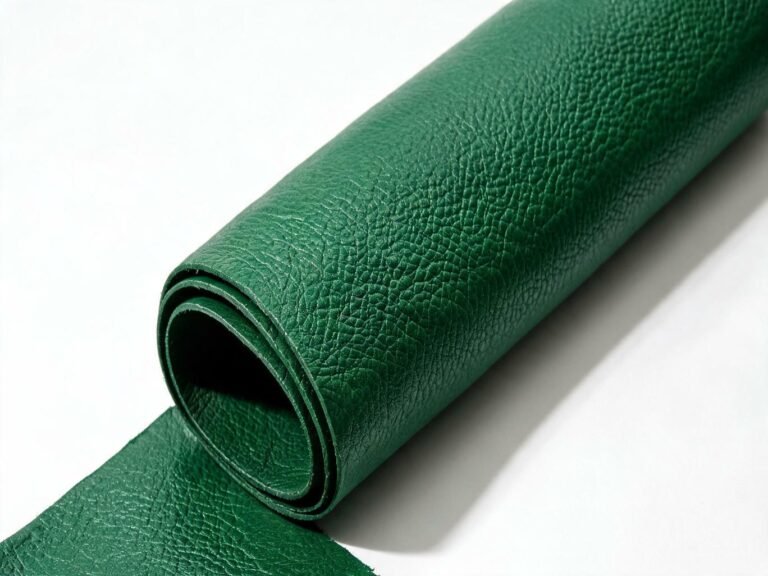
- Unlimited green shades: Pantone and RAL matching with Delta E ≤ 1.0 — from sage green to forest green to emerald.
- UV-stable green pigment: Green pigments in silicone don’t fade — 1,000+ hour UV resistance with no color shift, unlike green PU which fades fastest among common colors.
- Batch consistency: Spectrophotometer-controlled color formulation ensures every roll matches — critical for multi-unit projects where color variation is visible.
The Compliance Stack: What to Request from Your Supplier
For B2B buyers verifying “green” claims, request these specific documents:
- REACH compliance report — confirming no SVHCs above 0.1% w/w. TOPSUN: fully compliant.
- ISO 16000-6 / VDA 277 VOC test — actual emission data, not “low VOC” marketing. TOPSUN: zero/near-zero.
- FDA 21 CFR 177.2600 — food contact compliance. TOPSUN: compliant.
- RoHS — heavy metals not detected. TOPSUN: compliant.
- EU E1 / EN 717-1 — formaldehyde emission. TOPSUN: compliant (formaldehyde-free).
- Recycling pathway documentation — actual process, not aspirational. TOPSUN: silicone is 100% recyclable.
If a supplier cannot produce these documents, their “green” claim is marketing, not material science. For a deeper comparison, see eco leather guide and sustainable fabric material guide.
About TOPSUN
TOPSUN manufactures green leather material — in both senses — using a solvent-free dry coating process that produces platinum-cured silicone leather with zero VOC emissions, 100% recyclability, and no PVC, phthalates, BPA, or formaldehyde. The material is REACH compliant, FDA food-contact certified, ISO 10993-5 biocompatibility tested, LEED compatible, and EU Ecolabel compatible. With three production bases in Dongguan, Yichang, and Xiangyang, China, TOPSUN offers unlimited green color options via Pantone/RAL matching at Delta E ≤ 1.0, 500,000+ meters monthly capacity, 500-meter MOQ, and 7-day sampling. UV resistance of 1,000+ hours ensures green pigments stay true for the material’s 10+ year service life.
See why TOPSUN silicone leather is zero-VOC — no solvents, no plasticizers, safe for indoor air quality
Green Leather Material: FAQ
Is silicone leather really more environmentally friendly than bio-based leather?
It depends on which environmental dimension you prioritize. Bio-based leather (cactus, apple, mycelium) uses renewable raw materials, but most still use a PU or bio-polymer binder that hydrolyzes and isn’t recyclable — service life is typically 2-4 years with limited lifecycle data. Silicone leather uses non-renewable silica feedstock (sand-derived), but it’s 100% recyclable, lasts 10+ years, emits zero VOCs, and has a proven recycling pathway. On a lifecycle basis — emissions per year of service — silicone outperforms because one replacement cycle equals 2-5 PU/bio cycles. See biodegradable leather alternatives and carbon neutral leather.
Does green-colored silicone leather fade like green PU leather?
No. Green is actually one of the faster-fading colors in PU leather because the yellow component in green pigment breaks down under UV, causing a shift toward blue-gray. In silicone leather, the Si-O backbone is transparent to UV — UV passes through without degrading the polymer or the pigment. ISO 105-B06 testing confirms Grade 4-5 color fastness (no visible change) after 1,000+ hours of UV exposure for all green shades. This makes green silicone leather suitable for sun-exposed applications — outdoor furniture, automotive interiors, south-facing windows — where green PU would fade within 12-18 months. See sustainable leather guide.
Source Green Leather That’s Actually Green
Get green silicone leather samples with full compliance documentation, or discuss your ESG material requirements.
Related: Algae leather fabric gaps | Plant-based leather sustainable materials | Silicone leather sustainability report