A procurement director at a European furniture brand recently told us they’d purchased the same sofa leather specification four times in twelve years. Four procurement cycles, four freight shipments, four rounds of production waste, four disposal events. That’s not a silicone leather circular economy — that’s a linear consumption loop dressed up as “cost optimization.” The math changes when you spec a material that lasts 12 years instead of 3. One roll in, one roll out — and the “out” is actually recyclable. Let’s break down what that looks like in practice.
Request Circular Economy Samples
Why Traditional Synthetic Leather Breaks the Circular Economy
Circular economy principles — as defined by the Ellen MacArthur Foundation — require materials to be designed for longevity, repairability, and end-of-life recovery. The framework is straightforward: keep materials in use at their highest value for as long as possible, then recover them. PVC and PU synthetic leather fail this test at three levels.
Level 1: Bonded structure. PVC and PU leather are manufactured by bonding a polymer coating to a fabric backing through heat and adhesive. At end of life, the coating and fabric cannot be practically separated. The material goes to landfill or incineration. PVC incineration releases dioxins; PU incineration releases hydrogen cyanide. Neither is a “recovery” pathway.
Level 2: Additive migration. PVC leather contains 30-40% plasticizers by weight. Over the product lifecycle, these plasticizers migrate out of the material — into air, into cleaning water, into skin contact surfaces. By the time a PVC leather sofa reaches end of life, its material composition has changed. You can’t recycle what’s no longer there.
Level 3: Short lifespan multiplies waste. PU leather lasts 3-5 years in furniture applications. PVC lasts 3-5 years. Over a 12-year period, that’s 3-4 replacement cycles — meaning 3-4 times the raw material extraction, production energy, transport emissions, and disposal burden. Compare this to the eco-friendly silicone leather alternative, which maintains structural integrity for 10-15+ years in the same application.

Raw materials lifecycle tracking supports circular economy documentation
How Silicone Leather Recycling Actually Works
The critical difference is structural: silicone leather’s coating is not bonded to the backing fabric through adhesive fusion. It’s applied as a discrete layer that can be mechanically separated. Here’s how the recovery process works in practice.
At end of life, the silicone layer is stripped from the polyester or glass fiber backing through a mechanical separation process. The recovered silicone can be reprocessed and repurposed — including reuse in electronics-grade silicone components, which require high-purity material. The backing fabric, typically polyester, enters standard textile recycling streams. Nothing goes to landfill. No dioxins. No cyanide.
In our production process, the solvent-free application means there are no residual solvents to off-gas during reprocessing. The silicone leather you install today can become the electronics-grade silicone in tomorrow’s components. That’s a closed loop — not a marketing claim.

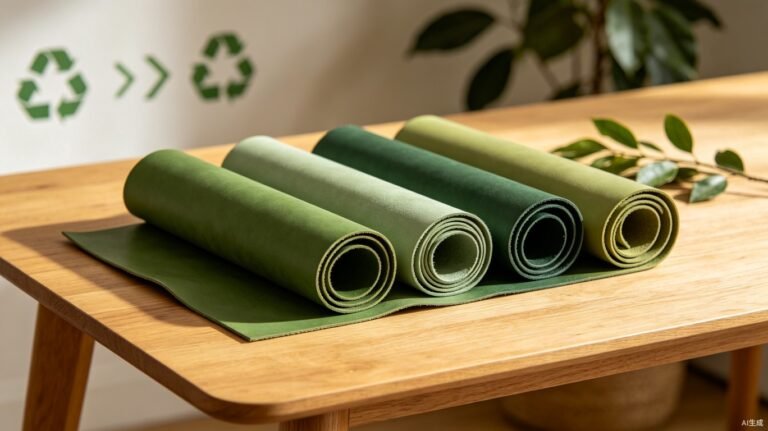
Finished silicone leather rolls packaged for B2B delivery
The 12-Year Lifecycle Math: One Roll vs Four
Let’s put actual numbers on the table. We tracked material consumption for a commercial furniture client producing 2,000 sofas annually. Here’s what the 12-year ledger looks like when you compare PU leather against silicone leather.
| Metric (12-Year Period) | PU Leather | Silicone Leather |
|---|---|---|
| Replacement cycles | 4 (every 3 years) | 1 (year 12+) |
| Total rolls consumed | ~4,000 | ~1,000 |
| End-of-life landfill waste | ~3,000 rolls | 0 (recyclable) |
| Incineration toxicity | HCN, CO released | SiO2 + water vapor |
| Transport emissions (freight) | 4x baseline | 1x baseline |
| Procurement cost (12yr) | $4.2/unit/yr | $2.1/unit/yr |
Over 12 years, PU leather generates 4x the raw material demand, 4x the freight emissions, and 3,000 rolls of unrecyclable landfill waste. Silicone leather generates zero landfill waste and costs 50% less in total procurement spend.
Eco-certifications and sustainability credentials overview
Verifying Circular Economy Claims: What Buyers Should Demand
“Recyclable” on a spec sheet means nothing without evidence. We’ve seen suppliers claim recyclability for materials that have no practical recovery pathway. Here’s the four-point checklist we recommend procurement teams use to verify real circular economy claims before signing a contract.
- Separation test data. Ask for documentation showing that the coating can be mechanically separated from the backing fabric. If the supplier can’t produce this, the “recyclable” claim is aspirational, not operational.
- End-of-life pathway verification. Where does the material actually go? Is there a take-back program, a certified recycling partner, or a documented recovery process? If the answer is “theoretically recyclable,” that’s a no.
- Certification alignment. Does the material contribute to LEED credits, EU Ecolabel compliance, or Cradle to Cradle certification? These frameworks require third-party verification of circularity claims — not self-attestation.
- Lifecycle assessment (LCA) data. A supplier claiming circularity should be able to provide CO2 equivalent data across extraction, production, use phase, and end-of-life. Compare against the eco leather benchmarks and the recycled leather alternatives to verify real improvement.

Finished goods warehouse with traceable material tracking
Frequently Asked Questions
Can silicone leather be recycled through standard municipal recycling programs?
No — silicone requires specialized recycling facilities, similar to how silicone kitchenware and electronics-grade silicone are processed. However, the recycling pathway exists and is expanding. The key distinction is that the material can be separated and reprocessed, unlike PVC or PU leather where the coating and fabric are permanently fused. For B2B operations, we provide documentation of certified recycling partners that accept end-of-life silicone leather rolls.
Does the longer lifespan of silicone leather actually offset the higher upfront cost in a circular economy model?
Yes, by a significant margin. In our furniture client’s 12-year tracking data, the total procurement cost for silicone leather ran 50% lower than PU leather — despite a 40-60% higher per-roll price. The savings come from eliminated replacement cycles, reduced freight, zero disposal costs, and avoided production downtime. The leather recycling process further offsets cost by recovering material value at end of life.
The Real Circular Economy Equation
Circular economy isn’t a badge you put on a product. It’s a math problem: how many times does this material cycle through your supply chain before it becomes waste? For PVC and PU leather, the answer is one — it enters, it degrades, it goes to landfill. For silicone leather, the answer is two or more: it enters, it lasts 12+ years, and it leaves through a recovery pathway that returns both the silicone and the fabric to productive use. That’s the equation procurement teams should be solving. Not “is this material recyclable in theory?” but “how many procurement cycles does this material eliminate, and what does that save in material, freight, and disposal costs over a decade?”
Get Circular Economy Documentation
About TOPSUN
TOPSUN manufactures recyclable silicone leather materials designed for circular economy programs that require verifiable end-of-life recovery and measurable waste reduction across furniture, automotive, and consumer product applications.
Our solvent-free production process, separable silicone-fabric structure, and compliance with REACH, RoHS 2.0, and LEED material credits enable brands to document quantifiable circularity gains across the full supply chain.