“Eco leather” is one of the most loosely used terms in the materials industry — it can mean anything from genuinely sustainable alternatives to conventional leather with a green marketing spin. For B2B buyers trying to meet corporate ESG targets, this ambiguity is frustrating. Eco leather, when properly defined, refers to leather alternatives manufactured with measurable environmental benefits: reduced chemical emissions, lower carbon footprint, recyclable or biodegradable content, and responsible supply chains. In this guide, we cut through the noise and explain what genuinely eco-friendly leather looks like, which types perform best in commercial applications, and how to evaluate eco leather suppliers without falling for greenwashing.
The Eco Leather Landscape: Types and Trade-offs
The term “eco leather” covers a broad spectrum of materials. Understanding the differences is essential for making informed sourcing decisions:
Silicone Leather. Manufactured through a solvent-free dry coating process with zero VOC emissions, zero plasticizers, and zero halogens. The silicone layer is fully separable from the fabric substrate for recycling. Silicone leather delivers the strongest combination of durability (Martindale ≥200,000 cycles), temperature resistance (-40°C to 250°C), and chemical safety among all eco leather options.
Water-Based PU Leather. Replaces traditional DMF solvents with water-based dispersion systems, significantly reducing VOC emissions. The environmental improvement is real but partial — water-based PU still uses polyurethane chemistry and typically lasts 3-5 years.
Plant-Based / Bio-Leather. Made from agricultural waste fibers (pineapple leaves, apple peels, mushroom mycelium) combined with bio-based polymers. These materials have strong sustainability narratives but variable mechanical properties and limited commercial scalability.
Recycled Leather. Reconstituted from leather industry waste fibers with binding agents. Offers waste diversion benefits but depends heavily on the type of binder used — PU binders reduce the overall environmental advantage.

Silicone paste preparation workshop — eco leather begins with clean, solvent-free compounding that eliminates VOC emissions at the source.
Environmental Performance Matrix: Which Eco Leather Delivers?
Not all eco-friendly leather performs equally on environmental metrics. We evaluated four key dimensions that matter most to sustainability-conscious buyers:
| Environmental Metric | Silicone Leather | Water-Based PU | Bio-Leather |
|---|---|---|---|
| VOC Emissions | Zero | Low (but not zero) | Varies by manufacturer |
| End-of-Life Recyclability | Fully separable & recyclable | Difficult to separate | Biodegradable (theoretical) |
| Hazardous Chemicals | None (no solvents, plasticizers, halogens) | Reduced vs. solvent PU | Generally low |
| Service Life | 10+ years | 3-5 years | 1-3 years (emerging) |
| Scalability | Industrial scale | Industrial scale | Limited / pilot scale |
| Certification Clarity | Clear (REACH, RoHS, VOC tests) | Moderate | Limited standards exist |
Our Perspective: We have been making eco-friendly leather through our solvent-free process since our founding. The truth is, no single eco leather material is perfect for every application. Silicone leather leads in durability and chemical safety. Bio-leather leads in renewable content. Water-based PU offers the most affordable transition path from solvent-based PU. The best sourcing decision matches the material to the application’s specific performance requirements and sustainability priorities.
Applications Driving the Shift to Environmentally Friendly Leather
Several industries are leading the adoption of eco leather, driven by regulatory pressure, consumer demand, and genuine performance advantages:
Automotive OEM. European carmakers face increasingly strict indoor air quality regulations (VDA 278, ISO 16000-6). Eco leather that emits zero VOCs — like silicone leather — helps OEMs pass these tests without complex ventilation engineering. For automotive interior applications, this is a decisive advantage.
Contract Hospitality. Hotel groups and restaurant chains with public sustainability commitments need upholstery materials that match their environmental narrative. Eco leather provides a credible alternative to both genuine leather and PVC, which face growing scrutiny from environmentally conscious travelers.
Consumer Electronics. Brands like Apple and Samsung have set expectations for sustainable materials in product packaging and accessories. Eco leather for device cases, laptop sleeves, and watch straps is a growing niche where material sustainability is a selling point, not just a compliance checkbox.

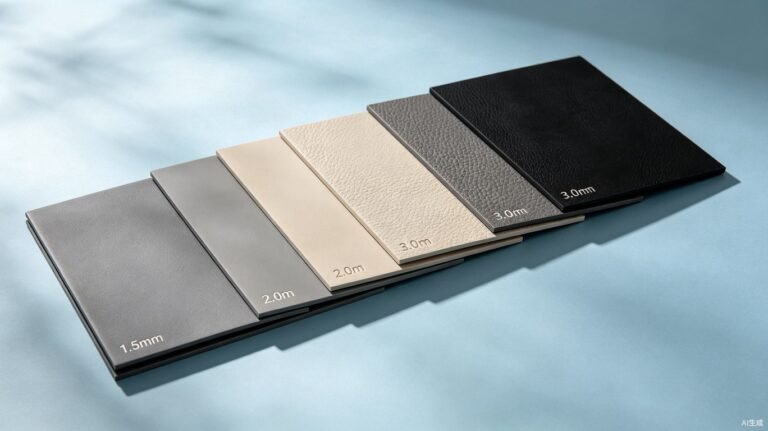
Texture comparison across eco leather grades — from smooth clinical finishes to embossed natural grain patterns.
Zero VOC: The Foundation of Genuine Eco Leather
Among all environmental claims in the leather industry, zero VOC is the most verifiable and impactful. Volatile organic compounds from solvent-based leather manufacturing contribute to indoor air pollution, worker health hazards, and atmospheric smog. Silicone leather eliminates this issue at the chemistry level — the platinum-cure coating process produces no solvent vapors. The video below explains our zero-VOC approach:
Learn how silicone leather’s solvent-free production achieves zero VOC emissions — the backbone of genuine eco leather.
How to Avoid Greenwashing When Sourcing Eco Leather
The eco leather market is unfortunately full of misleading claims. Here are five red flags to watch for — and the questions that expose them:
- Vague “eco” or “green” labeling without specifics. A legitimate eco leather supplier will quantify their claims: “zero VOC” with ISO 16000-6 test reports, “recycled content” with GRS certification, or “carbon neutral” with third-party LCA verification.
- No independent test data. If a supplier cannot provide test reports from recognized labs (SGS, Intertek, TÜV), their environmental claims are unsupported. Always request original documents.
- Ignoring end-of-life impact. A material that is “green” to produce but impossible to recycle is only half a solution. Ask about separation, recyclability, or biodegradation at end of life.
- Short service life masked by sustainability claims. Replacing furniture upholstery every two years is not eco-friendly, regardless of the material’s production footprint. Durability is a sustainability metric.
- Hidden trade-offs. Water-based PU may reduce VOCs compared to solvent PU, but still uses isocyanate chemistry and produces wastewater. Silicone leather avoids both, but at a higher material cost. Honest suppliers acknowledge trade-offs.

Finished eco leather rolls in standard and custom widths — each roll is fully traceable with batch documentation.
Frequently Asked Questions
Is eco vegan leather the same as eco leather?
Not necessarily. “Vegan leather” means no animal-derived content, but a vegan leather could still be made from PVC — which is neither eco-friendly nor sustainable. “Eco leather” focuses on environmental performance regardless of animal content. The best materials are both vegan and eco-friendly, such as silicone leather and certain plant-based alternatives. Read our vegan leather sustainability guide for more detail.
What certifications prove eco leather is genuine?
Look for: REACH compliance (EU chemicals regulation), ISO 16000-6 for VOC emissions, GRS/RCS for recycled content, EU Ecolabel for overall environmental impact, and LEED compatibility for green building applications. No single certification covers everything — the strongest claims are supported by multiple independent verifications.
Is eco leather more expensive than regular leather?
It depends on the material and the comparison. Silicone eco leather is typically 20-40% more expensive than standard PU leather per meter, but 40-60% less expensive than genuine top-grain leather. When factoring in service life (silicone lasts 10+ years vs. PU’s 3-5 years), the total cost of ownership often favors eco leather. See our cost comparison for specifics.
Making Eco Leather Decisions Based on Evidence
The eco leather market is maturing, but it is still plagued by ambiguity. The most effective approach for procurement teams is to evaluate materials on three concrete dimensions: verified environmental data (VOC tests, certifications, LCAs), measurable performance (abrasion, flex, UV resistance), and realistic total cost of ownership (material cost plus replacement frequency). When you run the numbers on these three axes, silicone leather consistently emerges as the strongest all-round eco leather option for commercial applications.
Start with samples and test under your actual use conditions. Sustainability claims matter, but performance under real-world stress is what determines whether your eco leather investment delivers value.
Get a Custom Eco Leather Quote
About TOPSUN
TOPSUN produces eco-friendly silicone leather through a 100% solvent-free coating process. Our materials are zero-VOC, halogen-free, phthalate-free, and fully recyclable — supporting sustainability goals across automotive, hospitality, furniture, and healthcare sectors in 40+ countries.
Relevant Certifications: REACH | RoHS | ISO 16000-6 Zero VOC | EU Ecolabel Applicable | EN 13773 Class 4 | FDA 21 CFR 177.2600 | SGS & Intertek Tested