A procurement team sources 10,000 meters of PVC faux leather at $6 per meter. The invoice reads $60,000. Three years later, the first wave of warranty claims arrives — peeling armrests, cracked headrests, delaminating seat covers. By year 10, that same material has been replaced three times. Total spend: $180,000 in material, $45,000 in labor, $12,000 in logistics, plus uncountable brand damage. The real cost of that faux material wasn’t $6 per meter — it was $30+. Most buyers never calculate this. They should.
What Is Faux Material? The 4 Types Every Buyer Must Know
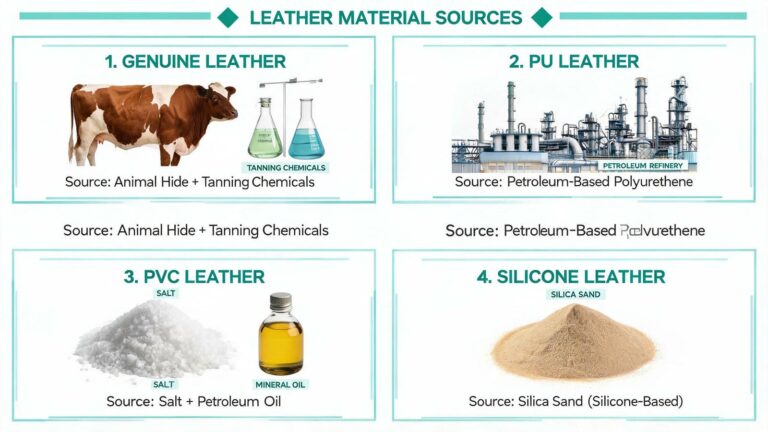
Faux material is any man-made substance designed to mimic the appearance and texture of genuine leather. It’s a layered composite: a textile base — polyester, cotton, nylon, or nonwoven — bonded to a synthetic coating that provides the leather-like surface. The coating chemistry determines everything: durability, cost, environmental impact, and how long the material lasts before failure.
There are four primary faux material types in the B2B market today. Each has a distinct chemistry profile, service life, and cost structure that procurement teams must understand before placing an order. For a detailed breakdown of each type, see our faux leather material guide.
- PVC (Polyvinyl Chloride) Faux Material — The oldest and cheapest option. A PVC coating mixed with plasticizers is applied to a fabric base. Initial cost: $4-7 per meter. The plasticizers that make PVC flexible migrate out over time, causing the material to harden, crack, and become brittle. Typical service life: 2-3 years in demanding applications.
- PU (Polyurethane) Faux Material — The most widely used synthetic leather. A polyurethane coating applied via solvent-based or water-based process. Softer hand-feel than PVC, wider color range. But PU is vulnerable to hydrolysis — moisture breaks down the polymer bonds. Typical service life: 3-5 years before cracking and peeling begin.
- Microfiber Faux Material — Ultra-fine polyester fibers bonded with a PU coating. The closest synthetic to genuine leather in feel and breathability. More durable than standard PU, but still contains polyurethane — meaning the same hydrolysis and UV degradation pathways apply. Service life: 5-7 years.
- Silicone Faux Material — The newest generation. A 100% silicone polymer coating applied through solvent-free dry coating. No PU, no PVC, no plasticizers. Service life: 10+ years with no hydrolysis, no UV degradation, no cracking. The only faux material that doesn’t follow the replacement cycle.
The Hidden Cost of Faux Material: A 10-Year Total Cost Analysis
Unit price is the number on the invoice. Total cost of ownership is the number that actually matters. When you factor in replacement cycles, labor for re-upholstery, logistics for new material shipments, and warranty claim processing, the cheapest faux material on paper often becomes the most expensive in practice.
Here’s the 10-year cost breakdown across four faux material types, based on real-world replacement data from furniture, automotive, and marine applications. For a deeper chemistry comparison, see our silicone vs PU analysis.
| Faux Material | Initial Cost/m | Service Life | Replacements (10 yr) | Total Material Cost/m | Failure Mode |
|---|---|---|---|---|---|
| PVC Faux | $4-7 | 2-3 years | 3-4 | $16-28 | Plasticizer migration, cracking |
| PU Faux | $6-10 | 3-5 years | 2-3 | $18-30 | Hydrolysis, peeling, UV cracking |
| Microfiber Faux | $10-15 | 5-7 years | 1-2 | $20-30 | PU coating degradation |
| Silicone Faux | $12-18 | 10+ years | 0 | $12-18 | None (no degradation) |
The data tells a counterintuitive story. Silicone faux material has the highest initial cost per meter but the lowest total cost over a 10-year period — because it doesn’t need replacing. Meanwhile, the cheapest option (PVC at $4/meter) accumulates the highest total cost due to 3-4 replacement cycles, each requiring labor, logistics, and downtime.
A $6/meter PU faux material becomes a $30+/meter expense over 10 years when you include three replacement cycles, labor costs at $15-25 per re-upholstered unit, and warranty claim processing at $50-80 per claim.
Why Faux Material Fails: The Chemistry Behind Cracking and Peeling
Faux material failure isn’t random — it’s chemistry. Every synthetic leather except silicone contains polyurethane or polyvinyl chloride as the surface coating. Both polymers have known degradation pathways that determine service life with surprising predictability.
PU faux material fails through hydrolysis. Water molecules — whether from ambient humidity, direct liquid contact, or body perspiration — penetrate the polyurethane polymer chain and break the ester bonds. This process accelerates in high-humidity environments: marine interiors, RV cabins, gym equipment, healthcare seating. The result is a surface that goes from flexible to brittle, then cracks and peels. Understanding the difference between faux leather and PU helps buyers predict where and when failure will occur.

Martindale abrasion tester — the machine that separates faux materials that last from those that peel after one season.
PVC faux material fails through plasticizer migration. The plasticizers that make PVC flexible are not chemically bonded to the polymer — they’re physical additives. Over time, heat, UV exposure, and mechanical stress cause these plasticizers to migrate to the surface and evaporate. The material hardens, loses flexibility, and cracks. This is why PVC automotive interiors become brittle and powdery after 2-3 years of sun exposure — the plasticizers have literally left the material.
Microfiber faux material lasts longer because the dense fiber structure provides mechanical stability. But the PU coating on top still degrades through the same hydrolysis pathway. The improvement is incremental — 5-7 years instead of 3-5 — not fundamental. Per ISO 12947-2 Martindale abrasion testing, microfiber typically reaches 50,000-80,000 cycles before surface degradation begins, versus 200,000+ for silicone.
Silicone Faux Material: Breaking the Replacement Cycle
Silicone faux material is chemically different from all other synthetic leathers. The coating is 100% silicone polymer — the same material family used in medical implants, baby bottle nipples, and aerospace seals. Silicone has no ester bonds to hydrolyze. No plasticizers to migrate. No solvent content to off-gas. The polymer is inherently UV-stable, thermally stable from -40°C to 250°C, and hydrolysis-proof.
This means silicone faux material doesn’t follow the replacement curve. A silicone leather sofa upholstery installed in year one is still performing in year ten — no cracking, no peeling, no plasticizer migration. The initial investment is higher, but the total cost over a product’s lifecycle is the lowest of any faux material. See how silicone compares as a silicone faux leather alternative across standardized testing.
Silicone leather long-term cost savings — why the highest unit price delivers the lowest 10-year total cost.
7 Questions to Ask Before Specifying Any Faux Material
Before committing to any faux material purchase, procurement teams should answer these seven questions. The answers determine whether you’re buying a 3-year disposable or a 10-year investment.
- 1. What is the coating chemistry? — PU, PVC, microfiber+PU, or silicone. This single answer predicts 80% of the material’s lifecycle performance. If the supplier can’t tell you, don’t buy from them.
- 2. What is the Martindale abrasion rating? — Per ISO 12947-2. PVC: 10,000-25,000 cycles. PU: 25,000-40,000 cycles. Microfiber: 50,000-80,000 cycles. Silicone: 200,000+ cycles. The gap between “passes” and “lasts” is enormous.
- 3. What is the hydrolysis resistance rating? — Per ISO 11507. PU and PVC both fail hydrolysis testing. Silicone passes with no degradation. If your application involves humidity, moisture, or outdoor exposure, this question is non-negotiable.
- 4. What is the UV resistance per ASTM G154? — PU and PVC crack and fade within 1,000 hours. Silicone shows no change after 1,000+ hours. For automotive, marine, and outdoor applications, UV resistance determines replacement frequency.
- 5. What VOC emissions does the material produce? — Per ISO 16000-6 or VDA 277. PU and PVC both emit volatile organic compounds. Silicone emits zero. For enclosed spaces — car cabins, furniture, healthcare — this affects regulatory compliance and user health.
- 6. What is the total cost over the product’s expected lifespan? — Not the unit price. Calculate: (unit price x replacement cycles) + labor + logistics + warranty. The “cheapest” material is rarely the cheapest.
- 7. Can the supplier provide third-party test reports? — Not spec sheets — actual SGS or Intertek laboratory reports. If the supplier can’t provide them, the performance claims are marketing, not data. Review our supplier audit checklist for a complete evaluation framework.
About TOPSUN
TOPSUN manufactures silicone faux material through a solvent-free dry coating process with platinum-catalyzed curing, producing the only synthetic leather that requires zero replacements over a 10-year service life for automotive, furniture, marine, and healthcare OEMs.
Monthly capacity of 500,000+ meters across 60,000+ m² of production facilities. Martindale 200,000+ cycles, UV-stable 1,000+ hours, REACH/RoHS/FDA compliant. Free A4 swatches shipped worldwide via DHL/FedEx.
Frequently Asked Questions
Which faux material lasts the longest?
Silicone faux material lasts 10+ years with no degradation — the longest service life of any synthetic leather. PVC lasts 2-3 years, PU lasts 3-5 years, and microfiber lasts 5-7 years. The difference comes down to chemistry: silicone polymer has no ester bonds to hydrolyze and no plasticizers to migrate, so it doesn’t follow the degradation pathway that destroys every other faux material.
Is silicone faux material worth the higher initial cost?
Over a 10-year period, yes — decisively. Silicone faux material costs $12-18 per meter initially versus $4-7 for PVC or $6-10 for PU. But when you factor in replacement cycles, silicone’s total 10-year cost stays at $12-18 per meter while PVC reaches $16-28 and PU reaches $18-30. Add labor for re-upholstery ($15-25 per unit per cycle), logistics, and warranty processing, and the gap widens further. The material with the highest unit price delivers the lowest total cost of ownership.
The Real Price of Faux Material
Faux material procurement fails when buyers optimize for invoice price instead of lifecycle cost. The $4 PVC meter that becomes $28 over a decade. The $6 PU meter that becomes $30. The warranty claims, the re-upholstery labor, the customer complaints, the brand damage — all predictable, all avoidable.
Silicone faux material costs more on the purchase order and less everywhere else. No replacements. No warranty claims. No degradation. The question isn’t whether you can afford the higher unit price — it’s whether you can afford three replacement cycles of the cheaper alternative.