A B2B buyer places a $120,000 order with a leather goods supplier that quoted 30% below market. The samples pass inspection. The production lot arrives with inconsistent color, delaminating edges, and REACH compliance gaps that fail EU customs. The buyer is out the order value plus the delay cost — because the “factory” was a trading company outsourcing to three different subcontractors with no quality control. This scenario plays out thousands of times per year. A supplier unwilling to provide a factory address or detailed photos is likely a trading company posing as a manufacturer, and a supplier with no MOQ or an extremely low MOQ (e.g., 50 pieces) indicates drop-shipping or no production control. The eight red flags below are the difference between a reliable leather goods supplier and a $100K mistake.
Request Supplier Verification Samples
What Makes a Leather Goods Supplier Reliable in 2026
A reliable leather goods supplier in 2026 is not the one with the lowest quote — it’s the one with the documentation, production infrastructure, and quality protocols to deliver consistent product across multiple production runs. The evaluation criteria fall into four tiers: product and market access documentation (REACH test reports, material declarations, country-of-origin capability), factory management certifications (SEDEX, ISO 14001, LWG Gold), quality control protocols (IQC, IPQC, FQC with AQL standards), and logistics capability (export experience, Incoterms familiarity, reference clients). For more on supplier evaluation, see our leather suppliers red flags guide.
The 8 Red Flags in Supplier Vetting
| # | Red Flag | What It Signals | Recommended Action |
|---|---|---|---|
| 1 | No factory address or photos | Trading company, not manufacturer | Demand third-party factory audit |
| 2 | MOQ below 300 pieces | No production control, drop-shipping | Seek realistic MOQ (1,000+ units) |
| 3 | Vague material descriptions | Lack of technical expertise | Require material specs (type, thickness, grade) |
| 4 | No LWG or SEDEX certification | Environmental and ethical gaps | Require certification with valid scope and dates |
| 5 | Quote 30%+ below market | Material substitution or quality compromise | Request material breakdown and cost analysis |
| 6 | No third-party QC reports | Self-inspection only, no accountability | Require SGS/Bureau Veritas inspection |
| 7 | No reference clients | No track record with international buyers | Request client list with permission |
| 8 | No REACH/Prop 65 test reports | Compliance documentation gap | Require current test reports from accredited labs |
Any single red flag is a warning. Three or more should disqualify the supplier from consideration. For the full B2B sourcing guide, see our quality leather goods B2B guide.
MOQ, Lead Time, and Capacity: What the Numbers Actually Mean
The numbers on the supplier profile tell a story — but only if you know how to read them. A realistic MOQ for custom leather goods is 300+ pieces per design for OEM and ODM orders. For leather material rolls, MOQ typically starts at 300–500 meters per roll, with custom embossing or special thickness negotiable. Lead time for in-stock orders is 3–5 working days; for custom orders, 12–18 days is industry standard.
| Parameter | Realistic Range | Red Flag Value | What It Means |
|---|---|---|---|
| MOQ (finished goods) | 300–1,000+ pcs | <50 pcs | No production line, drop-shipping |
| MOQ (material rolls) | 300–500 m | No MOQ | Trading company reselling |
| Lead time (custom) | 12–18 days | <7 days | Stock material relabeling |
| Monthly capacity | 10,000+ pcs | Unverifiable | No production records |
| Sample turnaround | 5–10 days | Same-day | Pre-made stock, not custom |
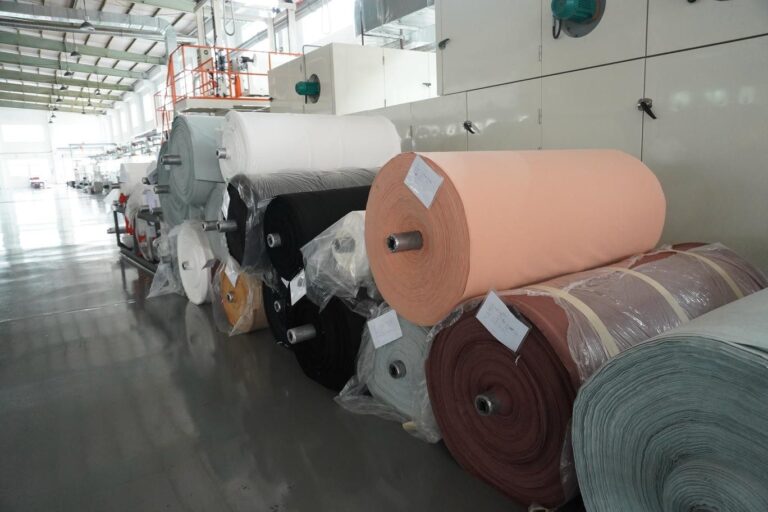
TOPSUN’s parameters: MOQ 500 meters, lead time 7–15 days, monthly capacity 500,000+ meters, and free A4 swatches shipped worldwide via DHL/FedEx. These are verifiable production numbers, not trading company estimates. For the full supplier audit checklist, see our supplier audit checklist.
Quality Control Protocols: IQC, IPQC, FQC, AQL
A reliable leather goods supplier operates a three-stage quality control system: Incoming Quality Control (IQC) inspects raw materials before production, In-Process Quality Control (IPQC) monitors cutting, stitching, and assembly during production, and Final Quality Control (FQC) inspects every finished item for cosmetic flaws, construction strength, and function. The acceptance standard for final inspection is AQL (Acceptable Quality Level) — typically AQL 0.65 for critical defects, 1.0–1.5 for major defects, per ANSI/ASQ Z1.4, with records kept for 3–5 years.
| QC Stage | What It Checks | Standard | Red Flag |
|---|---|---|---|
| IQC | Raw material inspection | 100% incoming inspection | No material testing |
| IPQC | In-process monitoring | First-piece approval + hourly patrol | End-of-line only |
| FQC | Final product inspection | AQL 0.65 critical / 1.0–1.5 major | No AQL standard |
| Lab Testing | Material performance verification | SGS / Intertek / Bureau Veritas | Self-tested only |
The Supplier Scorecard: 10 Criteria for Final Selection
Once red flags are cleared and QC protocols verified, the final supplier selection comes down to a weighted scorecard. Here’s the 10-criteria framework used by experienced sourcing teams, adapted from supplier scoring methodologies that weight relevant segment experience, sample quality, communication, and certifications:
| Criterion | Weight | What to Verify |
|---|---|---|
| Sample quality | 25% | Clean results within 2 sample rounds |
| Relevant experience | 15% | Portfolio of comparable products, tier-matched clients |
| Communication | 15% | Consistent, detailed, proactive updates |
| Certifications | 15% | REACH, LWG, SEDEX, ISO 14001 — valid and scoped |
| Production capacity | 10% | Monthly output matching your volume needs |
| Quality control | 10% | IQC/IPQC/FQC with third-party verification |
| Pricing | 5% | Market-competitive, not suspiciously low |
| Lead time | 5% | 7–18 days for custom, verified by references |
Notice that pricing is only 5% of the total score. The lowest quote wins nothing if the sample quality, certifications, or QC protocols don’t hold up. TOPSUN meets all 10 criteria: REACH-compliant, RoHS-certified, SGS/Intertek-verified, 500,000+ meters monthly capacity, 7–15 day lead time, 10+ engineers, and 100+ B2B brand partners. For silicone leather supplier selection, see our silicone leather supplier guide.
About TOPSUN: TOPSUN is a B2B silicone leather manufacturer with 60,000+ m² production facilities in Dongguan, Yichang, and Xiangyang. With 10+ automated production lines, 500,000+ meters monthly capacity, and 10+ engineers, TOPSUN serves 100+ B2B brands worldwide. All materials are REACH-compliant, RoHS-certified, and verified by SGS and Intertek. Free A4 swatch samples ship worldwide via DHL/FedEx. Contact: info@topsunsiliconeleather.com / WhatsApp +44 744 461 7933.
Request Supplier Documentation Pack