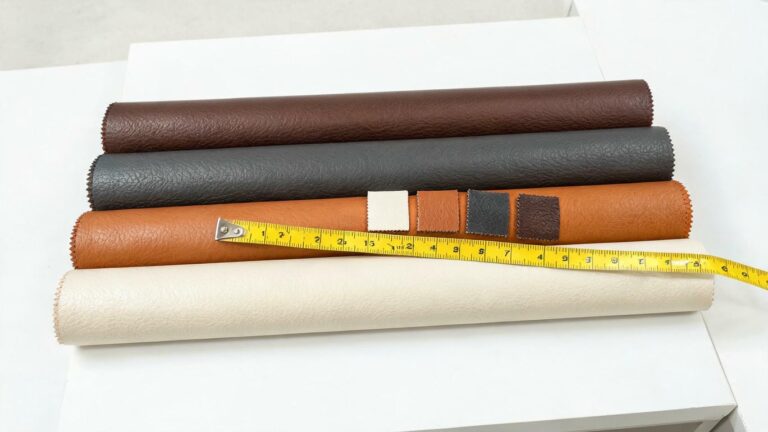
Last month a contract furniture brand sent one spec sheet to five faux leather suppliers. The spec was identical on all five copies: PU-coated fabric, 1.2 mm, slate gray, 3,000 meters. The quotes came back at $1.64, $2.26, $2.70, $3.04 and $4.27 per meter. That is a 2.6-fold spread on paper that describes one material. One sheet explained the difference; the other four priced a label. This article walks the quotes line by line, so the next spread reads like a menu instead of a lottery.
| Quote Line | What It Covers | What Moves the Price |
|---|---|---|
| 1. Base fabric | Knit, woven or microfiber cloth under the coating | Fabric type and gram weight |
| 2. Coating weight | Surface layer carried on the base | Coating share of total weight |
| 3. Finish | Release-paper grain, topcoat and print work | Embossing and print complexity |
| 4. Testing | Lab reports and third-party inspection | Test list depth and frequency |
| 5. MOQ and lead time | Minimum order, stock position, delivery window | Line ownership and inventory |
Five Quotes, One Spec: Why Faux Leather Suppliers Diverge
The spread is not noise. The global faux leather market is projected to grow from $38.6 billion in 2026 to $64.5 billion by 2033 at a 7.6% compound rate. Live B2B listings back the range: upholstery PU at $1.64 to $1.86 per meter, printed PU at $2.70, shoe-upper PU at $3.04 to $3.30. A meter price bundles five decisions, and suppliers diverge on all five.

Quote Lines 1 and 2: Base Fabric and Coating Weight
Base fabric sits under every coating and drives the first price gap. The $1.64 quote was built on a knit base with a foam-heavy layer. Knit stretches, costs little and relaxes on a sofa seat within a year. Woven polyester holds dimension and adds roughly $0.30 to $0.60 per meter. Microfiber bases cost more again and deliver the tightest surface uniformity for printed grains.
Coating weight is the second lever. Two rolls can both measure 1.2 mm while one carries a thin surface film on thick foam. The thin-film roll wins the sample touch test and fails the abrasion test first. Ask what share of the gram weight the surface layer represents. A supplier who answers with a number owns the line. One who answers with a brochure is reselling someone else’s.
Quote Lines 3 and 4: Finish, Testing and Paperwork
Finish covers the release-paper grain, the topcoat and any print work. A custom print or metallic topcoat adds setup cost and shows up in the $2.70 listing tier. Chemistry also lives here. PU coating feels soft but hydrolyzes in humid climates, while silicone costs more and skips plasticizers entirely. Our silicone versus PU comparison breaks down when the premium pays back.
Testing is where cheap quotes save their money. A serious sheet lists abrasion cycles, flex endurance, VOC results and flame class, each tied to a batch number. Third-party inspectors sample finished orders against the ANSI/ASQ Z1.4 AQL tables and grade every defect as critical, major or minor, so the result is pass or fail rather than an opinion. The $1.64 quote bundled none of this.
Inside the line: the R&D and production capability behind a quote.
Quote Line 5: MOQ, Lead Time and the Real Price
MOQ and lead time complete the bundle, and both leak into the meter price. Live listings run from a 1-yard minimum to 500 meters. A 1-yard minimum usually means a trader cutting from stock. A 500-meter minimum usually means the quote came from the factory that owns the line. Lead time tells the same story. Named production slots and finished-goods stock beat a promise of “about 30 days” every time.

Compare Faux Leather Suppliers in One Pass
Normalization takes one spreadsheet. Force every quote to name its base fabric, disclose its coating share, list its tests with batch numbers, and state MOQ in meters. Then restate the price with freight, duty and inspection fees included. Only then do the five numbers compete in the same currency. In our opening case, the buyer added a third-party AQL fee of about $0.04 per meter before comparing.
The brand chose the $3.04 sheet. It named a woven base, a disclosed coating share and a batch-linked test list. The seat program has survived its first year of hotel traffic without a claim. For similar seating work, our furniture and sofa applications page collects the surface specs that matter at contract volume.

Frequently asked questions:
- Why do faux leather suppliers quote such different prices per meter? Each meter price bundles base fabric, coating weight, finish, testing and MOQ terms. Different bundles, different numbers.
- What MOQ should I expect from faux leather suppliers? Live listings run from 1 yard to 500 meters. Low minimums often signal traders; factory minimums start near 300 to 500 meters.
- How do I verify quality before the full order? Book a pilot batch, then a third-party inspection against ANSI/ASQ Z1.4 AQL tables with critical, major and minor defect grades.
One line settles it: ask what each quote line buys, not what the meter costs.
Request a Quote With Line Items
References
- https://www.persistencemarketresearch.com/marke… — Global faux leather market: $38.6B (2026) to $64.5B (2033), CAGR 7.6%, spanning PU, PVC and bio-based types.
- https://www.accio.ai/find-product/faux-leather-… — Live supplier listings span $1.64 to $4.27 per meter with MOQs from 1 yard to 500 meters.
- https://www.utsinspection.com/leather-goods-ins… — Third-party inspection samples to ANSI/ASQ Z1.4 AQL tables and grades defects critical, major or minor.