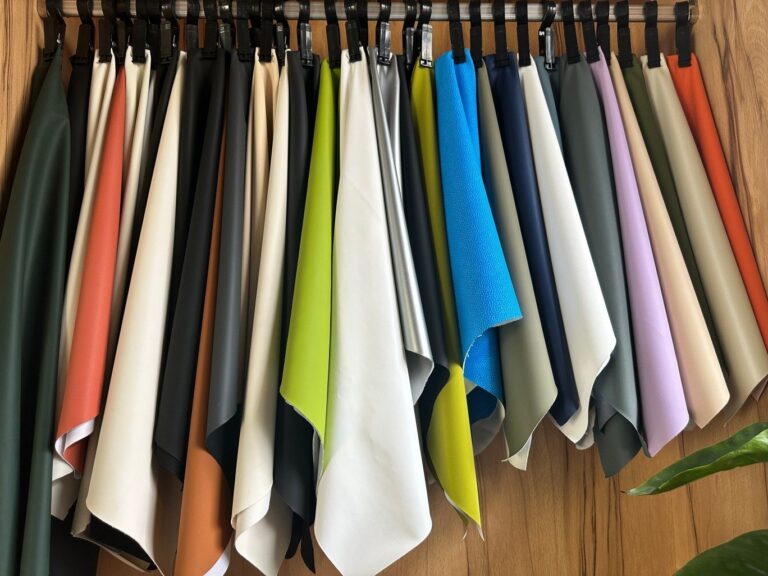
Green faux leather is the fastest-growing category in synthetic materials — and the most greenwashed. Walk any trade show and you’ll see “eco-friendly,” “sustainable,” and “bio-based” labels on PU and PVC leather that are chemically identical to the non-green versions they replaced. The difference between genuine green faux leather and marketing-driven greenwash comes down to five certifications: OEKO-TEX Standard 100, Global Recycled Standard (GRS), USDA Certified Biobased, REACH, and RoHS. Silicone leather passes all five without synthetic binders, without plasticizers, and without the 30–60% petrochemical content that most “green” PU blends quietly contain. This checklist shows B2B buyers exactly what to verify — and what most suppliers hope you won’t ask about.

Green faux leather swatches — silicone leather’s color range without the synthetic binders that undermine most “green” PU claims.
The Greenwashing Problem in Faux Leather
The green faux leather market suffers from a fundamental transparency problem. A manufacturer can label PU leather “eco-friendly” for any of the following reasons — none of which change the base chemistry:
- Water-based PU process — Replacing solvent-based PU with water-based formulation reduces VOC emissions during production by 60–80%. But the finished material is still polyurethane — it still hydrolyzes, still breaks down in 3–5 years, and still requires petrochemical feedstocks. “Water-based” describes the process, not the product.
- Recycled polyester backing — Using GRS-certified recycled PET bottles as the fabric substrate is genuinely better than virgin polyester. But the coating layer — the part you touch, the part that determines durability — is still solvent-based PU or PVC. A recycled backing doesn’t make the coating green.
- Bio-based PU blends — Replacing 10–30% of petrochemical polyol with castor oil or soy-based polyol earns a “bio-based” label. The remaining 70–90% is conventional petrochemical PU, with identical durability and end-of-life characteristics. The bio-polyurethane reality check documents this gap in detail.
- Plant-based marketing — Piñatex, apple leather, and grape leather use agricultural waste fibers, but most require 30–60% PU or PVC binder for water resistance and abrasion performance. The “plant-based” label obscures the synthetic content that determines the material’s actual environmental footprint.
The pattern: most green faux leather achieves one dimension of sustainability (recycled backing, water-based process, or bio-blended polyol) while leaving the core chemistry unchanged. Silicone leather is the exception — its sustainability is structural, not additive. The eco-friendly silicone leather overview explains the chemistry difference.

B2B sustainable fabric certifications — third-party verification separates genuine green faux leather from marketing claims.
The 5-Certification Checklist for Green Faux Leather
For B2B buyers, the only reliable way to separate real green faux leather from greenwash is third-party certification. Here’s the five-certification checklist — and how silicone leather performs against each:
| Certification | What It Verifies | Typical Green PU | Silicone Leather |
|---|---|---|---|
| OEKO-TEX 100 | Harmful substance-free | Sometimes (coating only) | Certified — full material |
| GRS | Recycled content % | Backing only (30–50%) | N/A — no recycled needed |
| USDA BioBased | Renewable plant content | 10–30% bio-polyol | Inorganic — no petroleum |
| REACH | Chemical compliance (EU) | Variable by batch | Compliant — all batches |
| RoHS | Heavy metal-free | Not tested by default | Certified — zero detected |
5/5 certifications passed — silicone leather is the only faux leather that achieves full third-party compliance without relying on recycled-content accounting or bio-blend percentages. The material is green by chemistry, not by offset.

Solvent-free coating process — silicone leather production eliminates the VOC emissions that even “green” PU manufacturing generates.
VOC and Indoor Air Quality: The Hidden Green Metric
Most green faux leather certification focuses on material content — what’s in the product. But for furniture, automotive, and healthcare applications, the metric that matters most is what comes out of the product over its service life: VOC emissions.
Water-based PU leather reduces production VOCs but doesn’t eliminate them entirely. Residual solvents trapped in the polymer matrix off-gas over 6–18 months, contributing to indoor air pollution. In enclosed environments — vehicle cabins, hospital rooms, office furniture — this creates both regulatory exposure and user complaints. The German automotive industry’s VDA 270 olfactory test rates water-based PU at 1.5–2.0 (nearly odorless), while conventional solvent-based PU typically rates 3.0–4.0 (noticeable odor). Silicone leather, tested under the same protocol, achieves a VDA 270 rating below 1.0 — virtually undetectable — because its inorganic polymer structure doesn’t trap or release organic compounds.
For automotive interiors where VDA 277 VOC limits are enforced, and for medical healthcare where ISO 10993 biocompatibility is required, VOC performance isn’t optional — it’s a specification gate. Silicone leather passes both standards inherently. Most green faux leather passes neither without post-production treatments that add cost and degrade over time.

Calendering production — industrial-scale silicone leather manufacturing with zero solvent emissions and closed-loop water recycling.
Eco-certifications overview — REACH, FDA, ISO 10993, RoHS, and EN 13773 compliance verified by SGS on every production batch.
End-of-Life: The Sustainability Test Nobody Asks About
The greenest material on day one isn’t necessarily the greenest on year ten. End-of-life analysis reveals the real sustainability gap in green faux leather:
Water-based PU leather lasts 3–5 years in commercial use. Over a 10-year period, it’s replaced 2–3 times — meaning 2–3× material production, 2–3× manufacturing energy, 2–3× shipping, and 2–3× landfill or incineration. The “green” water-based process advantage is multiplied by the replacement frequency disadvantage.
Bio-based PU with 30% plant content sounds sustainable — but the 70% petrochemical fraction still doesn’t biodegrade, and the plant-based fraction that does biodegrade is what limits the material’s Martindale cycles to 40,000–60,000. The same chemistry that makes it “bio” makes it fail faster.
Silicone leather’s 10+ year service life means one production cycle, one shipping cycle, one end-of-life event per decade. The silicone leather circular economy analysis shows that longevity is the single most impactful sustainability metric for high-wear B2B materials — more impactful than recycled content, bio-based percentages, or water-based processing. The full sustainability report provides the lifecycle assessment data.
Frequently Asked Questions
How can I verify if green faux leather is genuinely eco-friendly or just greenwashed?
Request three documents: (1) OEKO-TEX Standard 100 certificate covering the full material — not just the backing layer, (2) SGS or Intertek test report for REACH Annex XVII restricted substances, and (3) VDA 270 olfactory test results. If the supplier can’t provide all three, the “green” label is marketing, not certification. Then ask the critical question: what percentage of the coating layer (not the backing) is petrochemical-free? Most “green” PU blends contain 70–90% petrochemical polyol in the coating — the part that determines durability and end-of-life impact. Silicone leather’s coating is 100% inorganic polymer — zero petrochemical content — verified by SGS-certified test reports available on every batch.
Green by Chemistry, Not by Marketing
The green faux leather market rewards incremental improvements — 30% bio-content, recycled backings, water-based processes — while ignoring the structural problem: most alternatives still depend on petrochemical coatings that hydrolyze, off-gas, and require replacement within 5 years. Silicone leather doesn’t improve on PU chemistry incrementally. It replaces it entirely with an inorganic polymer that passes every third-party certification without offsets, without binders, and without excuses. For B2B buyers who need verifiable sustainability — not narrative sustainability — the five-certification checklist eliminates the ambiguity. And only one material passes all five.
About TOPSUN
TOPSUN manufactures silicone leather that passes OEKO-TEX, REACH, RoHS, FDA, and ISO 10993 certifications without synthetic binders or petrochemical coatings — the only faux leather that’s green by formulation, not by marketing.
Zero VOC, zero plasticizers, zero petrochemical coating — 10+ year service life makes it the lowest lifecycle-impact faux leather available.