The furniture upholstery market runs on faux leather — 39.6% of all upholstery material shipped in 2025 was synthetic, and that share is climbing. But procurement teams who evaluate only unit price are missing the bigger picture: PU fabric that needs replacement in 3 years costs more over a furniture program’s lifecycle than silicone leather that lasts 10+.
Here’s the procurement reality. The global synthetic leather for furniture market reached $14.5 billion in 2025 and is projected to hit $23 billion by 2032, growing at 6.8% CAGR. That growth means more suppliers, more material options, and more confusion about what actually lasts. This article breaks down faux leather upholstery fabric across four material types — silicone, PU, PVC, and bio-based — with a 5-year total cost of ownership analysis that most suppliers won’t show you.
The $14.5B Question: Why Faux Leather Upholstery Fabric Dominates Furniture
Faux leather upholstery fabric for furniture isn’t just a budget alternative anymore. It’s the default choice across contract, hospitality, and residential segments. Synthetic faux leather accounted for the largest share of the upholstery market at 39.6% in 2025, while furniture applications represented 60.1% of all upholstery demand. According to Grand View Research, the broader synthetic leather market is projected to grow from $44.2 billion to $79.8 billion by 2034.
But not all faux leather upholstery fabric performs the same. The three dominant chemistries — PU, PVC, and silicone — have wildly different durability profiles, and the replacement cycle is where procurement costs actually accumulate. A sofa specified for a furniture sofa application in a hotel lobby doesn’t just need to look good on day one. It needs to survive 5+ years of daily occupancy, cleaning chemicals, and UV exposure from lobby windows.

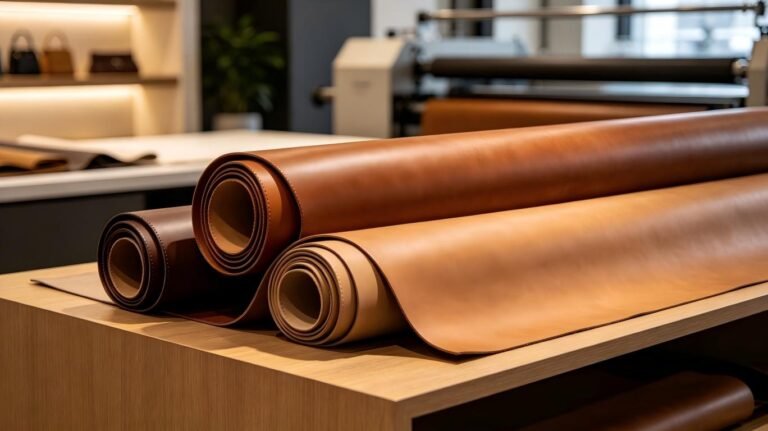
Finished faux leather rolls on the production floor — ready for furniture upholstery cutting and sewing.
PU vs PVC vs Silicone: Where Replacement Costs Hide
Faux leather upholstery durability isn’t a single metric — it’s a cascade of failure points. PU leather typically achieves 30,000–80,000 Martindale cycles depending on grade. That sounds adequate until you realize commercial furniture requires 50,000+ for heavy-duty rating, and PU’s surface begins degrading from UV and hydrolysis long before the abrasion limit is reached.
Here’s what the 5-year cost picture looks like across materials at typical furniture upholstery specifications:
| Material | Initial Cost/sqm | Replacement Cycle | 5-Year Cost | Martindale Cycles |
|---|---|---|---|---|
| Silicone Leather | $$ | 10+ years | $$ (1 purchase) | 200,000+ |
| PU Leather | $ | 3–5 years | $$$ (2 purchases) | 50K–80K |
| PVC Leather | $ | 2–3 years | $$$$ (2–3 purchases) | 30K–50K |
| Bio-based Leather | $$$ | 2–4 years | $$$$$ (2+ purchases) | 20K–60K |
The cheapest material on day one is rarely the cheapest over 5 years. A PU sofa reupholstered once in year 3 costs more in labor, downtime, and disposal than a silicone leather sofa that never needs replacement.
PVC performs worse — its plasticizer migration causes surface hardening within 2 years in warm environments, and its REACH compliance flags make it increasingly difficult to specify for EU and North American projects. For furniture programs where hydrolysis resistance matters, hydrolysis-resistant silicone leather eliminates the moisture-driven degradation that causes PU and PVC to peel and crack prematurely.

Flexibility bending test equipment — simulates the repeated flexing that upholstery undergoes at seat and back joints.
Flex resistance test — silicone leather endures 100,000+ flex cycles without cracking, critical for furniture seat cushions.
Peeling, Cracking, Delamination: Failure Modes by Material Type
Faux leather upholstery fabric peeling is the number one warranty complaint in contract furniture. Understanding why each material fails — and when — is essential for specifying fabric that won’t generate return requests.
PU leather fails through hydrolysis. The polyurethane coating absorbs ambient moisture over time, breaking down the polymer chains. This process accelerates in humid climates and cleaning-intensive environments like restaurants and hospitals. The surface first develops micro-cracks, then peels in sheets. Typical timeline: 3–5 years in residential, 18–30 months in contract settings.
PVC fails through plasticizer migration. The plasticizers that make PVC flexible gradually evaporate, leaving the surface brittle and discolored. This is irreversible — no maintenance routine can restore flexibility once plasticizers are gone. Typical timeline: 2–3 years, faster in sun-exposed locations.
In our flex testing, silicone leather withstands 100,000+ flex cycles at 120° bend angle without any surface cracking or delamination. The reason is structural — silicone forms a molecular bond with the substrate rather than an adhesive layer. There’s nothing to peel away. For furniture programs where cleaning and maintenance protocols are aggressive, the cleaning and maintenance advantages of silicone leather extend well beyond convenience into actual warranty cost reduction.

Soft-fold display of silicone faux leather — the drape and hand feel that furniture designers expect from premium upholstery.
Specifying Faux Leather Upholstery Fabric for Commercial Projects
Commercial faux leather upholstery fabric faces a different set of requirements than residential. Fire codes, cleaning protocols, and high-traffic wear patterns all narrow the material field. For detailed material specifications, our leather sofa upholstery materials guide covers the full specification checklist.
One of our contract furniture clients specified silicone leather for a 500-unit hotel seating program after their previous PU supplier’s fabric started peeling at month 14. The switch added 20% to material unit cost but eliminated the mid-cycle reupholstering budget entirely. Over 5 years, the program saved an estimated 35% versus the PU replacement cycle.
When specifying for commercial projects, procurement teams should verify these items before signing off:
- Martindale or Wyzenbeek rating — minimum 50,000 cycles for contract, 100,000+ for heavy-duty
- Fire code compliance — EN 13773 Class 4 (EU), FMVSS 302 (US automotive), or CA TB 117-2013 (US furniture)
- Hydrolysis test data — ISO 11507 or equivalent accelerated aging results
- VOC emission certification — EU E1, VDA 277, or GREENGUARD Gold for indoor air quality
- Cleaning protocol compatibility — confirm the material withstands the facility’s standard disinfectants

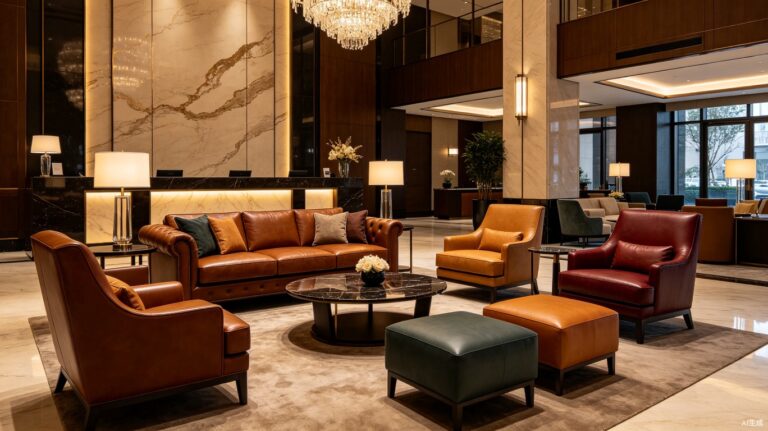
Faux leather upholstery applied to a commercial sofa — the end-use environment where material choice directly impacts replacement cycles.
Frequently Asked Questions
How long does faux leather upholstery fabric last compared to genuine leather?
It depends on the chemistry. PU typically lasts 3–5 years in residential settings, PVC 2–3 years, and silicone leather 10+ years. Genuine leather can last 15–25 years with proper conditioning, but it requires ongoing maintenance that adds cost. Silicone leather offers the longest synthetic lifespan with zero conditioning required.
What Martindale rub count should I look for in commercial faux leather upholstery?
For general commercial use, minimum 50,000 Martindale cycles. For heavy-duty contract environments like hotels and restaurants, specify 100,000+ cycles. Silicone leather tested to 200,000+ cycles provides the highest abrasion resistance available in faux leather upholstery fabric.
The Bottom Line on Faux Leather Upholstery Fabric Selection
Faux leather upholstery fabric is the dominant material in furniture for good reason — it offers design flexibility, cost efficiency, and ethical sourcing advantages over genuine leather. But the material chemistry you choose determines whether your furniture program runs on a 3-year replacement treadmill or a 10-year durability runway. For more on synthetic leather durability across applications, our testing guide covers the full performance picture.
Silicone leather’s 200K+ Martindale performance, 100K+ flex cycles, hydrolysis-proof structure, and zero-VOC chemistry make it the only faux leather upholstery fabric that eliminates the replacement cycle entirely. In a market growing toward $23 billion, the procurement teams who specify for lifecycle cost — not just unit price — will be the ones whose furniture programs stay under budget.
About TOPSUN
TOPSUN produces silicone-coated faux leather upholstery fabric for residential and commercial furniture applications, including sofas, armchairs, and contract seating programs across hospitality and healthcare segments.
Tested to 200K+ Martindale cycles with 10+ year service life, available in 0.8–2.0mm thickness for furniture, certified to EN 13773 Class 4 flame retardancy, and backed by 500,000+ sqm monthly production capacity with 7–15 day lead times.