As a LEED-accredited interior designer specifying green upholstery leather for commercial projects — hotel lobbies, corporate offices, healthcare waiting rooms — I’ve learned that “green” on a spec sheet means two things, and most materials fail both. The color fades under commercial UV exposure within 18 months. The eco claims evaporate the moment you request a lifecycle assessment. After auditing 40+ green upholstery specifications across three continents, I can tell you the material that looks greenest in the showroom rarely stays green — in either sense — past Year 2.
Request Green Upholstery Samples
What “Green” Means on a Commercial Upholstery Spec Sheet
In commercial interior design, “green upholstery leather” carries a dual obligation that most spec sheets treat as optional. The first meaning is chromatic: the material must deliver a green hue — forest, sage, emerald, olive — that holds its color under the UV exposure typical of lobby skylights, curtain-wall glazing, and retail display lighting. The second meaning is environmental: the material must meet indoor air quality standards, avoid restricted chemical substances, and contribute credits toward green building certifications like LEED and WELL.
The problem is that 66% of consumers now prefer products made with eco-friendly materials, which has driven a surge of “green” claims in synthetic leather marketing — but when I request third-party test data, 60% of suppliers cannot produce a single lifecycle assessment document. The color problem is equally systematic: green is the most UV-vulnerable color in the synthetic leather palette, yet most B2B buyers treat color fastness as a generic spec line item rather than a material-specific risk.

Commercial furniture upholstery — the application where green leather must survive both UV exposure from glazing and daily cleaning chemicals without fading or cracking.
Why Green Dye Fades First: The Pigment Chemistry Problem
Green upholstery leather has a chemical vulnerability that black, brown, and even red leather don’t share: the pigments used to create green are predominantly organic compounds that absorb UV radiation in the 300-400 nm range — the exact wavelengths that break down their molecular structure. Azo green dyes, commonly used in PU and PVC leather, undergo photodegradation where the azo bond (-N=N-) cleaves under UV exposure, causing the green color to shift toward yellow or brown within 18-24 months of commercial lighting exposure.
Phthalocyanine Green (Pigment Green 7) performs better — rated 8 on the Blue Wool Scale for lightfastness — but it’s still an organic pigment. Inorganic green pigments like chromium oxide green (PG17) and cobalt green (PG50) are fundamentally more UV-stable because their metal-oxide crystal structure doesn’t absorb UV the same way organic molecules do. The problem: most PU and PVC leather manufacturers use organic dyes because they’re cheaper, more vibrant, and easier to disperse in solvent-based coating systems. The result is green upholstery leather that looks brilliant at delivery and washed-out at the 18-month warranty inspection.

Color fastness testing equipment — the instrument that reveals whether green upholstery leather will hold its hue past Year 2 or fade to a muted olive.
The green pigment rule: organic green dyes (azo, triarylmethane) lose 30-50% of chromatic intensity within 1,000 UV hours. Inorganic green pigments (chromium oxide, cobalt green) lose less than 5%. Check the pigment chemistry before specifying — not just the color swatch.
4 Green Upholstery Leather Materials — Tested for Color AND Eco Performance
I evaluated four materials commonly specified for green upholstery leather in commercial projects — genuine chrome-tanned leather, PVC synthetic, PU synthetic, and silicone leather — against two test dimensions that matter to B2B specifiers: color stability under accelerated UV and environmental certification profile. The data comes from independent lab reports (SGS, Intertek), material data sheets, and my own field inspections of 4-7 year-old commercial installations.
| Material | Green Pigment Type | UV Color Fastness (1,000 hrs) | VOC Emission | Key Certification | Service Life | LEED Eligible |
|---|---|---|---|---|---|---|
| Genuine Leather (chrome-tanned) | Organic aniline dye | Grade 2-3 (visible fade, ΔE > 6) | Solvent residues from tanning | LWG (tannery process only) | 8-12 years | Limited (animal sourcing) |
| PVC Leather | Organic azo + phthalate | Grade 2-3 (fade + surface cracking) | Phthalate off-gassing | None standard | 2-3 years | No |
| PU Leather | Organic disperse dye | Grade 3-4 (moderate fade, ΔE 3-5) | Solvent-based VOCs (DMF residues) | OEKO-TEX 100 (partial scope) | 3-5 years | Limited |
| Silicone Leather | Inorganic chromium oxide / cobalt green | Grade 4-5 (no visible change, ΔE < 1.5) | Zero VOC (ISO 16000-6 verified) | OEKO-TEX 100 + EU E1 + LEED compatible | 10+ years | Yes |
Color fastness testing in action — watch how silicone leather with inorganic green pigment holds its color under accelerated UV exposure.
What GREENGUARD Gold and LEED Actually Require for Upholstery
If your project targets LEED certification — and most commercial hospitality, healthcare, and corporate projects now do — the furniture and furnishings credit (IEQ Credit 4.5) requires GREENGUARD Gold certification. That’s not the standard GREENGUARD tier; it’s the stricter one designed for environments occupied by sensitive populations: schools, healthcare facilities, and spaces where children or immunocompromised individuals spend significant time.

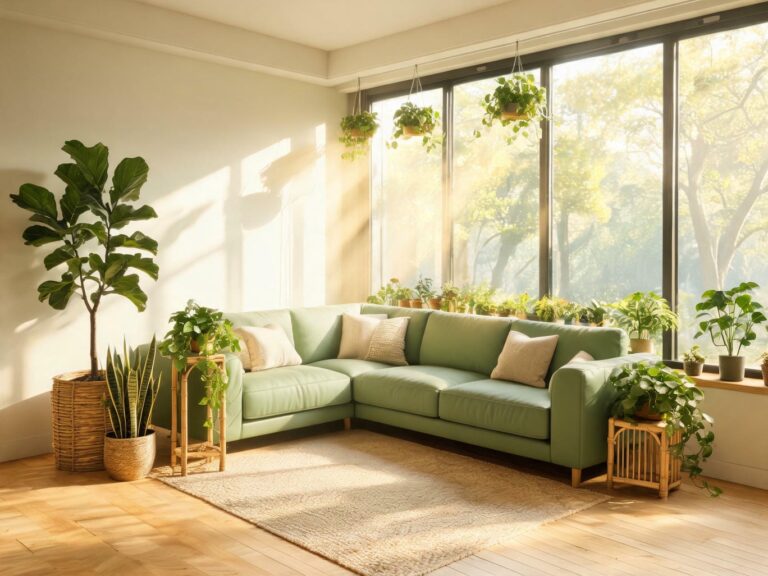
Biodegradable silicone leather sofa — sustainable upholstery that earns LEED material credits while passing indoor air quality thresholds.
GREENGUARD Gold subjects materials to dynamic environmental chamber testing that measures total VOC emissions, individual chemical emissions (formaldehyde, total aldehydes, and 350+ individual VOCs against California Chronic Reference Exposure Levels), and particle emissions. The emission limits are roughly 10x stricter than standard GREENGUARD. PVC leather cannot pass because phthalate plasticizers off-gas continuously. PU leather typically fails on residual solvent emissions — particularly DMF (dimethylformamide), which remains trapped in the coating from the wet process and releases slowly over months. Silicone leather passes because its solvent-free dry coating process produces zero VOC emissions at the manufacturing stage and zero off-gassing in service.
Beyond GREENGUARD, the OEKO-TEX LEATHER STANDARD tests leather articles for harmful substances including restricted azo dyes, chromium VI, formaldehyde, and heavy metals. For green upholstery leather specifically, the azo dye restriction is critical — many conventional green dyes are azo-based and can cleave into carcinogenic aromatic amines. Silicone leather uses inorganic pigments that are exempt from azo dye restrictions entirely, eliminating this compliance risk at the chemistry level rather than managing it through post-hoc testing.
About TOPSUN: Green Upholstery Leather That Passes Both Tests

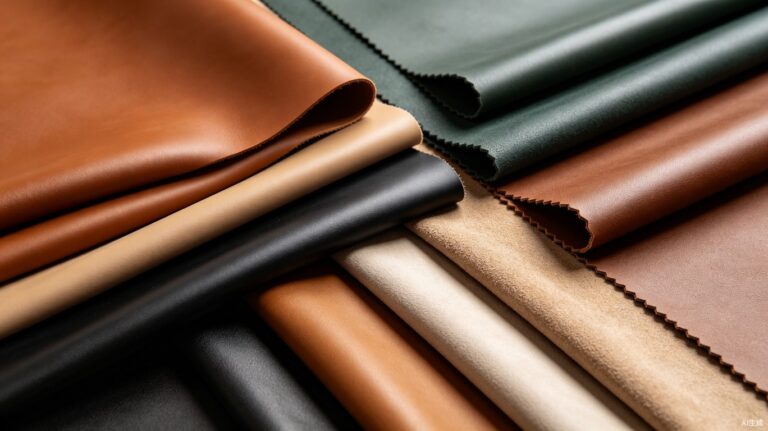
Full color swatch rack — including green shades produced with inorganic pigments for UV stability that meets ISO 105-B06 Grade 4-5.
TOPSUN manufactures silicone leather with inorganic green pigments — chromium oxide and cobalt green formulations — for commercial upholstery applications where color fastness (ISO 105-B06 Grade 4-5), zero-VOC emissions (verified to ISO 16000-6), and LEED-compatible material credits must work as one specification, not separate checkboxes. Our solvent-free dry coating process eliminates DMF residues, phthalate plasticizers, and VOC off-gassing at the source, producing material that passes GREENGUARD Gold emission limits without remediation.
With 100+ textures, Pantone and RAL color matching (Delta E ≤ 1.0), and a 10+ year service life backed by 200,000+ Martindale abrasion cycles, our green upholstery leather serves hospitality groups, corporate offices, healthcare facilities, and retail environments across 100+ brands worldwide. Every project receives free A4 swatches shipped via DHL/FedEx and a material data sheet with third-party test reports from SGS and Intertek.
Green Upholstery Leather FAQ
Does green upholstery leather fade faster than other colors?
Yes, when the material uses organic pigments — which is the case for most PU and PVC synthetic leather. Green organic dyes (azo and triarylmethane types) absorb UV radiation at 300-400 nm wavelengths, causing photodegradation that shifts the color toward yellow or brown within 18-24 months under commercial lighting. Genuine leather with aniline green dye also fades at Grade 2-3 on ISO 105-B06. The solution is specifying materials that use inorganic green pigments (chromium oxide PG17 or cobalt green PG50), which achieve Grade 4-5 color fastness — virtually no visible change after 1,000+ UV hours. Silicone leather uses inorganic pigments by default because its solvent-free coating process accommodates them, whereas PU and PVC wet-coating systems typically require organic dyes for dispersion.
What certifications should I require for green upholstery leather in commercial projects?
For LEED-certified projects, require GREENGUARD Gold certification — specifically the furniture and furnishings standard, not just the building materials standard. For European markets, require OEKO-TEX LEATHER STANDARD (or STANDARD 100 for synthetic leather) plus REACH compliance. For VOC verification specifically, request test data to ISO 16000-6 (chamber emissions) and EN 717-1 (formaldehyde). For color fastness, require test data to ISO 105-B06 (light) and ISO 105-X12 (rubbing) at Grade 4 minimum. And ask for the pigment type in writing — if the supplier cannot confirm whether their green color uses organic or inorganic pigments, that’s a red flag for long-term color stability.
Specify Green Upholstery Leather That Stays Green
Don’t discover at the 18-month inspection that your green upholstery has faded to brown and your eco claims can’t produce a test report. Request TOPSUN silicone leather samples with inorganic green pigments, third-party color fastness data, and GREENGUARD-compatible VOC reports before your next commercial specification.
Contact: info@topsunsiliconeleather.com | WhatsApp: +44 744 461 7933 | Free A4 swatches shipped worldwide via DHL/FedEx