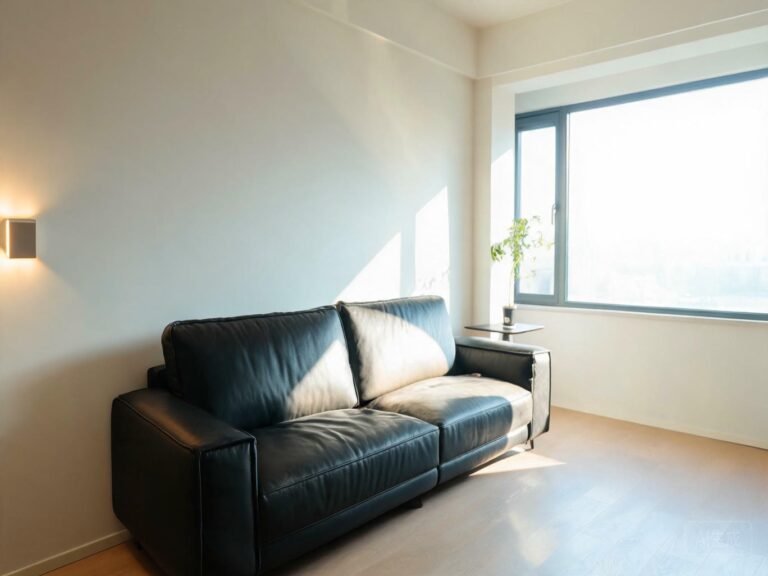
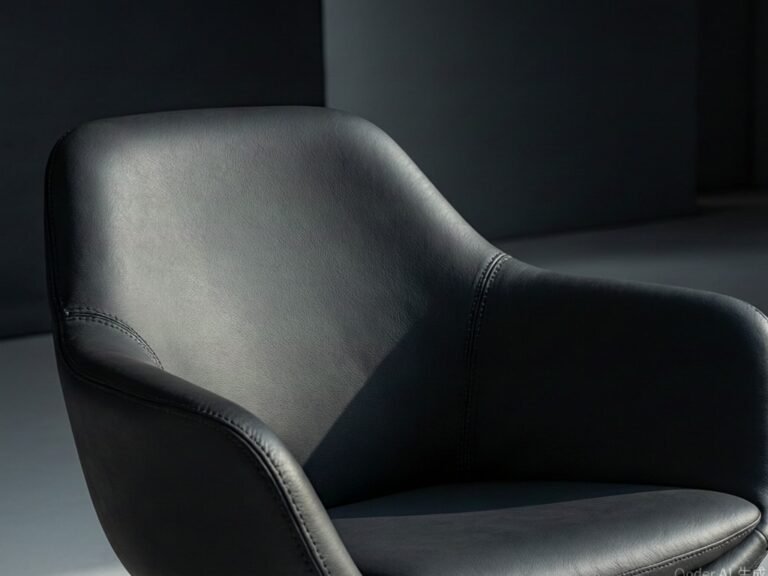
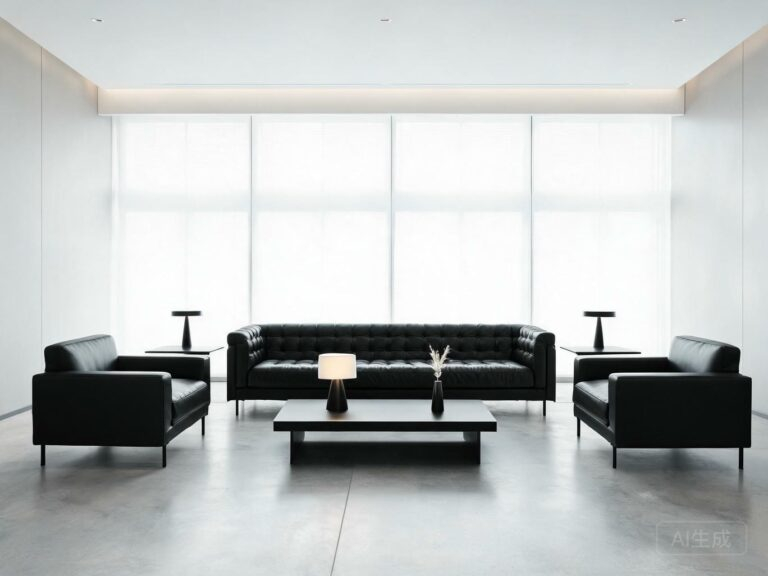
Black leather fabric is the default choice for an estimated 70% of commercial upholstery specifications — office chairs, cinema seating, automotive interiors, hotel furniture. It’s the safe, versatile, goes-with-everything option. It’s also the color where material quality differences show up fastest, because black absorbs more solar and thermal energy than any other color, accelerating every failure mode in synthetic leather.
If you’ve specified black leather fabric for a project and seen it fade to gray, crack at stress points, or develop a chalky surface within 2-3 years, the problem isn’t the color — it’s the chemistry underneath. Here’s why black is the hardest color to get right, and what to specify instead.

The Black Leather Problem: Why Dark Colors Degrade Faster
Black pigment absorbs across the full visible light spectrum — and converts that energy to heat. A black leather surface in direct sunlight can reach 70-80°C, while a white surface at the same exposure stays at 40-50°C. This thermal load has three compounding effects on synthetic leather:
- Thermal degradation: PU leather’s C-C backbone begins to break down above 80°C. Black PU in sunlight hits that threshold regularly — accelerating embrittlement and cracking.
- Pigment migration: Carbon black pigment in PU and PVC can migrate to the surface and rub off — causing the “graying” effect and color transfer to clothing.
- Plasticizer evaporation: PVC’s phthalate plasticizers volatilize faster at elevated temperatures — black PVC in a sun-exposed window becomes brittle 30-40% faster than lighter colors.

The result: black leather fabric that looks perfect in the showroom can start showing degradation within 12-18 months in real-world conditions — particularly in automotive interiors, south-facing windows, or outdoor applications.
Black Leather Fabric: Performance by Material Type
| Property | Black PVC | Black PU | Black Silicone |
|---|---|---|---|
| UV resistance | Poor — cracks in 1–2 years | Poor — fades and cracks in 1–2 years | Excellent — 1,000+ hrs, no fading |
| Thermal limit | 60°C — fails in sunlight | 80°C — borderline in sunlight | 250°C — unaffected by sunlight |
| Color fastness | Grade 2–3 — visible fading | Grade 3 — moderate fading | Grade 4–5 — no visible change |
| Surface temp in sun | 70–80°C (degradation zone) | 70–80°C (at thermal limit) | 70–80°C (well within range) |
| Pigment migration | Yes — carbon black rub-off | Moderate — some transfer | None — pigment locked in matrix |
| Martindale abrasion | 15,000–25,000 cycles | 25,000–50,000 cycles | 200,000+ cycles |
| Service life (black) | 1.5–2.5 years | 2–3.5 years | 10+ years |
Note the service life column: black color reduces the lifespan of PU and PVC by approximately 20-30% compared to lighter colors, because the thermal load accelerates every degradation pathway. Black silicone leather’s service life is unaffected by color because its 250°C thermal limit far exceeds any solar exposure temperature.

Why Black Silicone Leather Doesn’t Fade
Silicone leather solves the black leather problem at the molecular level. The Si-O backbone is thermally stable to 250°C — far above the 70-80°C surface temperature that black material reaches in direct sun. UV light passes through silicone without causing bond degradation, because silicone’s UV absorption spectrum doesn’t overlap with solar radiation. And the carbon black pigment is locked into the silicone polymer matrix, not sitting on the surface where it can rub off.
In ISO 105-B06 color fastness testing (the standard for color stability under light exposure), TOPSUN’s black silicone leather achieves Grade 4–5 — the highest rating, indicating no visible color change after extended light exposure. This is the same rating across all colors, because silicone’s UV resistance is a property of the material, not the pigment.

Applications Where Black Leather Fabric Quality Is Critical
- Automotive interiors: Dashboard, door panels, and seats — black surfaces in a car cabin reach 80-90°C in summer. PU fails within 2 years; silicone lasts 10+. See black leather upholstery specs.
- Cinema and theater seating: High-traffic, dark environments where wear isn’t visible until failure — but color consistency across the auditorium matters for luxury venues. TOPSUN’s Delta E ≤ 1.0 ensures every seat matches.
- Office chairs: Constant friction and body contact wear through surface pigment on PU/PVC. Silicone’s 200,000+ Martindale cycles and non-migrating pigment solve both problems.
- Restaurant booths: Food, grease, and cleaning chemicals attack leather finishes. Black silicone leather is bleach-safe and stain-resistant — see upholstery black leather comparison.
- Outdoor furniture: Direct sun + rain + temperature cycling. Black PU/PVC cracks in 12-18 months. Black silicone is UV-stable for 1,000+ hours and hydrolysis-proof.
About TOPSUN
TOPSUN manufactures black silicone leather with UV-stable pigmentation that resists fading, cracking, and thermal degradation across a 10+ year service life. Using platinum-cured silicone chemistry with a 250°C thermal limit, TOPSUN’s black leather achieves ISO 105-B06 Grade 4–5 color fastness and 200,000+ Martindale abrasion cycles. Production spans three bases in Dongguan, Yichang, and Xiangyang, China, with 500,000+ meters monthly capacity, Pantone/RAL color matching at Delta E ≤ 1.0, and 500-meter MOQ with 7-day sampling. All products are REACH compliant, FDA food-contact certified, and ISO 10993-5 biocompatibility tested.
See TOPSUN silicone leather on office chairs — heat-resistant black that won’t fade or crack under thermal stress
Black Leather Fabric: FAQ
Why does black leather fabric fade faster than lighter colors?
Black pigment absorbs the full visible light spectrum, converting it to heat. A black surface in sunlight reaches 70-80°C vs 40-50°C for white. This thermal load accelerates every degradation pathway in PU and PVC: the polymer backbone breaks down faster, plasticizers evaporate quicker, and surface coatings degrade more rapidly. Silicone leather doesn’t have this problem because its Si-O backbone is stable to 250°C — the 70-80°C surface temperature in sunlight is well within its operating range. See thermal fading analysis.
Can I specify a custom shade of black leather fabric?
Yes. TOPSUN offers Pantone and RAL color matching with Delta E ≤ 1.0 for all colors including black. Common black specs include Pantone Black 6 C, RAL 9005 (Jet Black), and custom “warm black” or “cool black” formulations. Batch-to-batch consistency is maintained through spectrophotometer-controlled color formulation. For black leather specifically, TOPSUN can also adjust sheen level — from matte to semi-gloss — to match design requirements. See black leather upholstery fabric specifications and black leather pieces guide.
Specify Black Leather That Stays Black
Get black silicone leather samples, review UV/thermal test data, or discuss your color specification.
Related: Leather fabric | Black upholstery vinyl | Leather couch fabric