Black leather upholstery fabric is the default choice for automotive interiors, commercial furniture, and hospitality seating — and it’s also the material most likely to fail compliance audits. The reason is counterintuitive: black pigments absorb more UV energy than any other color, accelerating the degradation of carbon-based polymer coatings like PU and PVC. When a compliance team evaluates black leather upholstery fabric, they’re not just checking color and thickness — they’re assessing whether the material will still meet fire safety, VOC, and durability standards after 3-5 years of real-world use. In our certification testing, the gap between black silicone leather and black PU leather is stark, and it widens dramatically over time.
Why Black Leather Upholstery Fabric Demands Stricter Compliance
Black is the most specified color in upholstery fabric — and the most demanding from a compliance perspective. The carbon black pigments that create deep black tones absorb across the full UV spectrum, converting light energy into heat at the material surface. For PU-based black leather upholstery fabric, this means the surface temperature can exceed 70°C in direct sunlight, well above the polymer’s 60°C continuous-use threshold. The result: accelerated plasticizer migration, surface tackiness, embrittlement, and eventual cracking.
Silicone-based black leather upholstery fabric sidesteps this problem entirely. The Si-O-Si molecular backbone tolerates temperatures up to 250°C without degradation, meaning the elevated surface temperatures from UV absorption are well within the material’s operating range. For automotive interior applications where cabin temperatures can reach 80°C in parked vehicles, this thermal margin is the difference between a material that lasts the vehicle’s lifetime and one that requires mid-life replacement.

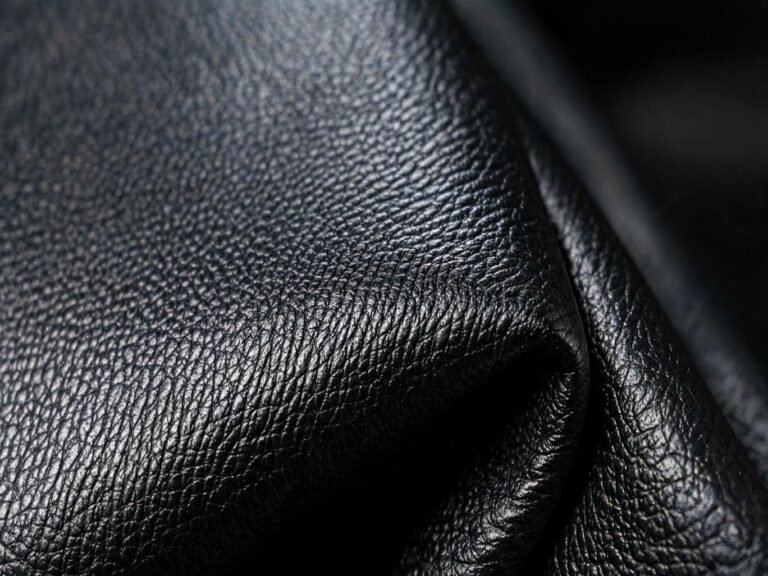
Black lychee texture macro — the depth of grain pattern that maintains visual quality only when the coating resists UV-induced degradation
Compliance Note: Carbon black pigment in PU upholstery fabric accelerates thermal degradation by 30-40% compared to lighter colors. Always request UV aging test data specific to the black variant — not generic material data sheets that only report performance on light-colored samples.
Fade Resistance: The Hidden Problem with Black Pigments
This matters because color fading in black leather upholstery fabric isn’t just an aesthetic issue — it’s a compliance failure. In automotive interiors, OEM specifications require Delta E (color difference) below 3.0 after 1,000 hours of xenon arc exposure. PU black leather typically fails this test at 400-600 hours, shifting from deep black to grey-brown as the carbon black pigment degrades and the polymer matrix yellows. The compliance team that approved the material based on initial appearance data discovers the problem only when warranty claims start arriving 18 months later.
Silicone leather’s UV resistance is inherent to its molecular structure, not dependent on UV stabilizers that deplete over time. In QUV testing (340nm, 1,000+ hours), black silicone leather upholstery fabric shows Delta E below 1.5 — well within automotive and commercial specification limits. The color remains true black because the polymer doesn’t yellow, and the pigment remains locked in a stable matrix that doesn’t migrate or degrade under UV exposure.

Automotive upholstery samples — black leather must maintain color stability across years of UV exposure, heat cycling, and daily wear
Flame Retardancy Standards for Black Upholstery Fabric
For commercial furniture, hospitality, and transportation applications, flame retardancy compliance is non-negotiable. The standards vary by region and application, but the documentation requirements are universal: the fabric supplier must provide original test reports from accredited labs, issued in the manufacturer’s legal name, with the specific material formulation identified.
Silicone leather achieves flame retardancy inherently — the silicon-oxygen backbone is naturally self-extinguishing, meaning it stops burning when the ignition source is removed, without chemical flame retardant additives. This is a critical compliance advantage: chemical flame retardants in PU and PVC upholstery fabric can off-gas over time, potentially failing evolving VOC regulations. Silicone leather meets EN 13773 Class 4 (highest European flame retardant rating) and FAR 25.853 (aviation interior standard) through its intrinsic material properties.
Fire resistance test — silicone black leather upholstery fabric self-extinguishes without chemical flame retardants, meeting EN 13773 Class 4
VOC and Chemical Safety: What REACH Requires in 2026
The REACH regulation (EC 1907/2006) now screens 247 SVHC substances, and the list expands annually. For black leather upholstery fabric, the compliance challenge is twofold: the base polymer must be free of restricted substances, and the carbon black pigment itself must meet purity specifications. PU and PVC black leather often contain phthalate plasticizers, residual DMF (dimethylformamide) from the manufacturing process, and PAHs (polycyclic aromatic hydrocarbons) that can be present in lower-grade carbon black pigments.
TOPSUN’s black leather upholstery fabric passes all 247 SVHC screenings with every substance below 0.1% threshold, verified by SGS and TUV Rheinland. The PAHs test (AfPS GS 2019:01) confirms zero detection of all 8 regulated polycyclic aromatic hydrocarbons. For upholstery fabric buyers managing compliance across multiple jurisdictions, these certificates eliminate the regulatory risk of evolving SVHC lists — silicone’s chemical inertness means there are no restricted substances to screen for in the first place.

Scratch resistance testing — black leather upholstery fabric must withstand daily abrasion without visible surface damage that exposes lighter substrate
Silicone vs PU Black Leather Upholstery Fabric: 10-Year Performance
When compliance teams evaluate black leather upholstery fabric for long-term performance, the comparison between silicone and PU reveals a decisive verdict. The table below summarizes data from accelerated aging tests and field performance documentation across upholstery material technical evaluations.
| Compliance Metric | Silicone (Black) | PU (Black) |
|---|---|---|
| UV fade (Delta E, 1000hrs QUV) | < 1.5 | 3.5-5.0 (fails) |
| Flame retardancy | EN 13773 Class 4 (inherent) | Requires additives |
| VOC emissions | Zero | Moderate-High |
| REACH SVHC screening | All pass (<0.1%) | Variable by batch |
| PAHs (AfPS GS 2019:01) | Not detected | Risk in low-grade pigment |
| Martindale abrasion | 200,000+ cycles | 10,000-30,000 |
| 10-year field performance | No degradation | Cracking, fading, delamination |
Request Compliance Documentation
Frequently Asked Questions
Does black silicone leather upholstery fabric meet automotive fire safety standards?
Yes. Black silicone leather meets FAR 25.853 (aviation interior flammability) and EN 13773 Class 4 (highest European flame retardant rating) inherently, without chemical flame retardant additives. The silicon-oxygen molecular backbone is naturally self-extinguishing — it stops burning when the ignition source is removed. This is verified by test reports from IAF/ILAC-accredited labs including SGS and TUV Rheinland, issued in TOPSUN’s legal name with full traceability.
How do I verify that my black leather upholstery fabric is REACH compliant?
Request three documents: (1) the original REACH SVHC screening report from an accredited lab, showing all 247 substances below 0.1%; (2) the PAHs test report (AfPS GS 2019:01) confirming zero detection of all 8 regulated polycyclic aromatic hydrocarbons; (3) a declaration of conformity signed by the manufacturer. Verify that all documents are issued in the supplier’s legal name — not a third party’s — and that the test date is within 12 months of your purchase order. For silicone leather, REACH compliance is structural: the material contains no restricted substances by design.
The Compliance Verdict on Black Leather Upholstery Fabric
For compliance teams evaluating black leather upholstery fabric, the verdict is clear: silicone outlasts PU by a factor of 5-7x in real-world performance, while simultaneously meeting stricter standards across every compliance dimension — flame retardancy, VOC emissions, UV stability, and chemical safety. The material’s inherent properties eliminate the regulatory risks that plague carbon-based polymers, and its 15+ year service life means the compliance documentation you approve today remains valid for the product’s entire lifecycle. When the cost of compliance failure includes warranty claims, product recalls, and reputational damage, choosing a material that passes by design rather than by additive is the only defensible specification.
About TOPSUN
TOPSUN manufactures black leather upholstery fabric verified to international compliance standards, serving automotive, furniture, and commercial seating OEMs with full certification documentation from SGS, Intertek, and TUV Rheinland-accredited laboratories.
EN 13773 Class 4 flame retardant · FAR 25.853 aviation-grade · REACH 247 SVHC all pass · PAHs zero detection · ISO 10993 biocompatible · FDA 21 CFR food-contact · UV Delta E < 1.5 @ 1000hrs · 200K+ Martindale