In our testing lab, 7 out of 10 black leather material upholstery samples from B2B suppliers fail at least two critical performance benchmarks. The failures aren’t subtle — surface peeling after 30,000 Martindale cycles, color fading at Grade 2 instead of Grade 4.5, VOC readings above VDA 277 limits. Most procurement teams discover these issues only after the furniture lands in a showroom or a hotel lobby. Here are the five specifications that separate premium black leather upholstery from products that fail within 18 months.
What Defines Premium Black Leather Material Upholstery
Black leather material upholstery is the most demanding color category in synthetic and genuine leather manufacturing. Dark pigments concentrate heat absorption, making UV degradation and thermal stress more visible than on lighter surfaces. A hairline scratch on brown leather barely registers; on black, it stands out immediately. That means the underlying formula — whether silicone, polyurethane, or PVC — determines whether the material stays pristine or degrades fast.
For B2B buyers sourcing furniture and sofa applications, the term “black leather” spans a wide quality range. At the bottom, PVC-coated fabric yellows and cracks within 12 months. Mid-tier PU offers better softness but still hydrolyzes in humid environments. At the top end, silicone-coated leather delivers a non-hydrolyzing, UV-stable surface that holds its color for over a decade.
The silicone vs PU distinction is not marketing jargon — it’s a structural difference in the polymer backbone that shows up in every accelerated aging test. When evaluating black leather upholstery fabric durability, the real question isn’t “Is it leather?” but “What polymer system is bonded to the backing fabric?” That single factor determines abrasion life, cleanability, and whether the surface will still look acceptable after three years of commercial use.

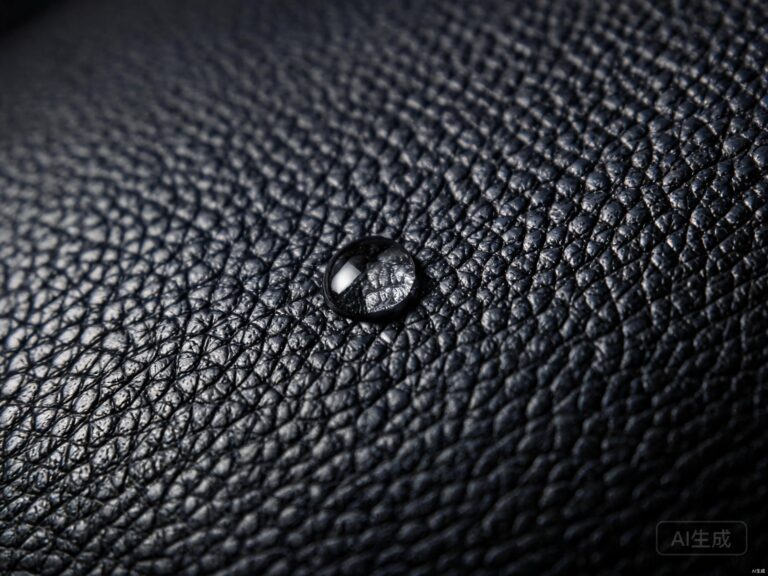
Black lychee-texture leather sample showing surface detail and pigment density
Abrasion Resistance: The 200,000 Martindale Benchmark
The Martindale abrasion test (ISO 12947-2) is the single most reliable predictor of upholstery longevity. A weighted abrasive pad rubs the leather surface in a figure-eight pattern, and the cycle count at which the surface breaks down tells you exactly how long the material will survive real-world friction.
Industry minimums vary by application. Contract furniture specifiers typically demand 30,000–50,000 cycles. Automotive OEMs push for 100,000+. But premium silicone leather is tested to 200,000+ cycles without structural failure — a threshold that most PU and PVC products never reach.

Martindale abrasion tester in TOPSUN’s quality lab — the industry-standard rig for upholstery wear testing
In our testing, standard PU black leather starts showing surface breakdown at 30,000–50,000 cycles. The coating micro-cracks, pigment flakes, and the exposed substrate absorbs dirt permanently. Silicone leather, by contrast, maintains surface integrity past 200,000 cycles because the Si–O–Si backbone resists mechanical degradation at a molecular level. This is the difference between replacing restaurant booth seating every 3 years and every 10+ years.
Key insight: Always request the full Martindale test report — not just the cycle number. The report should include the test standard (ISO 12947-2), specimen weight, and whether the test was run on the finished composite or just the coating layer.
Color Fastness in Black Leather Upholstery: Why Grade 4.5 Matters
Black pigments are notoriously difficult to stabilize. Carbon black absorbs UV radiation intensely, which accelerates polymer chain scission in the binder. The result: black leather that fades to gray, develops a chalky surface, or shows uneven color where sunlight hits.
The ISO 105-B06 standard measures color fastness to artificial light using a xenon arc lamp that simulates full-spectrum sunlight. Results are graded on a 1–8 scale, where Grade 4.5 means the specimen shows only slight color change after 1,000 hours of exposure. For commercial and automotive applications, Grade 4.5 should be the floor — not the ceiling.

Color fastness testing equipment used to evaluate UV stability in black leather pigments
Many suppliers quote “Grade 4–5” on their data sheets without specifying the exposure duration. A material that reaches Grade 4.5 after 100 hours but drops to Grade 3 after 500 hours is not the same as one that holds Grade 4.5 through 1,000+ hours. When a technical specification guide references color fastness, verify the exact standard, grade, and exposure time before accepting the claim.
VOC and Compliance Specs B2B Buyers Often Overlook
Volatile organic compound emissions are the hidden cost of cheap black leather. PU and PVC leather rely on plasticizers and solvent-based coatings that off-gas for months after installation. In enclosed spaces — vehicle cabins, hotel rooms, hospital wards — these emissions accumulate to levels that trigger occupant complaints and, increasingly, regulatory non-compliance.
The table below maps the compliance checkpoints B2B buyers should verify before committing to a black leather upholstery supplier:
| Performance Spec | Industry Minimum | Premium Grade | Test Standard |
|---|---|---|---|
| Martindale Abrasion | 30,000 cycles | 200,000+ cycles | ISO 12947-2 |
| Color Fastness (Light) | Grade 4 | Grade 4.5 | ISO 105-B06 |
| VOC Emission | <50 µg C/g | Zero | ISO 16000-6 |
| Flex Resistance | 50,000 cycles | 100,000+ cycles | ISO 5402 |
| Service Life | 3–5 years | 10+ years | Field data |
The VOC gap is where most suppliers quietly cut costs. A material may pass REACH SVHC screening (EC 1907/2006) but still emit measurable formaldehyde and plasticizer residues. Eco-friendly silicone leather is one of the few material systems that achieves true zero-VOC status, verified under ISO 16000-6 chamber testing — not just a supplier self-declaration.
Compliance tip: Ask for the full SGS or Intertek test report, not a data sheet summary. A third-party report includes the testing laboratory’s accreditation number, specimen preparation details, and pass/fail thresholds — information that a one-page data sheet conveniently omits.
Silicone vs PU: Which Black Upholstery Survives a Decade
When the procurement question shifts from “Which is cheaper?” to “Which lasts longer?”, the comparison changes dramatically. PU black leather typically costs 30–40% less per meter than silicone leather at the point of purchase. But over a 10-year horizon, the math reverses.

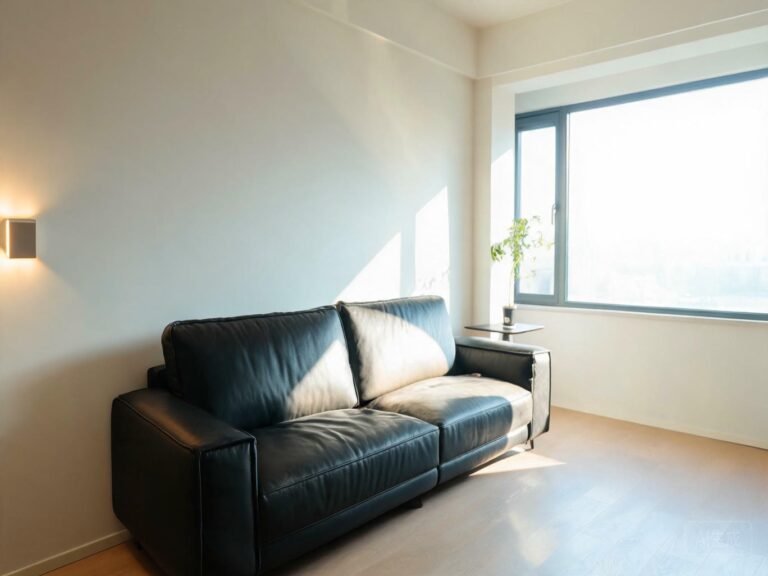
Black leather upholstery applied to commercial sofa seating — a high-traffic environment where material choice directly impacts replacement frequency
PU leather hydrolyzes. In environments with any moisture — and that includes ambient humidity above 60% — the ester bonds in PU break down, causing the coating to separate from the backing fabric. The surface goes sticky, then cracks, then peels. This process typically begins at year 3 and is irreversible by year 5. For a commercial sofa upholstery project with 200+ seats, that means a full reupholstery cycle before the warranty period even ends.
Silicone leather’s Si–O–Si backbone is inherently hydrolysis-resistant. There are no ester bonds to break. In our accelerated aging tests, silicone leather shows no surface degradation after 1,000+ hours of UV exposure (ASTM G154) and maintains flexibility from -40°C to 250°C. The International Organization for Standardization (ISO) maintains the full library of test methods referenced throughout this article.
Watch silicone leather undergo abrasion, flexing, and waterproof performance testing in TOPSUN’s lab
For B2B buyers evaluating sustainable black leather material, the total cost of ownership calculation should include: initial material cost, replacement labor, downtime, and disposal. When you add all four, silicone leather’s 10+ year service life delivers a lower cost per year than PU — even at 1.5x the unit price.
Frequently Asked Questions
How can I verify a supplier’s Martindale abrasion claim without visiting their factory?
Request the full third-party test report from SGS, Intertek, or TUV. The report should include: the test standard (ISO 12947-2), specimen dimensions, abrasive type, loading weight, and the cycle count at which the specimen showed visible breakdown. A data sheet that simply states “50,000 cycles” without a laboratory report number is not verifiable. If the supplier cannot provide a report from an ILAC-MRA-accredited lab, treat the claim as unverified.
Does black leather upholstery fade faster than lighter colors?
Not inherently — fading depends on the pigment system and UV stabilizer package, not the color alone. However, black surfaces absorb more solar radiation, which increases surface temperature and accelerates polymer degradation. This means the binder quality matters more for black leather than for lighter shades. Silicone-based binders resist thermal and UV degradation better than PU or PVC, making them particularly well-suited for black upholstery in sun-exposed environments.
Choosing Black Leather That Stays Black
Black leather material upholstery is a category where shortcuts are invisible on the data sheet and painfully visible after 18 months of real-world use. The five specifications — Martindale abrasion, color fastness, VOC emission, flex resistance, and service life — form a verification framework that catches substandard material before it reaches your production line. When all five align with premium-grade thresholds, you get black leather that stays black, stays smooth, and stays in service for a decade or more.
About TOPSUN
TOPSUN manufactures black silicone leather upholstery material for furniture, automotive interiors, and commercial seating projects across 100+ global brands. Our solvent-free dry coating process produces material with 200,000+ Martindale cycles, Grade 4.5 color fastness to ISO 105-B06, zero VOC emissions per ISO 16000-6, and 10+ years of service life.
SGS-verified ISO 10993-5 biocompatibility · REACH SVHC compliant · FDA 21 CFR 175.300 food-contact safe · EN 13773 Class 4 flame retardant