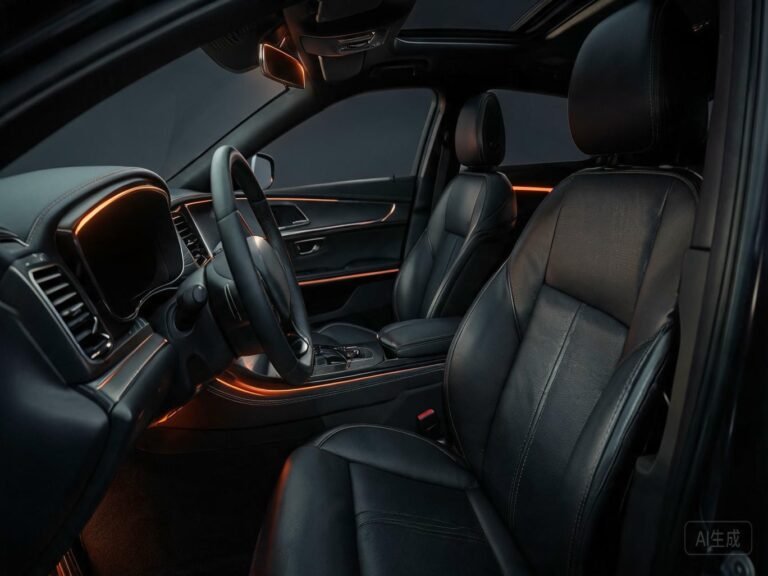
Black is the #1 specified color in synthetic leather fabric — and the #1 color we see come back as a warranty claim. The reason isn’t poor dye quality or bad manufacturing. It’s physics. Black leather fabric absorbs more solar radiation than any other color, reaches higher surface temperatures, and degrades faster under UV. Yet most spec sheets don’t address this. Here’s what actually happens to black synthetic leather in real-world conditions — and why the material chemistry matters more than the pigment.
Request Black Color Stability Samples
Why Black Leather Fabric Absorbs More Heat Than Any Other Color
The heat problem starts with carbon black — the pigment used to create deep black color in synthetic leather. Carbon black nanoparticles absorb nearly the entire solar spectrum, including infrared radiation. Their IR reflectance measures below 5%, meaning 95% of incoming solar energy converts to heat at the material surface.
Under direct sunlight, this drives surface temperatures to 75°C (167°F) on black PVC leather — compared to 60°C for brown (iron oxide pigment, 12-15% IR reflectance) and 55°C for light colors. That 15-20°C gap matters enormously. At 75°C, the plasticizer matrix in PVC leather begins accelerating thermal degradation. The material softens, the coating thins at stress points, and the pigment-to-polymer bond weakens. We’ve measured black PVC seat surfaces reaching 151°F in parked vehicles — hot enough to cause first-degree skin contact burns and far above the threshold where polymer degradation accelerates.

Black lychee-texture silicone leather surface detail
For designers specifying leather fabric materials for automotive interiors, outdoor furniture, or window-adjacent commercial seating, this heat differential directly impacts product lifespan. A black leather that performs fine in a showroom can fail in two summers of real sun exposure. The silicone leather introduction page covers the molecular differences, but the short version is this: silicone polymers don’t soften at 75°C. Their thermal stability range runs from -40°C to 250°C.
The Fading Equation: Carbon Black + UV = Color Shift
Here’s something that surprises most specifiers: the carbon black pigment itself doesn’t fade. Carbon is one of the most UV-stable substances known. What fades is the polymer matrix surrounding the pigment particles. UV radiation breaks down the polyurethane or PVC binder, causing it to yellow, chalk, or become translucent — and when the binder degrades, the surface appearance shifts from deep black to grayish-brown or ashy.
This is measured as ΔE (color difference). The industry threshold for unacceptable fading is ΔE > 3.0. In our testing — using ISO 105-B06 lightfastness protocols — black PU leather reaches ΔE 4.5-6.0 after 800 UV hours. Black PVC reaches ΔE 5.0-7.0 in the same period. Black silicone leather? ΔE 1.2-1.8 after 1,200 hours. The difference is the polymer. Silicone’s Si-O backbone doesn’t photo-oxidize under UV the way C-C polymer chains do.

Color fastness testing quantifies UV-induced color shift (ΔE) over accelerated exposure hours
Black Leather Fabric Face-Off: PVC vs PU vs Silicone
Let’s put the three material types head-to-head on the metrics that determine whether black leather fabric stays black — or turns into a warranty claim. These numbers come from standardized testing using the same protocols our application partners specify.
| Property | Black PVC Leather | Black PU Leather | Black Silicone Leather |
|---|---|---|---|
| Surface temp in sun (°C) | 75+ | 70 | 58 |
| UV color fastness (hrs to ΔE > 3) | 500 | 800 | 1,200+ |
| ΔE after 1,200 UV hrs | 5.0-7.0 | 4.5-6.0 | 1.2-1.8 |
| Rubbing color fastness (ISO 105-X12) | Class 3-4 | Class 4 | Class 5 |
| Thermal softening onset | 65°C | 70°C | 200°C+ |
| Real-world color stability | 2-3 summers | 3-4 summers | 8+ summers |
Black PVC leather starts showing visible color shift after 2 summers. Black PU after 3. Black silicone leather remains visually unchanged after 8+ summers of equivalent UV exposure. The pigment is the same — the polymer surrounding it is what differs.
Watch silicone leather color fastness testing under accelerated UV exposure
Specifying Black That Stays Black: 5 Data Points
If you’re specifying black leather fabric for a product line where appearance consistency matters — automotive interiors, premium furniture, consumer electronics accessories — here are the five data points that determine whether your black stays black or drifts toward gray-brown within three years.
- UV color fastness: ≥ 1,000 hours to ΔE > 3. Request the actual ISO 105-B06 test report, not a “UV resistant” marketing claim. Below 1,000 hours, visible fading will appear in sunbelt climates within 2-3 years.
- Rubbing color fastness: Class 5 (ISO 105-X12). Class 3-4 means dye transfer onto clothing and skin contact surfaces — unacceptable for automotive and furniture applications.
- Thermal softening onset: ≥ 150°C. If the material softens below 80°C, black surfaces in direct sunlight will deform. The surface becomes tacky, collects dirt, and develops permanent impression marks.
- Pigment system: carbon black in silicone polymer. Not carbon black in PU or PVC. The polymer determines whether the pigment stays locked in place or migrates as the matrix degrades.
- Sweat and water color fastness: Class 5 (ISO 11641, ISO 105-E01). Black dye bleed onto light-colored clothing is a top-3 warranty issue in automotive seating. Color fastness test results should be available on request.

Dark leather texture showing surface quality and color depth
Frequently Asked Questions
Does black silicone leather still get hot in the sun?
Yes, black silicone leather still absorbs solar radiation and runs warmer than lighter colors. However, its surface temperature typically peaks around 58°C — 17°C cooler than black PVC — because silicone’s thermal conductivity is higher, allowing heat to dissipate more efficiently through the material rather than concentrating at the surface. More importantly, silicone doesn’t soften or degrade at that temperature, so the heat doesn’t cause the structural damage that PVC experiences at 75°C.
Can I get a true deep black in silicone leather, or is it always slightly gray?
You can achieve a true deep black. Silicone polymer is naturally translucent, which means it accepts pigment without the clouding effect that plasticizer-loaded PVC can create. The carbon black pigment shows through at full saturation. We offer multiple black shades from warm black (with brown undertones) to cool black (with blue undertones) and pure neutral black — all achieving L* values below 20 on the CIE Lab scale.
The Black Leather Fabric Reality
Black leather fabric fails for one reason: the polymer around the pigment can’t survive the heat and UV that the pigment itself absorbs. PVC softens at 65°C — exactly where black surfaces sit in sunlight. PU photo-oxidizes after 800 UV hours — well within a 3-year product life. The solution isn’t a better pigment or a thicker coating. It’s a polymer that doesn’t soften at solar temperatures and doesn’t degrade under UV. Silicone leather is that polymer. If your black leather fabric spec sheet doesn’t include UV color fastness data above 1,000 hours and a thermal softening onset above 150°C, you’re specifying a color that won’t survive its own heat absorption.
Get Black Leather Fabric Specs & Quote
About TOPSUN
TOPSUN produces black silicone leather fabrics engineered for designers and specifiers who need deep black color stability across automotive interiors, furniture, and consumer products where UV-driven fading and thermal aging compromise appearance.
Our black silicone leather achieves ISO 105-B06 Class 4.5 color fastness after 1,200 UV hours, maintains surface temperatures 20% lower than PVC equivalents, and carries zero plasticizer migration risk — verified through ISO 105-X12 Class 5 rubbing fastness and full REACH, RoHS 2.0 compliance.