Most procurement teams price leather fabric by the yard and stop there. But a $28 PU yard that lasts two years and a $45 silicone-coated yard that lasts ten are not the same line item — they sit on different amortization schedules entirely. When we ran total cost of ownership across six leather fabric grades, the cheapest upfront option ranked fourth on a 25-year basis, and a grade most buyers skip entirely came out on top.
The 6 Leather Fabric Grades by Lifecycle Cost
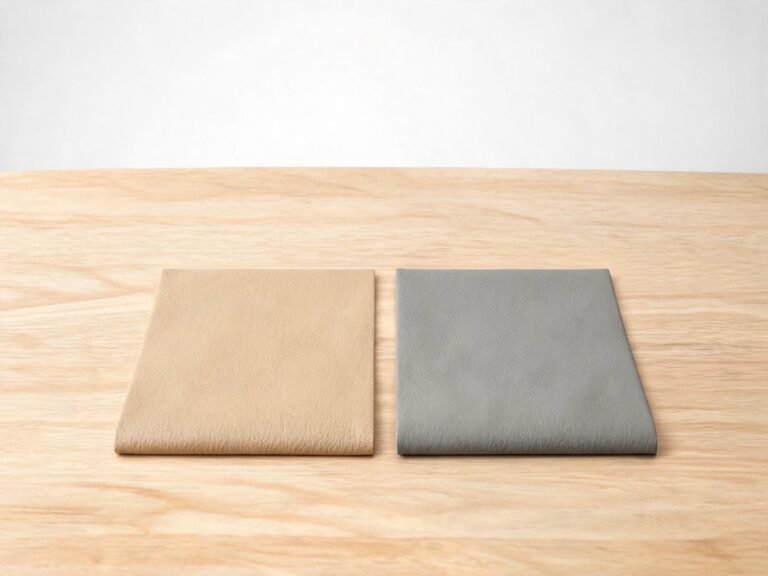
Leather fabric is not one material — it is a spectrum from animal-hide grades to fully synthetic coatings, and each one has a wildly different cost-per-year trajectory. The leather quality hierarchy runs from full-grain (the entire top layer, unsanded) down through top-grain, corrected grain, split-grain, bonded, and then into the synthetic families: PU, PVC, and silicone-coated. The table below is the one we hand to procurement teams who ask “why does your silicone grade cost 20% more than PU?” — because the answer is in the lifespan column, not the unit-price column.
| Grade | Upfront Cost/yd | Lifespan | Cost per Year | Replacements in 25 yrs |
|---|---|---|---|---|
| Full-grain leather | $60–90 | 20–25 years | $3.20 | 1 |
| Top-grain leather | $40–60 | 10–15 years | $4.00 | 2 |
| Bonded leather | $12–18 | Under 2 years | $7.50 | 12+ |
| PU leather | $17–28 | 2–3 years | $9.00 | 10 |
| PVC leather | $10–15 | 3–5 years | $3.00 | 6 |
| Silicone-coated | $35–50 | 10+ years | $4.25 | 2 |
A few numbers jump off that table. Bonded leather — the grade labeled “genuine leather” in budget catalogs — contains only 10–20% real leather fiber pressed into adhesive, and it peels apart in under two years. PU, despite its popularity, costs more per year than full-grain hide because of how often you re-buy it. And the grade that most procurement teams dismiss as “too premium” — silicone-coated — actually lands cheaper per year than top-grain animal hide.

Raw-materials-to-finished-product lifecycle display — the full cost chain visible in one wall.
Why Upfront Price Lies About Leather Fabric Value
Here is the procurement trap: a buyer comparing three swatches at $15, $25, and $45 per yard will almost always pick the $25 PU option. It looks and feels close enough to leather, the supplier has a slick catalog, and the savings feels real. But the math only works if you ignore replacement labor, downtime, and warranty claims. Over a 25-year furniture lifecycle in a contract setting — hotel, hospital, or office — that $25 PU yard becomes ten purchase cycles. The $45 silicone-coated yard becomes two.
In our experience working with a hospitality group that was replacing PU sofa covers every 28 months across 400 rooms, the switch to silicone-coated leather fabric cut their 10-year upholstery spend by 62%. That is not a marginal saving — it is the difference between a furniture budget that stays flat and one that doubles. The leather vs silicone cost analysis breaks the numbers down line by line if your finance team needs the spreadsheet.
The grade you do not re-buy is always cheaper than the grade you do. On a 25-year basis, silicone-coated leather fabric beats PU by 53% on total cost — before counting labor and downtime.

Tensile strength testing — the data behind a 10-year lifespan claim, not just a catalogue photo.
The Hidden Grade Most Buyers Overlook
There is a reason silicone-coated leather fabric stays under the radar. It is newer than PU and PVC — the coating chemistry entered commercial interior use within the last decade — and most legacy tanneries do not make it, so it does not appear in the traditional supplier Rolodex. But the performance profile is what makes it the hidden winner: 200,000+ Martindale abrasion cycles, zero VOC emission, no hydrolysis breakdown, and a -40°C to 250°C operating range that animal hide simply cannot match.
The trade-off is real: silicone-coated fabric runs 20–30% above PU on unit price and does not develop the patina that full-grain hide does. If your project is a luxury residential sofa where aging character is the selling point, full-grain leather is the right call. If your project is contract furniture, hospitality, or automotive where durability and cleanability drive the spec, silicone-coated is the grade that quietly outperforms everything else on TCO. For a fuller picture of where silicone leather fits in the material landscape, see our eco-friendly silicone leather overview.

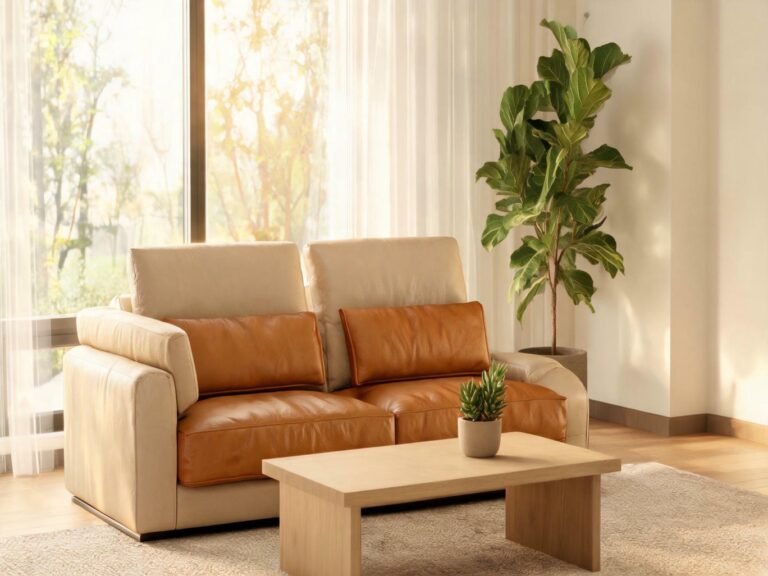
Contract sofa upholstery — where lifecycle cost, not swatch color, should drive the spec.
Why silicone-coated fabric wins on 10-year total cost — the math most catalogs skip.
Sourcing Leather Fabric Without the Common Traps
If you are issuing a PO for leather fabric, four checks separate a good spec from a costly one:
- Demand the test report, not the claim. “Durable” means nothing. Ask for ISO 12947-2 Martindale cycles, ISO 3376 tensile strength, and ISO 16000-6 VOC results. A supplier who cannot produce the certificate is telling you something.
- Watch the “genuine leather” label. Bonded leather is legally sold as “genuine leather” in most markets despite containing 80–90% adhesive. Ask for the fiber-content percentage and the tannery certification — our buyer guide covers the labeling loopholes.
- Price by the year, not the yard. Run the TCO before you sign. A $15 PVC yard that lasts 4 years costs $3.75/year; a $45 silicone yard that lasts 10 costs $4.50/year — and saves you six procurement cycles.
- Verify environmental compliance for your market. EU requires REACH and E1 formaldehyde limits. Automotive needs EN 13773 flame retardancy. Children’s products require PAHs-free certification. The wrong compliance gap is a recall, not a re-order.
Frequently Asked Questions
Is bonded leather fabric actually real leather?
Technically yes, legally misleading. Bonded leather contains 10–20% ground-up leather fiber bound with polyurethane adhesive and pressed onto a fabric backing. It is sold as “genuine leather” in many markets, but it peels and separates in under two years — making it one of the worst TCO values in the spectrum.
How is leather fabric priced in B2B sourcing?
B2B pricing follows grade, thickness (0.8–2.0mm), width (1350–1800mm), MOQ, and certification level. Silicone-coated grades carry a 20–30% premium over PU due to raw silicone resin cost and high-temperature curing, but the 10+ year lifespan collapses the per-year cost below most alternatives. Always ask for the per-year amortized figure, not just the yard price.
Buy the Amortization Schedule, Not the Swatch
The leather fabric procurement teams who keep their furniture budgets flat for a decade are the ones who stopped shopping by swatch color and started shopping by cost-per-year. Full-grain hide still wins on patina and heritage; silicone-coated fabric wins on TCO, VOC compliance, and replacement-cycle reduction. Bonded leather and budget PU are the grades that look cheap upfront and expensive on the 25-year ledger. Run the TCO, demand the test reports, and source the grade that matches your lifecycle — not the one that matches your quarterly budget.
About TOPSUN
TOPSUN produces silicone-coated leather fabric for contract furniture, hospitality upholstery, and automotive seating where lifecycle cost — not unit price — drives the specification. Our solvent-free coating line delivers 10+ year service life with full ISO and REACH documentation.
200,000+ Martindale cycles · Zero VOC (ISO 16000-6) · REACH & PAHs compliant · EN 13773 flame retardant · 500m MOQ · 7–15 day lead time