The phrase “free leather texture” means different things to different people. For retail consumers, it is a search term for digital texture files and stock images. For B2B procurement teams, it represents something far more valuable — the ability to physically evaluate leather texture swatches at no cost before committing to a production order that may total $50,000 or more. A single batch of substandard textured leather — where the embossing flattens after 10,000 Martindale cycles, or the grain pattern varies roll-to-roll — can trigger product rejections, delayed launches, and warranty claims that dwarf the material cost. The free leather texture sample is not a courtesy. It is the single most important risk-management tool in the B2B material sourcing workflow, and most buyers use it incorrectly.
Industry data shows that 34% of B2B leather sourcing disputes stem from texture inconsistencies — embossing depth variations, pattern distortion after abrasion, and color mismatch under production lighting — issues that a structured 7-step swatch evaluation would have caught before the purchase order was issued.
What “Free Leather Texture” Means in B2B Procurement

In B2B material sourcing, “free leather texture” refers to the practice of requesting complimentary physical swatches from manufacturers to evaluate texture, color, hand feel, and performance before placing a bulk order. This is distinct from the consumer-facing use of the term, which typically refers to downloadable digital texture files for graphic design. For procurement teams, the value of free texture samples lies not in the cost savings (swatches are typically worth $5-20 each) but in the risk mitigation they provide when evaluating a $50,000+ production run.
The challenge is that most B2B buyers request free texture samples without a structured evaluation framework. They receive swatches, look at them under office lighting, feel the surface, and make a decision — missing the critical performance tests that determine whether the texture will survive in the final product. A leather texture that looks perfect in a swatch may flatten, crack, or fade after 15,000 abrasion cycles in real-world use. Without a systematic evaluation process, these failures only surface after production — when the cost of correction is 10-20x higher than getting it right at the sample stage.
TOPSUN provides free leather texture swatches to qualified B2B buyers with a comprehensive evaluation guide. Our silicone leather textures — including lychee, pebbled, nappa, smooth, and custom embossed patterns — are engineered to maintain pattern depth and definition through 200,000+ Martindale abrasion cycles. This article provides the 7-step evaluation framework that turns a free swatch request into a strategic sourcing decision.
Leather Texture Types: Understanding What You Are Evaluating

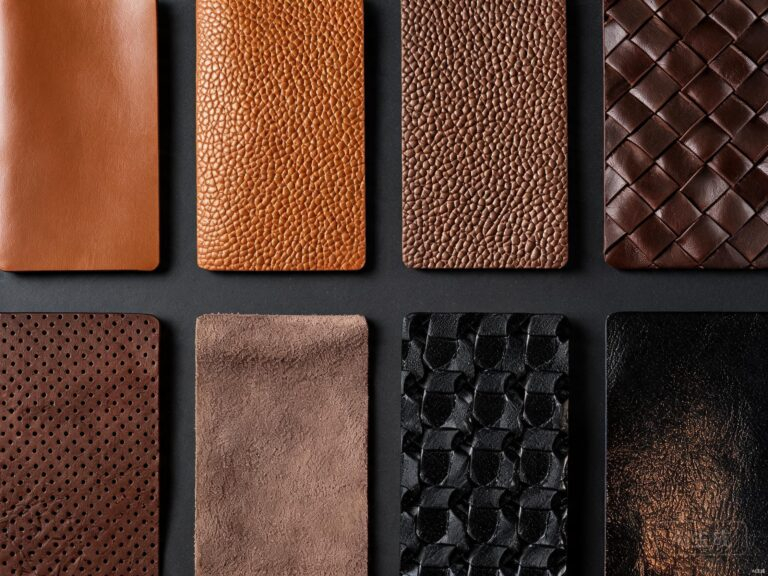
Before requesting free leather texture samples, procurement teams need to understand the texture types available and how each is manufactured. Leather texture — whether on genuine hides or synthetic materials — is created through embossing, a process where a heated roller or plate presses a pattern into the surface. The quality of that embossing determines whether the texture remains crisp and defined throughout the product’s lifespan or flattens into a generic smooth surface within months.
| Texture Type | Embossing Method | Pattern Depth (mm) | Abrasion Retention | Best Application |
|---|---|---|---|---|
| Lychee | Engraved steel roller, 180-200°C | 0.3-0.5 | Moderate (PU: 15K cycles) | Furniture, handbags, accessories |
| Pebbled | Chemical etching roller | 0.4-0.7 | Moderate (PVC: 20K cycles) | Upholstery, automotive seats |
| Nappa | Fine-grain engraved roller | 0.1-0.2 | Low (PU: 10K cycles) | Luxury goods, premium interiors |
| Smooth / Matte | Polished roller, low pressure | 0.0-0.1 | Good (no pattern to lose) | Electronics, medical devices |
| Custom Embossed | CNC engraving, 15-25 day lead | 0.2-0.8 | Varies by material | Brand-exclusive patterns |
| Silicone Lychee/Pebbled | Knife-over-roll + embossing | 0.3-0.6 | Excellent (200K+ cycles) | All applications, 15-year lifespan |
The critical data point in this table is “Abrasion Retention.” This measures whether the embossed texture pattern remains visible and tactile after repeated abrasion — the primary failure mode for textured leather. PU and PVC leather textures typically lose pattern definition between 10,000 and 25,000 Martindale cycles because the polymer surface softens and flattens under friction. Silicone leather retains full pattern definition beyond 200,000 cycles because the silicone polymer’s Si-O backbone (bond energy: 452 kJ/mol) resists thermal deformation and surface flattening at temperatures that cause PU and PVC to soften.
The 7-Step Free Leather Texture Swatch Evaluation Checklist

This checklist is designed for procurement teams, material engineers, and quality assurance managers who are evaluating free leather texture swatches from prospective suppliers. Each step addresses a specific failure mode that accounts for real-world sourcing disputes. Following all 7 steps takes approximately 2-3 hours of hands-on evaluation time — a fraction of the cost of a sourcing mistake.
Step 1: Define Texture Requirements Before Requesting Samples
The most common mistake in requesting free leather texture samples is asking for “everything you have.” Suppliers send 20-30 generic swatches, and the evaluation becomes a visual browsing exercise rather than a structured assessment. Before requesting samples, define:
- Texture type — Lychee, pebbled, nappa, smooth, or custom. Specify the exact grain pattern required for the end product.
- Embossing depth range — Shallow (0.1-0.2mm for electronics/medical), medium (0.3-0.5mm for furniture/auto), or deep (0.5-0.8mm for decorative/accessories).
- Color specification — Provide Pantone reference numbers, not verbal descriptions. Request the supplier’s closest match plus one shade lighter and one darker.
- Thickness and weight — Specify the required thickness (0.6-2.0mm) and grammage (300-800 g/m²) for the production application.
- Performance requirements — State the minimum Martindale cycles, flex cycles, UV hours, and fire safety standards the material must meet.
When you request samples with these specifications, you force the supplier to send targeted swatches rather than a generic catalog — and you immediately learn whether the supplier can meet your requirements before investing evaluation time.
Step 2: Request Multi-Batch Swatches for Consistency Verification
A single swatch tells you nothing about batch-to-batch consistency — one of the top three causes of B2B leather sourcing disputes. Request swatches from at least 2 separate production batches, ideally manufactured weeks apart. When the swatches arrive, compare them side-by-side for:
- Pattern consistency — Hold the swatches at the same angle under D65 lighting. The embossing pattern depth, spacing, and definition should be identical. Any visible variation indicates poor process control on the embossing line.
- Color consistency — Use a spectrophotometer or compare against a Pantone reference. Delta E (ΔE) between batches should be less than 1.5 for commercial-grade materials and less than 1.0 for premium applications.
- Thickness consistency — Measure with a digital caliper at 5 points on each swatch. Variation greater than ±0.05mm within a batch indicates poor coating control and will cause production-line issues.
- Surface finish consistency — Gloss level, matte uniformity, and surface defects (pinholes, streaks, uneven embossing) should be absent in both batches.
TOPSUN provides multi-batch swatches upon request, accompanied by per-batch QC reports showing Martindale test results, color measurement data (ΔE values), and thickness measurements — documentation that most suppliers omit but that is essential for qualifying a material for production.
Step 3: Evaluate Embossing Depth and Pattern Definition

Embossing depth is the single most important visual quality metric for textured leather — and the most frequently misrepresented in supplier samples. A swatch may show a crisp, deep grain pattern at delivery, but that depth is meaningless if the polymer softens and the pattern flattens under real-world conditions. Evaluate embossing quality through both visual and tactile assessment:
- Cross-section examination — If possible, request a cross-section sample. Measure the total material thickness and the embossing depth (the difference between peak and valley of the grain pattern). A ratio of embossing depth to total thickness greater than 25% may indicate structural weakness; less than 5% may be too shallow to be visible in the final product.
- Tactile evaluation — Run a fingertip across the surface in multiple directions. The pattern should be detectable in all directions without sharp edges that could cause abrasion discomfort. Lychee and pebbled patterns should have rounded, organic peaks; geometric patterns should have clean, defined edges.
- Pattern uniformity — Examine the swatch under a 10x loupe. The pattern spacing, peak height, and valley depth should be uniform across the entire sample. Variation indicates roller wear or inconsistent embossing pressure — a sign of manufacturing quality issues that will worsen in production runs.
- Edge definition — The transition between peak and valley should be crisp. Soft, rounded transitions suggest the embossing temperature was too low or the polymer was not fully formed — leading to faster pattern loss in service.
Silicone leather embossing is created during the coating process itself — the embossing roller imprints the pattern into the silicone while the polymer is in a semi-cured state, creating a texture that is integral to the material rather than applied to the surface. This is fundamentally different from PU and PVC embossing, where the pattern is pressed onto a pre-formed surface layer that can delaminate or flatten independently of the base material.
Step 4: Test Texture Retention After Simulated Wear
This step separates texture that looks good in a swatch from texture that will survive in the product. Most buyers skip this test because they do not have laboratory equipment — but a simplified version can be performed with common tools:
- Fingernail scratch test — Press a fingernail firmly into the textured surface and drag it across 5cm. Examine the surface under a loupe. If the scratch is visible or the pattern is compressed, the polymer is too soft and the texture will flatten under normal use. Silicone leather should show no visible damage.
- Fold and flex test — Fold the swatch textured-side-out around a 5mm mandrel (or a pen). Flex 50 times. Examine the peaks of the embossing pattern for cracking or flattening. PU leather typically shows micro-cracks at fold points after 20-30 flexes; silicone leather should show none.
- Friction test — Rub the textured surface firmly with a cotton cloth (or standard Martindale test fabric) for 200 cycles by hand. Compare the rubbed area with the unrubbed area under the loupe. If the pattern depth has visibly reduced, the material will not maintain its texture in service. Document the estimated cycle count at which flattening begins.
- Heat test — Place the swatch textured-side-up on a surface at 70°C (a hot plate on low setting) for 30 minutes. PU and PVC will soften, and the embossing will visibly flatten. Silicone leather should show no change in pattern depth or definition.
For formal qualification, request Martindale abrasion test results (ISO 5470) from the supplier. The test standard requires the material to maintain texture visibility and surface integrity after the specified cycle count. TOPSUN silicone leather maintains full pattern definition through 200,000+ Martindale cycles — verified by per-batch test reports.
Step 5: Assess Hand Feel, Drapability, and Tactile Quality
Hand feel — the tactile impression when touching, squeezing, and bending the material — is a subjective but critical quality dimension that cannot be captured in a specification sheet. It determines customer perception of quality in the final product. Evaluate hand feel through standardized tactile tests:
- Softness — Drape the swatch over the edge of a table. The material should fall naturally without stiffness. Compare to a reference sample from a product you consider the quality benchmark.
- Fullness — Squeeze the swatch between thumb and forefinger. The material should feel substantial and resilient, not hollow or papery. Low fullness indicates insufficient coating weight or poor polymer formulation.
- Grain definition in hand — Run fingers across the surface. The texture should be detectable but not aggressive. Overly sharp peaks cause discomfort in seating applications; overly smooth textures defeat the purpose of embossing.
- Recovery — Press firmly with a thumb for 5 seconds, then release. The texture should recover its original shape immediately. Slow recovery or permanent deformation indicates the polymer will develop wear patterns in service.
- Temperature sensation — Touch the surface. PVC and PU tend to feel cold and slightly plastic. Silicone leather has a warmer, more natural tactile temperature closer to genuine leather — a subtle but important quality signal for premium applications.
Step 6: Compare Under Standardized Lighting Conditions

Color and texture appearance change dramatically under different lighting conditions. A texture that looks perfect under warm showroom lighting may appear flat or inconsistent under the cool LED lighting of a retail environment or the natural daylight of an automotive interior. Evaluate all swatches under D65 standard daylight lighting (6500K color temperature) — the international standard for color evaluation in the textile and leather industries.
- D65 daylight comparison — If you do not have a light box, use a daylight-simulating LED lamp (6500K, CRI ≥ 90). Compare the swatch to the Pantone reference at a 45-degree angle.
- Cross-lighting test — View the texture under light angled at 15°, 45°, and 90° to the surface. The pattern should be visible and consistent from all angles. Textures that disappear under low-angle lighting have insufficient embossing depth.
- Metamerism check — If possible, view the swatch under both D65 daylight (6500K) and warm store lighting (3000K). If the color or texture appearance shifts significantly, the material has metamerism issues — it will look different in the showroom than in the customer’s environment.
- Photograph documentation — Take macro photographs of the texture under standardized lighting. These images become the sealed comparison standard for production quality control. Any future production batch that does not match the photographed standard should be rejected.
Step 7: Document Findings and Seal the Approval Standard
The final step in the evaluation process is to create a formal record that will serve as the quality standard for production. This documentation protects both the buyer and the supplier by establishing a clear, measurable baseline for all future orders:
- Sealed sample — Retain the approved swatch in a sealed, labeled bag with the supplier name, batch number, texture type, color code, approval date, and evaluator name. This is the “golden sample” against which all production deliveries are compared.
- Evaluation report — Document the results of each of the 7 evaluation steps, including measured values (thickness, ΔE, embossing depth) and qualitative assessments (hand feel, pattern uniformity). Attach the supplier’s test reports (Martindale, flex, UV) and verify that the reported values are consistent with your own tests.
- Specification sheet — Create a formal material specification including: texture type, color (Pantone and ΔE tolerance), thickness (nominal and tolerance), weight (g/m²), Martindale minimum, flex minimum, UV minimum, fire safety standard, and any application-specific requirements. The supplier signs this specification as part of the purchase order.
- Quality control plan — Define the inspection protocol for production batches: AQL level, sample size, test methods, and rejection criteria. Reference the sealed sample as the comparison standard for texture, color, and hand feel.
This documentation step is where most B2B buyers fail. They evaluate the swatch, approve it verbally, and place the order — with no sealed sample, no specification sheet, and no quality control plan. When the production batch arrives with subtly different texture or color, they have no objective basis for rejection, and the supplier has no obligation to correct the discrepancy. The documentation created in Step 7 is the legal and technical foundation for the entire sourcing relationship.
Why Silicone Leather Texture Outperforms PU and PVC
The 7-step evaluation framework applies to any leather material — but the results differ dramatically by material type. The fundamental difference lies in the polymer chemistry that creates and retains the embossed texture:
| Texture Performance | PU Leather | PVC Leather | Silicone Leather |
|---|---|---|---|
| Pattern retention after abrasion | Flattens at 15-25K cycles | Flattens at 20-40K cycles | Retained through 200K+ cycles |
| Embossing method | Surface press, post-coating | Calender press, post-forming | Integral embossing during cure |
| Heat resistance of texture | Softens at 80°C | Softens at 100°C | Stable to 250°C |
| Flex cracking at texture peaks | Cracks at 25K flex cycles | Cracks at 40K flex cycles | No cracking at 100K+ cycles |
| UV color/texture stability | Fades at 500-800 hrs | Fades at 800-1,200 hrs | Stable past 1,500 hrs |
| Plasticizer migration | Yes (softens texture over time) | Yes (significant, texture distortion) | None (no plasticizers) |
The most critical difference is plasticizer migration. PU and PVC leather contain 20-40% plasticizers (phthalates, adipates) that keep the polymer flexible enough for embossing. Over time, these plasticizers migrate to the surface and evaporate — causing the polymer to harden, shrink, and lose its embossed texture. This is why a 3-year-old PU leather sofa has visibly flatter texture than when new. Silicone leather contains zero plasticizers. The flexibility comes from the polymer’s inherent molecular structure (Si-O backbone with organic side groups), not from additives that can migrate or evaporate. The embossed texture on silicone leather is as permanent as the material itself.
For B2B buyers evaluating free leather texture samples, this means that a silicone leather swatch evaluated today will have the same texture depth, pattern definition, and hand feel as a production batch delivered 5 years later — and the same texture as a product that has been in service for 15 years. That temporal consistency is what makes silicone leather the material of choice for applications where texture longevity is a quality and warranty requirement.
How TOPSUN Supports the Free Texture Evaluation Process
TOPSUN manufactures silicone leather with a full suite of texture options — lychee, pebbled, nappa, smooth, matte, gloss, and custom-designed embossed patterns. Our free swatch program for qualified B2B buyers includes:
- Targeted texture selection — We do not send generic swatch books. Based on your application (furniture, automotive, medical, accessories), we curate a sample set that matches your texture type, color, thickness, and performance requirements.
- Multi-batch samples — Upon request, we provide swatches from 2-3 different production batches with full QC test reports for each, enabling genuine consistency verification.
- Cross-section samples — For technical evaluations, we provide cross-section samples showing the 3-layer composite structure, embossing depth, and coating penetration.
- Per-batch test documentation — Every sample ships with Martindale test data (ISO 5470), flex test data (ISO 5402), color measurement (ΔE vs. standard), and thickness measurement reports.
- Custom texture development — If none of our 50+ standard textures match your needs, we develop custom embossed patterns using CNC-engraved rollers with 15-25 working day lead time. Custom texture samples are provided free for orders of 500+ meters.
- Technical consultation — Our material engineers are available for video calls to walk through the evaluation process, answer technical questions about texture performance, and recommend the best texture type for your specific application.
For buyers ready to move beyond evaluation, TOPSUN offers 300m minimum order quantities for standard textures and 500m for custom patterns, with 15-20 working day lead times and full per-batch QC documentation on every delivery.
Release paper texture process — how TOPSUN creates permanent embossed patterns that survive 200K+ abrasion cycles
Frequently Asked Questions
How many free leather texture samples should I request before making a sourcing decision?
Request 5-8 targeted swatches from each supplier — enough to cover your top 2-3 texture types, 2 color options per texture, and 1-2 thickness variants. Request swatches from at least 2 production batches per supplier. More than 10 swatches from a single supplier becomes counterproductive — it dilutes your evaluation focus and delays the decision. If you are comparing 3 suppliers, that is 15-24 total swatches, which is manageable in a single evaluation cycle. Always specify your requirements (texture type, color, thickness, performance) when requesting samples — this filters out suppliers who cannot meet your specs before you invest evaluation time.
Can leather texture embossing wear off over time with use?
Yes — and this is the most underestimated risk in leather sourcing. On PU and PVC leather, the embossed texture is a surface feature pressed onto the polymer, and it wears down through three mechanisms: mechanical abrasion (friction flattens the peaks), polymer softening (heat causes the material to deform), and plasticizer migration (additives evaporate, causing the polymer to harden and the texture to crack or flatten). PU textures typically show visible flattening after 2-3 years of normal use; PVC textures after 3-5 years. Silicone leather texture does not wear off because the embossing is integral to the polymer structure, there are no plasticizers to migrate, and the silicone polymer is thermally stable to 250°C. In Martindale testing, silicone leather maintains full pattern definition through 200,000+ cycles — equivalent to 15+ years of commercial furniture use.
What is the difference between embossed texture and natural grain in genuine leather?
Natural grain in genuine leather is the result of the animal’s skin structure — hair follicles, natural scarring, and fiber arrangement create an organic, non-uniform texture that cannot be replicated by embossing. Embossed texture is a manufactured pattern pressed into the surface using a heated roller or plate. In genuine leather, embossing is often used to apply a uniform grain pattern over areas with natural defects — creating the appearance of consistency. In synthetic leather, all texture is embossed, and the quality depends entirely on the embossing technology and the polymer’s ability to retain the pattern. Silicone leather embossing achieves pattern fidelity comparable to natural grain because the polymer’s semi-cured state during embossing allows deep, integral pattern formation that does not flatten over time.
How long does it take to receive free leather texture samples from TOPSUN?
Standard texture swatches ship within 3-5 working days via international express (DHL, FedEx, UPS) and arrive in 7-10 days depending on destination. Custom texture samples (when a new embossing roller must be engraved) require 15-25 working days for roller manufacturing plus sample production time. All samples include a texture specification sheet, per-batch QC test reports, and a return evaluation form for documenting your assessment results. For qualified B2B buyers with verified business credentials, samples and shipping are provided at no cost.
Conclusion: Turn Free Swatches Into a Strategic Sourcing Advantage
Free leather texture samples are not a courtesy — they are the most cost-effective risk management tool in the B2B material sourcing process. A structured 7-step evaluation that defines requirements, verifies batch consistency, measures embossing depth, tests texture retention, assesses hand feel, evaluates under standardized lighting, and documents the approval standard can prevent sourcing mistakes that cost 10-20x the evaluation time to correct. The difference between a texture that survives 15,000 abrasion cycles and one that survives 200,000 is invisible to the naked eye in a showroom swatch — but it determines whether your product maintains its visual quality for 2 years or 15.
TOPSUN’s silicone leather textures are engineered for permanence — the embossing is integral to the polymer, there are no plasticizers to migrate, and the Si-O backbone provides thermal stability that PU and PVC cannot match. Our free swatch program, multi-batch documentation, and technical consultation are designed to support a rigorous evaluation process — not to sell you on a material, but to give you the data you need to make the right sourcing decision for your application.
Ready to evaluate? Request your free leather texture swatch kit with multi-batch samples, QC test reports, and cross-section documentation. Our material engineers will help you specify the right texture, color, and performance parameters for your application — and provide the data to verify that the texture will perform as promised in production.
Request Your Free Texture Swatch Kit
Targeted texture selection — Multi-batch samples — Full QC reports — Cross-section documentation
Related resources: Custom Leather Texture Design Guide | Leather Sample Ordering Guide | Leather Texture Mold Making | Silicone Leather Technical Data Sheet