“Dry processing leather” sounds clean. The name implies a method that skips solvents, avoids chemical baths, and produces material without environmental impact. In practice, the traditional dry processing leather method uses solvent-based polyurethane resin that evaporates volatile organic compounds into the atmosphere during the drying oven phase. For B2B buyers facing tightening VOC regulations under China’s MIIT mandates and EU REACH restrictions, understanding which dry processing method a supplier actually uses — solvent-based dry, solvent-free dry, or wet coagulation — determines whether the material passes compliance or fails it.
What Is Dry Processing Leather? The Method Behind the Name
Dry processing leather is a manufacturing method where a polymer coating — typically polyurethane or silicone — is applied to a release paper carrying an embossed grain pattern, then dried and laminated to a textile substrate. The release paper determines the surface texture: its pattern transfers directly to the polymer film during the drying oven phase, creating the leather-like grain that consumers recognize. Once the polymer cures, the release paper is peeled away, leaving a patterned, consistent surface ready for lamination to the backing fabric.
The term “dry” refers to the coating application method — the resin is applied as a liquid film and dried through evaporation — not to the absence of solvents. This distinction matters: a supplier can describe their product as “dry processed” while using solvent-based PU resin that emits VOCs throughout production. The silicone leather manufacturing process uses the same dry coating method but with a solvent-free silicone formulation that produces zero VOC emissions.

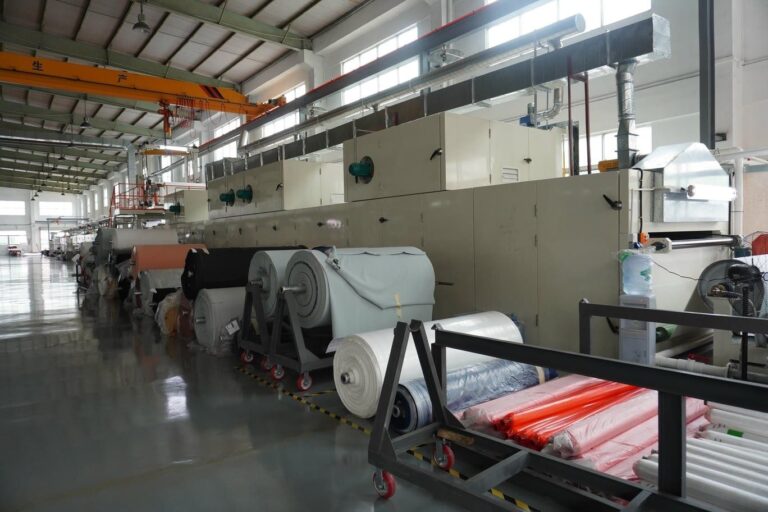
Release paper coating line — the release paper carries the grain pattern that transfers to the polymer film. The same equipment runs solvent-based PU or solvent-free silicone; the chemistry determines VOC output.
Dry Process vs Wet Process: Fundamental Differences
Synthetic leather manufacturing uses two fundamental methods, and they produce materially different products:
Dry process: Polymer resin is coated onto release paper, dried through an oven to evaporate carrier solvents (or cure solvent-free formulations), then laminated to the textile substrate. The result is a smooth, consistent surface with excellent pattern definition — ideal for fashion, accessories, and applications where surface aesthetics matter most. Traditional dry processing uses solvent-based PU; the solvent evaporates into exhaust gas that requires treatment equipment [$TOPSUN](https://taiteleather.com/pu-leather-manufacturer-guide/).
Wet process (coagulation): The textile substrate is immersed directly in a polyurethane solution containing DMF (dimethylformamide), then passed through a water coagulation bath. Water displaces the DMF solvent, causing the PU to precipitate into a microporous structure with pore sizes of 0.1–10μm. This creates a breathable, leather-like feel suited for automotive interiors, athletic footwear, and applications requiring durability and moisture permeability. However, the wet process consumes large volumes of DMF — a reproductive toxicant restricted under REACH Annex XVII — and generates wastewater requiring specialized treatment [$TOPSUN](https://fjyudeng.com/id/dry-and-wet-processing-of-pu-leather/).

Water-based PU production — an intermediate step between traditional solvent-based processing and fully solvent-free silicone coating. Each method carries different compliance implications.
The VOC Problem: Why Traditional Dry Processing Fails 2026 Rules
China’s Ministry of Industry and Information Technology (MIIT) has mandated that by end of 2026, all new synthetic leather projects must use 100% water-based or solvent-free technology. Existing solvent-based processes are capped at 15% of capacity. The environmental tax mechanism makes this a cost issue, not just a compliance issue: factories using traditional solvent-based dry processing pay 2,500–3,000 RMB per ton in additional environmental costs, while water-based and solvent-free lines see a 70%+ reduction in tax burden.
For B2B buyers, this regulatory shift has a direct supply-chain consequence. Factories that have not transitioned to solvent-free or water-based methods will either shut down capacity or pass environmental compliance costs to buyers through price increases. A supplier quoting suspiciously low prices on dry-processed leather may be using a non-compliant solvent-based process that will face regulatory enforcement — disrupting supply continuity. Verify the eco-friendly manufacturing credentials before placing orders with any supplier still using solvent-based methods.
Solvent-Free Dry Coating: The Silicone Standard
Solvent-free dry coating is the only dry processing method that eliminates VOC emissions at the source rather than treating them downstream. Instead of dissolving PU resin in DMF or other solvents, a silicone elastomer is applied directly to the release paper and cured through thermal crosslinking — no evaporation, no exhaust gas, no wastewater. The same release paper texture transfer applies; the same coating line equipment can be used. The difference is entirely in the chemistry.
TOPSUN manufactures silicone leather using a solvent-free dry coating process that produces zero VOC emissions, meeting EU E1, VDA 277, and China MIIT 2026 mandates without environmental tax penalties. The resulting material combines the surface quality of dry processing — consistent grain, smooth finish, uniform color — with the durability of silicone chemistry: 10+ year service life, 200,000+ Martindale abrasion cycles, hydrolysis resistance, and UV stability exceeding 1,000 hours. For a process-level comparison, see our solvent-free synthetic leather guide.
| Process Dimension | Dry (Solvent-Based PU) | Dry (Solvent-Free Silicone) | Wet (DMF Coagulation) |
|---|---|---|---|
| Carrier solvent | DMF / MEK | None — thermal cure | DMF (water coagulation) |
| VOC emission | High — requires exhaust treatment | Zero | High — DMF in wastewater |
| Environmental tax (China) | +2,500–3,000 RMB/ton | 70%+ reduction | +2,500–3,000 RMB/ton |
| MIIT 2026 compliance | Non-compliant (capped at 15%) | Fully compliant | Non-compliant (capped at 15%) |
| Surface quality | Smooth, consistent grain | Smooth, consistent grain | Microporous, breathable |
| Service life | 3–5 years | 10+ years | 4–6 years |

Drying oven for solvent-free silicone coating — the same equipment that processes solvent-based PU, but with zero exhaust gas treatment required because there is nothing to evaporate.
Specifying Dry Processing Leather: 5 Compliance Checkpoints
When sourcing dry-processed leather, verify these five compliance dimensions before placing an order:
1. Carrier chemistry. Request the exact carrier formulation — solvent-based (DMF/MEK), water-based, or solvent-free. “Dry processed” is not sufficient documentation; the carrier chemistry determines VOC compliance status.
2. VOC test data. Require ISO 16000-6 chamber testing results. EU E1 compliance (formaldehyde ≤ 0.1 ppm) is the minimum for indoor applications; VDA 277 is required for automotive interiors. Solvent-free silicone coatings produce zero measurable VOC; solvent-based PU cannot meet VDA 277 without post-processing.
3. MIIT compliance status. For suppliers manufacturing in China, confirm whether their production lines meet the 2026 MIIT mandate. Non-compliant factories face capacity caps that can disrupt supply continuity. Request the technical data sheet with environmental compliance declarations.
4. Wastewater and exhaust documentation. Wet process facilities must provide DMF recovery rates and wastewater treatment certificates. Dry process facilities using solvents must provide exhaust gas treatment compliance. Solvent-free dry coating requires neither — a documentation advantage that simplifies supplier audits.
5. Certification stack. Verify REACH Annex XVII compliance (DMF restriction), RoHS (heavy metals), and EU Ecolabel compatibility. Full certification documentation is available on our certificates page — including SGS, Intertek, and FAA-approved lab test reports.
FAQ
Is dry-processed leather always solvent-free?
No. “Dry processing” refers to the coating application method — resin applied to release paper and dried through evaporation — not to the absence of solvents. Traditional dry processing uses solvent-based PU resin that emits VOCs during the drying oven phase. Solvent-free dry coating uses silicone elastomer that cures through thermal crosslinking without any carrier solvent. Both methods are “dry processing,” but only the solvent-free variant produces zero VOC emissions. Buyers must specify “solvent-free dry coating” or “solvent-based dry coating” explicitly in purchase orders to avoid receiving non-compliant material.
Dry Processing Leather: Method Determines Compliance
Dry processing leather is not a compliance claim — it is a manufacturing method that can use solvents or avoid them entirely. The 2026 MIIT mandate, EU REACH restrictions, and environmental tax mechanisms have made the distinction a procurement-critical variable: solvent-based dry processing faces capacity caps, tax penalties, and supply disruption risk; solvent-free silicone dry coating faces none of these. When the spec says “dry processed,” the next question must be: with or without solvents? The answer determines whether the material passes compliance for the next decade or fails it on delivery.