A luxury handbag brand in Milan ordered “crocodile-embossed machine leather” from a new supplier at 22% below their usual cost. The texture looked identical in showroom samples — deep, defined, visually indistinguishable from genuine crocodile. Eight months after retail launch, the brand’s warranty inbox filled with complaints: the crocodile pattern was wearing flat on handbag flaps, corners, and strap attachment points. Lab analysis revealed the embossing depth was 0.2 mm — below the 0.3 mm minimum needed to survive normal flexing and abrasion. The supplier had used chemical etching on the roller mold instead of CNC engraving, cutting mold cost by 60% but reducing pattern durability by 70%. Machine leather isn’t just “leather with a pattern.” It’s an engineered surface where mold type, embossing depth, pressure, and temperature determine whether the texture lasts eight months or eight years.
How Machine Leather Gets Its Texture: The Two Manufacturing Routes
Machine leather texture is created through one of two processes: plate embossing or roller (calendering) embossing. In plate embossing, a hydraulic press forces an engraved metal plate into the leather surface under thousands of pounds of pressure. The plate method produces deep, precisely aligned impressions — ideal for handbags, wallets, and panels where pattern placement is critical. But the process works in sections, making it slow and expensive for large volumes.
Roller embossing — the calendering process — feeds leather continuously between a heated, pattern-engraved steel roller and a pressure roller. The pattern transfers to the leather surface as it passes through. This continuous process is faster and more cost-effective for upholstery, automotive, and large-volume applications. At TOPSUN, our calendering lines produce machine leather textures on silicone-coated rolls at 54-inch width, with CNC-engraved rollers achieving pattern depths of 0.3–1.5 mm depending on the texture specification.

Release paper coating line — the texture is transferred from engraved release paper or embossing rollers to the leather surface during the dry coating process
Mold Technology: What Determines Pattern Lifespan
The Milan brand’s failure traced to a single procurement decision: the supplier chose chemical etching over CNC engraving for the embossing roller. The four mold-making techniques each produce different pattern fidelity and durability outcomes:
| Mold Technique | Depth Range | Lead Time | Mold Cost | Pattern Lifespan |
|---|---|---|---|---|
| CNC Engraving | 0.3–1.5 mm | 15–25 days | $3,000–8,000 | 8+ years |
| Chemical Etching | 0.1–0.3 mm | 10–15 days | $800–2,000 | 6–12 months |
| Laser Engraving | 0.5–2.0 mm | 10–20 days | $2,000–5,000 | 5–8 years |
| Electroforming | 0.3–1.2 mm | 20–30 days | $2,000–5,000 | 8–10 years |
The data is unambiguous: chemical etching produces shallow patterns (0.1–0.3 mm) that flatten under abrasion within 6–12 months. CNC engraving and electroforming produce deeper patterns (0.3–1.5 mm) that survive 5–8+ years of normal wear. For B2B buyers specifying machine leather, the question isn’t “what pattern do you want?” — it’s “what mold technique produced the pattern, and what depth does it achieve?” Require the embossing depth in writing on the purchase order: 0.3 mm minimum for furniture, 0.5 mm minimum for automotive and high-wear applications. For a broader look at how texture options integrate into the silicone leather material system, our technical overview covers the full range.
Specification rule: Require on the PO: (1) mold technique (CNC/chemical/laser/electroforming), (2) embossing depth in mm, (3) roller material hardness (HRC 58–62 for production durability), (4) pattern repeat size, (5) ISO 105-X12 rubbing fastness grade for the embossed surface. A supplier who cannot provide all five is selling a texture, not a specification.
Silicone vs. PU: Why the Base Material Determines Texture Survival
Even with the right mold and depth, the base material determines whether the texture survives. PU leather embossing relies on the polyurethane coating’s ability to hold a pattern — but PU coatings soften at 60–80°C and undergo hydrolysis over 2–5 years, gradually flattening the embossed pattern even without mechanical wear. Silicone leather’s Si-O backbone is thermally stable up to 250°C and does not hydrolyze, meaning the embossed texture retains its depth for the full 10–15+ year service life of the material.
The processing temperature also matters. Silicone leather requires calendering at 150–200°C — higher than PU’s 80–120°C range. This higher temperature forces the silicone polymer deeper into the mold, creating a more defined impression that bonds permanently to the substrate. TOPSUN’s texture vault showcases 100+ standard patterns produced on our CNC-engraved calendering rollers, with custom textures available at 500-meter MOQ.

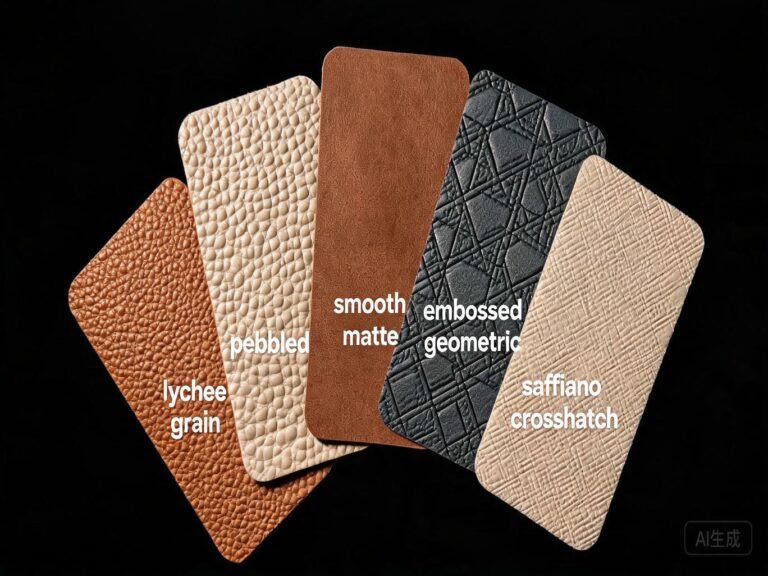
Custom texture samples — CNC-engraved rollers produce 0.3-1.5mm depth patterns that survive 8+ years of commercial use; chemical etching produces 0.1-0.3mm patterns that flatten within 12 months
Machine Washable: When “Machine Leather” Means Washability
A second interpretation of “machine leather” relates to machine washability — the ability to clean leather in a standard washing machine. Genuine leather can never be machine washed: water strips natural oils, agitation damages the fiber structure, and shrinkage is guaranteed. PU faux leather can rarely survive machine washing because water seeps into seams and backing, and the polyurethane film cracks after drying. PVC vinyl can occasionally survive a delicate cycle but warps under heat.
Silicone-coated leather is the only material that is fully machine washable and bleach-safe. The non-porous silicone surface repels water at hydrostatic pressure ratings exceeding 10,000 mm, maintains structural integrity through wash cycles, and resists abrasion at 100,000+ Martindale cycles. For applications in healthcare upholstery, infant products, and food-contact surfaces — where cleaning protocols require regular machine washing — silicone leather eliminates the trade-off between leather aesthetics and sanitization. For brands evaluating faux patent leather and other synthetic alternatives, the washability gap is often the deciding factor in material selection.
Custom Texture Development: What B2B Buyers Should Expect
When sourcing custom machine leather textures, B2B buyers should evaluate suppliers on five criteria: (1) in-house mold-making capability versus outsourced — in-house reduces lead time by 10–15 days and ensures quality control. (2) standard texture library size — suppliers with 100+ standard patterns can deliver faster turnaround for common textures. (3) prototype capability — the ability to produce 5–10 meters of prototype before committing to a full production run. (4) mold maintenance program — calendering rollers require periodic refinishing every 50,000–100,000 linear meters to maintain pattern depth. (5) silicone-specific mold engineering — silicone leather’s higher processing temperatures (150–200°C) demand heat-resistant mold materials; standard aluminum molds may deform.

Rewinding and slitting line — after calendering, textured silicone leather rolls are slit to specification width and rewound for shipment to B2B manufacturers
At TOPSUN, our in-house mold-making facility includes CNC engraving, laser engraving, and electroforming capabilities. Our standard texture library includes 100+ patterns — from pebble grain and lychee to crocodile and basketweave — with custom textures developed in 15–25 working days at 500-meter MOQ. All calendering rollers are hardened steel (HRC 58–62) with periodic maintenance to maintain pattern fidelity across production runs. For automotive, furniture, and fashion applications, the texture development process is the difference between a pattern that lasts and one that flattens.
Request Free Custom Texture Development
Frequently Asked Questions
What embossing depth should machine leather have for furniture?
For furniture upholstery, machine leather should have a minimum embossing depth of 0.3 mm. This depth ensures the pattern survives normal abrasion and flexing over the expected service life. For high-wear applications like automotive seats and commercial furniture, specify 0.5 mm or deeper. The mold technique matters as much as the depth: CNC engraving and electroforming produce patterns that last 8+ years, while chemical etching produces shallow patterns (0.1–0.3 mm) that flatten within 6–12 months. Always require the mold technique and embossing depth in writing on the purchase order.
Is silicone leather machine washable?
Yes — silicone-coated leather is fully machine washable and bleach-safe. The non-porous silicone surface repels water at hydrostatic pressure ratings exceeding 10,000 mm, and the Si-O polymer backbone maintains structural integrity through wash cycles without cracking, shrinking, or losing texture depth. This makes silicone leather the only washable leather option for healthcare upholstery, infant products, and food-contact surfaces. Genuine leather, PU, and PVC cannot be machine washed without structural damage — water strips natural oils from genuine leather, penetrates PU backing seams, and warps PVC under heat.
The Texture Is the Specification
The Milan handbag brand’s warranty crisis was preventable with one line on the purchase order: “Embossing depth: 0.5 mm minimum, CNC-engraved roller, HRC 58–62 steel.” That specification would have eliminated the supplier who used chemical etching at 0.2 mm depth — and the 1,200 warranty claims that followed. Machine leather is an engineered surface where every parameter — mold technique, depth, pressure, temperature, base material — determines whether the texture lasts months or years.
For B2B buyers, the framework is: specify the mold technique, require the embossing depth, verify the roller material, and choose a base material whose thermal stability matches your durability requirements. Silicone leather calendered at 150–200°C on CNC-engraved rollers produces textures that survive the full 10–15+ year service life of the material — the only combination where pattern, performance, and longevity align.
About TOPSUN
TOPSUN operates in-house CNC engraving, laser engraving, and electroforming mold-making facilities with 100+ standard textures in its library — producing machine-embossed silicone leather at 0.3–1.5 mm depth on hardened steel calendering rollers (HRC 58–62) for B2B brands requiring textures that survive the full material service life.
500,000+ m monthly capacity · 100+ standard textures · Custom texture development: 15–25 days · MOQ 500m · HRC 58–62 calendering rollers · Free A4 swatches worldwide via DHL/FedEx