A procurement manager at a hospitality furniture company contacted us last quarter with a familiar problem: their premium bison leather couch line was bleeding margin. Each unit cost 3.2x more than cowhide equivalents, and field returns for cracking and drying had climbed to 4.7% after just 18 months in service. They needed a material that delivered the same rugged, textured aesthetic without the sourcing headaches and maintenance overhead. That conversation prompted a deep dive into bison leather couch economics — and where silicone leather changes the equation.
Why Bison Leather Couches Command Premium Prices
Bison leather sits at the top of the upholstery hierarchy for good reason. The hide is 2-3 times thicker than standard cowhide, with densely packed fibers that make it roughly 40% stronger in tensile testing. That natural toughness translates to exceptional abrasion resistance — a critical metric for couches in high-traffic commercial environments like hotel lobbies and executive lounges.
But the premium pricing isn’t just about material performance. American bison are commercially raised in limited numbers, and the tanning process is notoriously finicky. Unlike cowhide, which can be stretched during tanning to increase yield, bison hide shrinks if overstretched. Tanneries report usable yield rates 15-22% lower than cowhide, which directly inflates per-square-foot costs to $40-80 for finished upholstery-grade material. For B2B buyers sourcing a bison leather couch line, a single three-seater sofa can consume $600-1,200 in hide material alone — before cutting, sewing, or framing.

Commercial furniture environments demand materials that balance aesthetics with long-term durability.
The Maintenance Burden Nobody Warns You About
Here’s what most sourcing guides gloss over: bison leather is thirsty. The same natural, unfinished tanning that gives it that rich hand-feel also means it lacks a protective topcoat. Without conditioning every 6-12 months, the hide loses moisture, stiffens, and develops stress cracks along seat cushions and armrests — the exact zones where a couch sees the most flex.
We’ve seen this firsthand. One of our hospitality clients specified genuine bison leather for a 40-unit lobby seating project. Within 14 months, 11 of those units showed visible cracking on the seat edges. The maintenance team was spending $85-120 per unit annually on conditioner, specialist cleaning, and spot repairs — costs that never appeared in the original material budget. Spills are another vulnerability. Bison leather absorbs liquids rapidly because it’s porous by design. A single red wine incident on an unprotected surface can leave a permanent mark requiring professional refinishing. For commercial settings where spills are a daily reality, that’s a material liability that compounds over time.

Silicone leather’s non-porous surface repels water and stains without chemical treatments.
How Silicone Leather Replicates the Bison Grain Aesthetic
The visual appeal of a bison leather couch comes down to one thing: the grain. Bison hide has a deep, irregular, pebbled texture that catches light differently across every square inch. It looks organic, rugged, and unmistakably premium. Silicone leather can replicate that exact aesthetic through custom embossing. Using engraved release paper, we press a bison-grain pattern into the silicone surface layer during coating — producing the same random, pebbled texture that makes bison hide visually distinctive. The difference is what you don’t get: no porosity, no conditioning schedule, no sensitivity to spills.

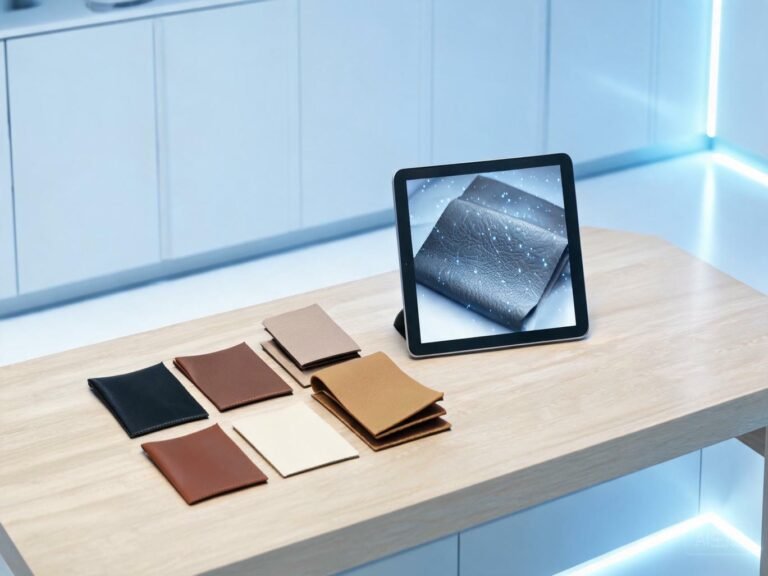
Custom embossed textures can match the distinctive pebbled grain of natural bison hide.
In our abrasion testing, silicone leather withstands 100,000+ Martindale cycles without surface breakdown — the threshold most commercial furniture specifiers use for “heavy domestic use” classification. Bison leather, for comparison, typically tests at 25,000-40,000 cycles before visible wear appears on finished upholstery, partly because the unfinished surface degrades faster under mechanical friction. For more on how silicone stacks up against conventional synthetics, see our detailed silicone vs PU comparison.

Scratch resistance testing verifies surface integrity under repeated mechanical stress.
Watch how silicone leather performs across durability, stain resistance, and flame retardancy for sofa applications.
Why Bison Leather Couch Supply Is Unreliable for B2B
Let’s talk about the supply chain. The American bison population commercially raised for meat and hides numbers roughly 20,000-30,000 animals processed annually. Compare that to cattle: over 33 million head processed in the U.S. alone each year. The hide supply gap is enormous, and it means bison leather availability fluctuates with seasonal processing cycles and herd management decisions.
For a B2B buyer running a furniture production line, that volatility is a serious problem. You can’t commit to a 500-unit couch production run if your tannery might only have 200 hides available in Q3. Lead times for bison leather routinely stretch to 12-16 weeks, and price quotes are often only valid for 30 days because supply is so tight. By contrast, our furniture and sofa applications use engineered silicone leather with production capacity exceeding 50,000 square meters monthly, lead times of 15-20 days for standard orders, and 25-30 days for custom colors and textures. Every batch meets identical specifications without natural variation — something no tannery can guarantee with bison hide.
Bison leather couch projects face 12-16 week lead times and 30-day price quote validity. Silicone leather ships in 15-30 days with year-round supply stability and fixed pricing for 90 days.
| Property | Bison Leather | Silicone Leather |
|---|---|---|
| Material Cost ($/sq ft) | $40-80 | $6-12 |
| Conditioning Frequency | Every 6-12 months | None required |
| Martindale Abrasion (cycles) | 25,000-40,000 | 100,000+ |
| Lead Time | 12-16 weeks | 15-30 days |
| Supply Stability | Seasonal, limited | Year-round, stable |
| 5-Year TCO ($/sq ft) | $52-98 | $7-14 |
TCO includes material cost, conditioning, cleaning, and expected replacement frequency over 5 years for commercial furniture use.
Frequently Asked Questions
Can silicone leather truly replicate the feel of bison leather?
Silicone leather matches the visual grain pattern through custom embossing, but the hand-feel differs. Bison leather has a raw, warm, organic tactility from the natural hide. Silicone leather offers a softer, more consistent surface that many designers actually prefer for commercial furniture applications where uniformity matters across large production runs.
Is a bison leather couch worth the premium for commercial use?
For residential luxury buyers who value authenticity and commit to conditioning schedules, bison leather retains strong appeal. For B2B commercial furniture where durability, cleanability, and supply reliability matter more, silicone leather delivers comparable aesthetics at 60-70% lower 5-year TCO. Understanding the types of synthetic leather available helps clarify the alternatives.
Making the Right Call for Your Production Line
A bison leather couch makes a statement — there’s no denying the material’s heritage and visual character. But when B2B procurement teams factor in the real costs of acquisition, maintenance, and supply volatility, the math often doesn’t work for production-scale furniture lines. Silicone leather offers the same rugged aesthetic with engineered consistency, zero maintenance, and stable supply backed by OEKO-TEX certification. For specifiers weighing the trade-offs, the question isn’t whether bison leather is beautiful — it’s whether your budget and production timeline can absorb the hidden costs.
Request Bison-Texture Sample Swatches
About TOPSUN
TOPSUN manufactures silicone leather upholstery solutions for furniture brands seeking the rugged aesthetic of bison leather without the sourcing volatility and maintenance overhead.
Custom bison-grain embossing to match natural texture | Zero-VOC formulation certified to REACH and OEKO-TEX Standard 100 | 100,000+ Martindale abrasion cycles verified | Stable supply with 50,000+ sqm monthly production capacity.