The leather market is splitting in two. On one side: traditional genuine leather and legacy synthetics facing regulatory pressure, supply chain disruption, and shrinking margins. On the other: advanced materials like silicone leather riding a 14% CAGR wave. For B2B procurement teams, the question isn’t whether the leather market is growing — it’s which materials within that market will still be compliant and available in 2028. Here’s what the data, regulations, and supply chain signals tell us.
Leather Market Size: The Numbers B2B Buyers Need
The leather market size and forecast 2026 data tells a story of divergence. The global leather goods market stands at $291.82 billion in 2026, projected to reach $469.69 billion by 2034 at 6.13% CAGR. But within that growth, the synthetic leather segment is expanding faster — valued at $41.47 billion in 2026 and projected to hit $57.49 billion by 2030 at 8.2% CAGR.
Here’s what matters for procurement: the fastest-growing sub-segment isn’t PU or PVC — it’s advanced silicone leather, growing at 14% CAGR with a projected market size of $536 million by 2030. That’s nearly double the overall synthetic leather market growth rate.

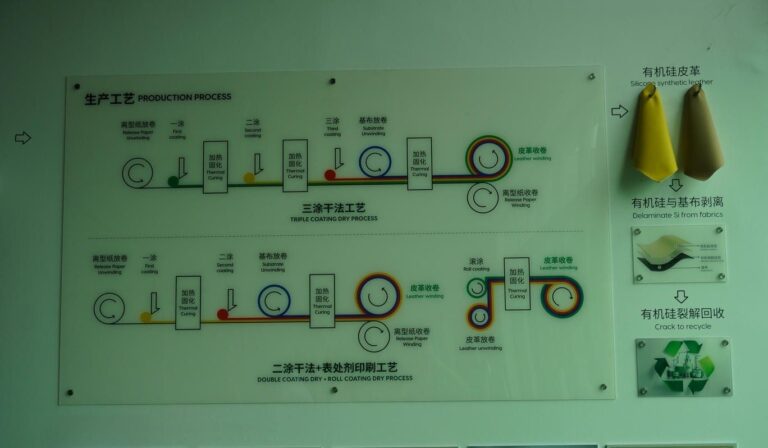
Silicone leather lifecycle display showing raw materials through finished product
In our factory, we’ve tracked a 3x increase in silicone leather sample requests from automotive OEMs and hospitality furniture manufacturers since Q4 2025. The procurement questions have shifted from “what is silicone leather?” to “how fast can you scale to 500,000m/month?” — a clear signal that the market is moving past evaluation into bulk adoption.
3 Materials the Leather Market Is Quietly Dropping
The synthetic leather market growth isn’t lifting all materials equally. Three types are losing B2B buyer preference — not because they’re disappearing, but because their compliance and performance gaps are becoming unsustainable.
| Material Type | Market Share 2026 | Regulatory Risk | Growth Outlook | B2B Action |
|---|---|---|---|---|
| Genuine Leather | ~55% | High (EUDR) | Declining in EU | Diversify sourcing |
| PVC Leather | ~20% | High (PFAS, plasticizers) | Shrinking | Phase out |
| PU Leather | ~15% | Moderate (solvents) | Flat to declining | Transition to water-based |
| Silicone Leather | ~3% (growing) | Low | 14% CAGR | Scale up |
| Bio-based Leather | ~2% | Low-moderate | Early stage | Monitor |
PVC faces the steepest regulatory pressure — the EU’s PFAS ban and growing restrictions on plasticizer content make it increasingly difficult to specify for commercial applications. Genuine leather, while still dominant, is under EUDR traceability requirements that many non-EU tanneries cannot meet. PU leather occupies a middle ground: solvent-based production is under scrutiny, but water-based PU alternatives are improving. For a deeper understanding of silicone leather as a market alternative, our technical introduction covers the molecular advantages driving its adoption.
EUDR, CSDDD, PFAS: Regulations Reshaping Sourcing
The leather industry regulations EUDR compliance landscape is the single biggest disruption factor in the 2026 leather market. Three regulatory frameworks are reshaping how B2B buyers source:
EUDR (EU Deforestation Regulation): From December 2026, cattle hide and leather imports into the EU must prove deforestation-free origin with geolocation traceability back to the slaughterhouse. For non-EU suppliers, this is effectively a new compliance barrier. The U.S. Leather and Hide Council has called it “the industry’s most pressing geopolitical threat.”
CSDDD (Corporate Sustainability Due Diligence Directive): EU companies with revenue over €150M must identify and mitigate environmental and human rights risks across their global supply chains — including leather processing wastewater, chromium emissions, and waste handling.
PFAS Bans: The EU’s restriction on per- and polyfluoroalkyl substances directly impacts PVC leather production, which uses fluorinated treatments for water and stain resistance. Silicone leather, by contrast, is inherently water-repellent without chemical additives.

Leather factory production line showing industrial-scale manufacturing capacity
Where the Leather Industry Is Heading: Silicone and Beyond
The sustainable leather market alternatives landscape is bifurcating. Bio-based leathers — grape, apple, mushroom — generate headlines but lack the durability and scale for B2B applications. Recycled PET fabrics offer sustainability credentials but can’t match leather’s hand feel and cleanability. Silicone leather sits in a unique position: it’s the only material that combines genuine sustainability (zero VOC, 100% recyclable, solvent-free process) with performance that exceeds traditional synthetics.

Factory supplier guide illustrating production capabilities and quality standards
For eco-friendly silicone leather, the market trajectory is clear: 14% CAGR through 2030, driven by automotive EV interiors (low-VOC requirements), hospitality furniture (bleach-clean requirements), and healthcare (biocompatibility certification). Our factory production capabilities are scaled to meet this demand with 500,000+ m monthly capacity across three facilities.
How to Audit Your Leather Market Supply Chain in 2026
Leather market supply chain traceability is no longer optional. Here’s what B2B procurement teams should verify before committing to a supplier in 2026:
1. Material origin traceability: Can the supplier provide geolocation data for raw material sources? (EUDR requirement)
2. VOC emission test reports: Request VDA 277 or ISO 16000-6 results from accredited labs
3. Chemical compliance certificates: REACH, RoHS, and PFAS-free declarations
4. Manufacturing process audit: Verify solvent-free or water-based production methods
5. Capacity and scalability: Confirm monthly output and ability to scale within 30 days
6. Certification portfolio: ISO 10993 (medical), EN 13773 (fire), FDA 21 CFR 177.2600 (food contact) as applicable
For more on leather supply chain risks in 2026, our analysis covers specific disruption scenarios. The silicone leather market forecast provides segment-by-segment growth projections for procurement planning.
Silicone leather market outlook — growth drivers, segment analysis, and supply chain implications
Frequently Asked Questions
How does EUDR affect leather market supply chains?
EUDR requires geolocation-based traceability for cattle hide and leather imports into the EU from December 2026. Suppliers must prove deforestation-free origin back to the slaughterhouse. For non-EU tanneries, this creates a significant compliance barrier — many lack the tracking infrastructure to meet these requirements. B2B buyers should verify supplier traceability capabilities now, before the regulation takes full effect.
Which leather material type is growing fastest in 2026?
Silicone leather is the fastest-growing segment at 14% CAGR, nearly double the overall synthetic leather market growth rate of 8.2%. This growth is driven by automotive EV interiors requiring zero-VOC materials, hospitality furniture needing bleach-cleanable surfaces, and healthcare applications requiring biocompatibility certification (ISO 10993).
Positioning for the Next Phase of the Leather Market
The leather market is growing — but not uniformly. Materials that can’t meet 2026 regulatory requirements, durability expectations, and sustainability mandates are losing share. Silicone leather is absorbing that displaced demand because it solves all three problems simultaneously: zero-VOC compliance, 200,000+ Martindale durability, and 100% recyclability. For B2B buyers, the strategic move is clear: audit your current material specifications against EUDR, CSDDD, and PFAS requirements now, and identify which suppliers can scale silicone leather production to meet your volume needs.
About TOPSUN
TOPSUN produces silicone leather for B2B manufacturers navigating the shifting leather market — supplying compliant, zero-VOC materials that meet EUDR traceability and CSDDD sustainability requirements across automotive, furniture, and healthcare applications.
500,000+ m monthly capacity across 3 facilities | REACH, FDA 21 CFR 177.2600, and ISO 10993 certified | 14% CAGR segment growth aligned with market trajectory | Free A4 swatch samples shipped worldwide via DHL/FedEx