Sourcing vegan leather manufacturers looks straightforward on paper — search Alibaba, request samples, compare prices, place an order. In practice, the gap between a polished sample and a reliable bulk supplier is where most B2B procurement projects fail. We’ve seen brands receive first articles that pass every spec, then watch the production run arrive with inconsistent color batches, solvent odor, and documentation that doesn’t survive a retailer audit. The problem isn’t that good vegan leather manufacturers don’t exist — it’s that most buyers don’t know what to verify before the money moves. This guide gives you seven specific checkpoints, benchmarked against real industry data, that separate manufacturers from middlemen.
| Parameter | Industry Benchmark | Red Flag |
|---|---|---|
| MOQ (stock) | 300–500 m | No MOQ stated / unrealistically low |
| Lead time (custom) | 15–20 days | “3 days” with no production evidence |
| Monthly capacity | 100,000+ m | Can’t show factory floor or equipment |
| VOC test report | ISO 16000-6 passed | “Low VOC” claim, no lab report |
| Vegan traceability | No animal-derived inputs documented | “Trust us” with no chain-of-custody |
View TOPSUN Factory Production
The 7-Point Vegan Leather Manufacturer Audit Framework
Every audit we run for vegan leather manufacturers follows the same seven-point framework. These aren’t theoretical — each point maps to a failure mode we’ve encountered in real sourcing projects. Skip any one and you’re gambling on the rest of your supply chain.
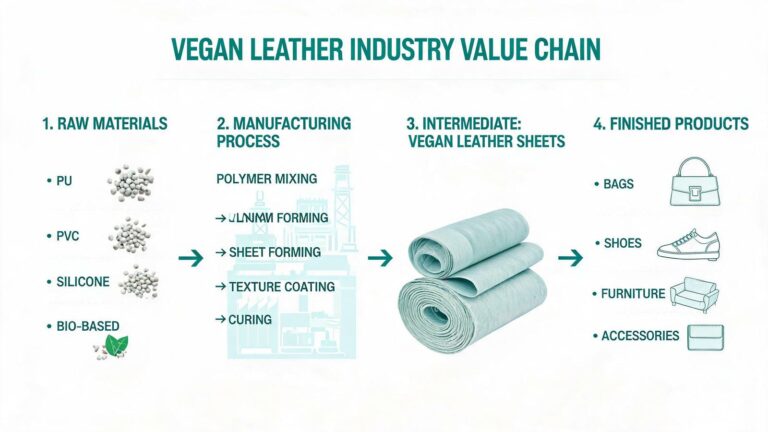
1. Material composition disclosure. Request a written composition breakdown — not a marketing sheet. What polymer is the coating? PU, PVC, or silicone? What’s the substrate? Is the process solvent-based or solvent-free? A legitimate manufacturer states the chemistry; a trading company deflects to “similar to” or “same as brand X.” This matters because vegan leather manufacturers who won’t disclose composition often can’t guarantee it stays consistent across production runs.
2. Certification stack with third-party verification. The baseline for EU access is REACH compliance and OEKO-TEX Standard 100. For the US market, California Prop 65 applies. For medical or infant products, add ISO 10993 biocompatibility. Here’s the catch — PETA’s “Approved Vegan” certification is declaration-based, not third-party audited (Lilalila Bags). It confirms the company claims no animal inputs, but doesn’t independently verify the production line. REACH compliance, by contrast, is enforceable under EU regulation EC 1907/2006 (European Commission). Always check whether the certification is self-declared or lab-issued.

A real production line — overhead cranes, multi-line capacity, and visible equipment are the first visual proof of manufacturing capability
3. Production capacity vs. your demand curve. Ask for monthly capacity in meters, not square feet or yards — meters is the industry standard for roll goods. Top-tier Chinese vegan leather factories report monthly capacities exceeding 3 million yards of dry-processed material, with annual capacity over 100 million yards. But that’s the upper tier. For a B2B buyer placing 5,000–10,000 meter orders, you need a manufacturer whose capacity comfortably absorbs your volume without deprioritizing your run. A factory running at 95% utilization will delay your order the moment a larger client needs capacity. See our factory production overview for what real manufacturing capacity looks like.
4. Lead time transparency. Industry standard lead times range from 7–10 days for stock items to 15–20 days for custom formulations. If a supplier quotes “3 days” for a custom color match, they’re either shipping from existing stock (not custom) or cutting corners on quality control. Custom embossing adds 7–10 days. Always request the lead time breakdown: formulation → coating → drying → embossing → inspection → packing. Each stage should have a day count.
5. Traceability documentation. Vegan leather traceability means documented proof that no animal hides, by-products, or animal-derived adhesives enter the production line. This isn’t a philosophical preference — major retailers like IKEA and H&M require chain-of-custody documentation for vegan claims. If your supplier can’t produce a traceability document with the sample, they won’t magically produce it during a retailer audit months later. Our experience with how to choose a silicone leather factory confirms: suppliers who provide traceability upfront are the ones who survive compliance audits.

In-line fabric inspection — the QC checkpoint that separates manufacturers who test every roll from those who sample-test at best
6. Sample-to-production consistency protocol. The sample on your desk is hand-picked. The production run isn’t. Ask the manufacturer: “What is your batch-to-batch color consistency standard?” The answer should reference Delta E values — anything ≤ 1.0 is excellent; ≤ 2.0 is acceptable for most applications. If they can’t answer with a Delta E number, they don’t measure color consistency systematically. In our production, we maintain Delta E ≤ 1.0 using Pantone-matched color formulations and spectrophotometer verification on every batch. That’s the standard B2B buyers should demand.
7. After-sales and warranty terms. A 12-month warranty is standard. But what does it cover? Color fading? Peeling? Delamination? Get the warranty scope in writing, including the claims process — photo documentation requirements, return shipping responsibility, and refund or replacement timelines. Manufacturers who hesitate on warranty terms are telling you what they expect to happen.
Vegan Leather Manufacturers: Certification Stack Requirements
The certification requirements vary by target market and application. Here’s what to demand based on where your product will be sold and how it will be used:
- EU market (any application): REACH compliance (EC 1907/2006), RoHS (heavy metals), OEKO-TEX Standard 100. For indoor furniture, add EU E1 formaldehyde emission compliance.
- US market (general consumer): California Prop 65 compliance. For children’s products, add EN 71 toy safety. For food-contact applications, FDA 21 CFR 177.2600.
- Automotive interiors: FMVSS 302 flame retardancy, ELV Directive (EU 2000/53/EC), VDA 270 odor rating, VDA 277 VOC emission. DIN 75201 fogging.
- Medical/healthcare: ISO 10993-5 biocompatibility (cytotoxicity), ISO 10993-10 sensitization. Sterilization compatibility (EtO or Gamma).
- Aviation: FAR 25.853 flammability test, low smoke density, low toxic gas emission.
Not every vegan leather manufacturer holds all of these — and they shouldn’t need to. But they should hold the certifications relevant to your product. A supplier who claims to be “certified for everything” is either exceptional or exaggerating. Cross-check certification numbers against the issuing lab’s database. SGS and Intertek both offer online verification — a 30-second check that catches forged certificates.
Compare Silicone vs PU Materials
Production Capacity and Lead Time Benchmarks
Understanding what’s normal helps you spot what’s not. Here are the benchmarks we’ve compiled from across the industry:
| Metric | Low-End | Industry Standard | Top-Tier |
|---|---|---|---|
| MOQ (stock colors) | 1,000 m | 300–500 m | 500 m |
| MOQ (custom color) | 2,000 m | 500–1,000 m | 500 m |
| Lead time (stock) | 21+ days | 7–10 days | 7–15 days |
| Lead time (custom) | 30+ days | 15–20 days | 7–15 days |
| Monthly capacity | 10,000 m | 100,000 m | 500,000+ m |
A note on MOQ: lower isn’t always better. A supplier accepting 50 meters as MOQ on a custom formulation is either trading, not manufacturing, or cutting quality steps. Real manufacturing has setup costs — coating line changeovers, color formulation, embossing roller changes — that make sub-300m orders uneconomical unless the material already exists in stock.
When we evaluate our own production metrics against these benchmarks, we sit in the top-tier category: 500,000+ meters monthly capacity, 500-meter MOQ, and 7–15 day lead times including custom orders. But what differentiates a manufacturer isn’t just capacity — it’s whether they can prove the capacity with a factory tour or video walkthrough, not just a number on a website. More on choosing a silicone leather supplier in our dedicated sourcing guide.
Red Flags: When to Walk Away
Some warning signs are obvious. Others are subtle. Here are the ones that should terminate a supplier evaluation immediately:
- Factory address verification fails. If the “factory” address resolves to a residential building or a shared office park, you’re dealing with a trading company posing as a manufacturer. There’s nothing wrong with trading companies — but there is something wrong with one that misrepresents itself.
- Certification numbers can’t be verified online. SGS and Intertek both maintain databases. A certificate number that returns no result is forged. This happens more often than most buyers expect.
- “Universal” material claims. A supplier who says their vegan leather is “suitable for everything from baby products to aviation seating” is either the most advanced materials company on Earth or oversimplifying. Different applications require different formulations, thicknesses, and certifications.
- Sample quality inconsistent within the same shipment. If your three sample swatches show visible color or texture variation, the production run will be worse, not better.
- Refusal to allow factory tour or video call. Post-pandemic, virtual factory tours are standard practice. A manufacturer who won’t show their production floor is hiding something — usually that the production floor belongs to someone else. Learn about TOPSUN’s facilities and what a transparent factory tour should look like.

Finished goods warehouse — visible inventory and organized storage indicate a manufacturer managing real production volume
In one case, a client came to us after their previous supplier shipped 8,000 meters of “vegan leather” that turned out to be PVC rebranded as PU — discovered when the material started cracking at 18 months and the lab analysis identified the polymer. The supplier’s price had been 35% below market. That discount cost the client a full product recall.
Your Pre-Order Action Checklist
Before you place a bulk order with any vegan leather manufacturer, complete these steps:
- Request and verify written material composition disclosure (polymer type, substrate, process)
- Cross-check all certification numbers against issuing lab databases (SGS, Intertek)
- Confirm monthly capacity ≥ 3× your largest single order volume
- Get lead time breakdown by production stage, in writing
- Demand traceability documentation for vegan claims — before the first order, not after
- Ask for Delta E color consistency standard and verification method
- Review warranty scope, claims process, and coverage duration
- Schedule a factory tour (in-person or virtual) and verify the address
Vegan leather manufacturers who can pass all eight checks are the ones worth your first order — and your fifth. Everything else is a sample with a website.
About TOPSUN
TOPSUN operates 60,000+ m² of silicone leather manufacturing capacity across Dongguan, Yichang, and Xiangyang, serving B2B clients in automotive, furniture, medical, and consumer goods sectors.
500,000+ m monthly capacity · 500-meter MOQ · 7–15 day lead time · 10+ in-house engineers · SGS and Intertek certified · Free A4 swatch samples shipped worldwide via DHL/FedEx