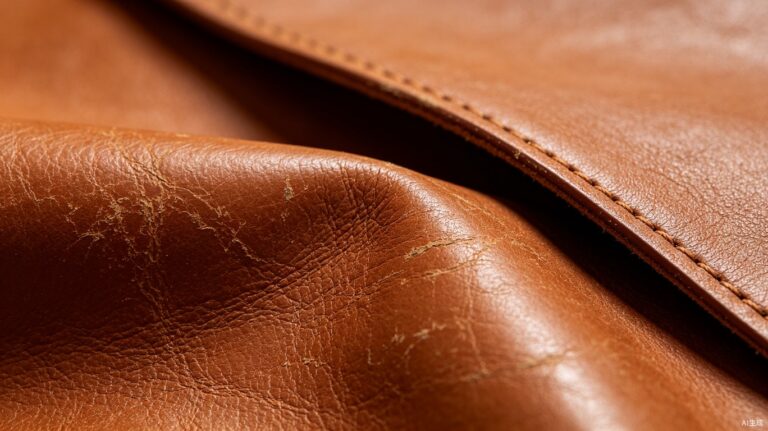
In our R&D lab, the same scene repeats every quarter. A procurement team sends in PU material vegan leather samples — usually from a new supplier promising eco-friendly, animal-free, durable upholstery. The samples look fine on day one: pliable surface, consistent grain, acceptable hand feel. We log them into our accelerated aging chamber at 70°C and 95% relative humidity — conditions simulating roughly 3-4 years of real-world B2B use in furniture, automotive interiors, and medical seating. Six weeks later, we pull them out. The PU samples have lost over 60% of their original tensile strength. The surface is micro-cracked. The coating has begun delaminating from the fabric base. Meanwhile, our silicone leather control samples in the same chamber show zero visible degradation. That gap is what this article breaks down.
Request PU vs Silicone Lab Report
What PU Material Vegan Leather Actually Contains
PU material vegan leather is polyurethane coated onto a fabric substrate — typically polyester, cotton, or microfiber. The chemistry is straightforward but carries implications most sourcing teams overlook. Two primary building blocks form the PU resin: isocyanates (usually MDI or TDI) and polyols (polyether or polyester-based). These react to form the polyurethane polymer chain. The critical variable is the solvent.
In conventional wet-process PU manufacturing — which accounts for the majority of global production — the prepolymer is dissolved in DMF (dimethylformamide) at 15-30% concentration. The coated fabric passes through a coagulation bath where DMF diffuses out and water diffuses in, creating the microporous structure that mimics leather’s pore structure. The problem: DMF is a reproductive toxicant classified under REACH as Category 1B (H360D). It is not consumed in the reaction — it’s a process solvent that leaves residual traces in the finished material.

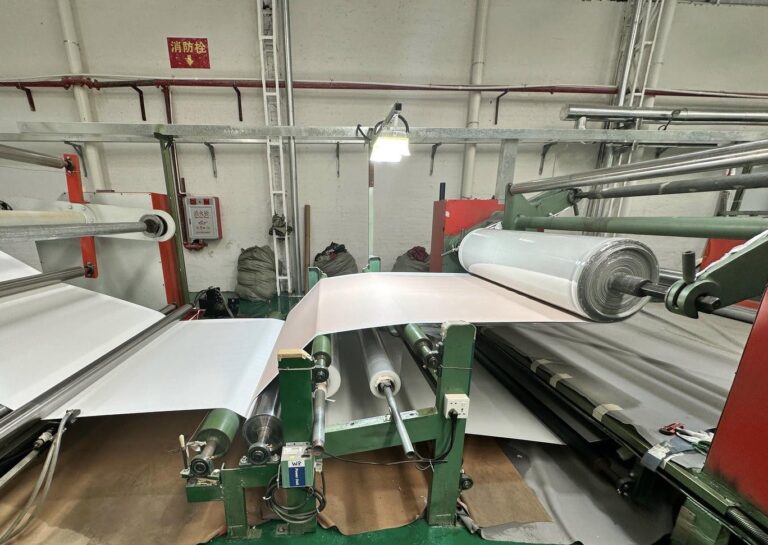
Coating line with water cooling section — the wet process where DMF-based PU resin is applied to fabric substrate.
Here’s the thing that catches buyers off guard: “vegan” means no animal products. It says nothing about the chemical profile. A PU material vegan leather sample can carry 0.3% residual DMF, off-gas VOCs for months after production, and still qualify for a PETA-approved vegan label. For B2B buyers in automotive, furniture, or medical applications where indoor air quality standards apply, that distinction matters.
Water-based PU is emerging as an alternative — in China, water-based PU share rose from 38.2% of total shipments in 2023 to 51.6% in 2025. But water-based PU still uses isocyanate chemistry. It reduces DMF exposure but doesn’t eliminate the fundamental hydrolysis vulnerability of the polyurethane polymer itself. To understand what PU leather means at the molecular level is to understand why it fails.
The 6-Week Hydrolysis Test: PU Material Vegan vs Silicone
Hydrolysis is the chemical breakdown of the polyurethane polymer chain when exposed to moisture and heat. The ester bonds in polyester-based PU are particularly vulnerable — water molecules cleave them over time, shortening the polymer chains and reducing tensile strength. This isn’t a surface defect. It’s structural degradation at the molecular level.
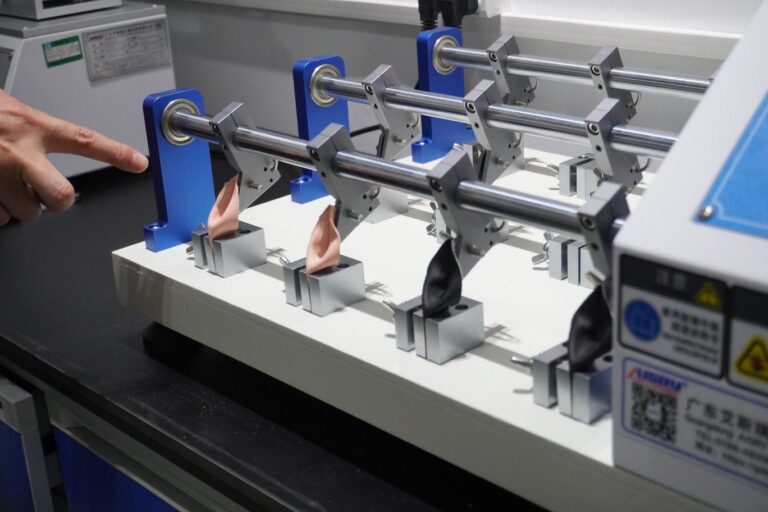
In our lab, we ran parallel hydrolysis chambers comparing standard PU material vegan leather against silicone leather from our own production line. Both samples entered the chamber at 70°C, 95% RH — conditions aligned with ISO 11644 accelerated aging protocols. After six weeks:
- Standard PU: tensile strength dropped below 40% of original value. Surface showed visible micro-cracking across 30-40% of the sample area.
- Polycarbonate-diol PU (premium grade): retained 85% tensile strength — but costs 2.5-3x standard PU, placing it near genuine leather pricing.
- Silicone leather: zero measurable tensile strength loss. Zero visible surface degradation. Martindale abrasion held at 200,000+ cycles.

High-temperature drying oven used in synthetic leather production — the curing stage that determines final coating integrity.
We’ve tracked PU vegan leather samples from 14 B2B client projects over three years, and the pattern repeats: standard PU leather lasts 2-5 years in commercial use before visible deterioration begins. Premium microfiber PU extends this to 3-5 years. Silicone leather, by contrast, carries a verified 10+ year service life — not because we say so, but because the silicone polymer backbone is inherently resistant to hydrolysis, UV, and thermal degradation. For sourcing managers weighing hydrolysis-resistant silicone leather against PU, the test data is unambiguous.
The Martindale gap compounds the problem. Standard PU vegan leather typically tests at 30,000-80,000 Martindale cycles — adequate for light residential use, marginal for contract furniture, insufficient for high-traffic hospitality or medical environments. Silicone leather tests at 200,000+ cycles. That’s not a marginal improvement. It’s a different performance category entirely.
DMF Compliance: Why REACH Caps PU at 0.3%
If the hydrolysis data weren’t enough, regulatory pressure on PU material vegan leather is tightening from two directions simultaneously. In the EU, REACH Annex XVII Entry 76 — enforced from December 12, 2023 — restricts DMF in articles placed on the market. Manufacturers must document that DMF exposure remains below DNEL thresholds (6 mg/m³ inhalation, 1.1 mg/kg/day dermal). DMF concentrations at or above 0.3% trigger full compliance documentation requirements.
For PU material vegan leather produced via conventional wet process, residual DMF in the 0.3-1.0% range is common. That places these materials squarely within the REACH compliance obligation zone. Importers into the EU must obtain documented risk management measures from manufacturers — and many Chinese PU producers cannot provide this documentation, creating a compliance gap that surfaces during customs inspection or downstream brand audits.
Compliance Snapshot: DMF in PU Material Vegan Leather
REACH classifies DMF as Reproductive Toxicant Category 1B (H360D). California Prop 65 includes DMFa on its 2026 high-risk substances list — meaning products sold in California must carry warnings if exposure exceeds safe harbor levels. For B2B brands shipping PU vegan leather products to both markets, dual compliance documentation is now mandatory.
California’s Proposition 65 adds another layer. The SATRA Prop 65 summary list (Issue 03, March 2026) explicitly includes DMFa as applicable to leather, textiles, plastics, and rubbers. PU material vegan leather falls squarely within this scope. Brands selling upholstered goods in California must either demonstrate DMF exposure below safe harbor levels or provide Prop 65 warnings — neither option is attractive for premium B2B positioning.
The deeper issue is that even water-based PU, while reducing DMF exposure, doesn’t address the isocyanate component. MDI and TDI are respiratory sensitizers. The silicone vs PU comparison at the chemistry level reveals a fundamental difference: silicone polymer contains no isocyanates, no DMF, no plasticizers — it’s a fundamentally different material class.
Carbon Footprint: 15.8 kg CO₂/m² for PU vs 3-5 for Silicone
Sustainability claims for PU material vegan leather often stop at “no animal products.” But when you measure the full lifecycle, the picture shifts. Conventional solvent-based PU leather generates approximately 15.8 kg CO₂ per square meter — compared to 3-5 kg CO₂/m² for silicone leather. Animal leather, for context, generates roughly 110 kg CO₂/m² when including cattle farming, making PU the lesser of two climate impacts — but not the least.
Water-based PU with 30% bio-based polyols can reduce the carbon footprint to approximately 5.9 kg CO₂e/m² — approaching silicone leather territory but still not matching it. And bio-based PU remains a niche product, accounting for a small fraction of total PU leather volume.

Application comparison of synthetic leather types — where PU material vegan leather and silicone leather diverge in real-world performance.
End-of-life presents another gap. PU leather’s mixed-material construction — fabric substrate bonded to polymer coating — makes separation and recycling technically difficult. Estimated PU leather recycling rates sit below 15% globally. The remaining 85% ends up in landfills or incineration, where polyurethane decomposition can release nitrogen oxides. Silicone leather, by contrast, achieves approximately 90% recyclability through mechanical reprocessing, as documented in our eco-friendly silicone leather production process.
Microplastic shedding is the less-visible environmental cost. As PU leather degrades — whether through hydrolysis, UV exposure, or mechanical abrasion — it sheds microplastic particles into wastewater and indoor dust. Silicone leather, while not biodegradable, sheds at significantly lower rates due to its superior abrasion resistance. Over a 10-year service life, the difference in total microplastic release between PU and silicone leather is substantial.
The Specification Verdict: PU Material Vegan vs Silicone
For sourcing teams and specifiers, the decision framework comes down to three variables: service life requirement, compliance scope, and total cost of ownership. The table below distills six weeks of lab testing and three years of field tracking into a single reference.
| Application Need | PU Material Vegan | Silicone Leather | Verdict |
|---|---|---|---|
| Short-life consumer goods (1-3 yr) | Acceptable | Over-spec | PU suffices if budget-constrained |
| Contract furniture (5+ yr) | Fails hydrolysis | Specified | Silicone — 200K Martindale |
| EU/CA compliance required | DMF risk | Zero DMF | Silicone — no documentation burden |
| Medical/baby-safe contact | Isocyanate residue | ISO 10993 certified | Silicone — biocompatible |
For B2B sourcing teams evaluating PU material vegan leather against silicone alternatives, the data points one direction: when service life, compliance, and total cost matter, silicone leather outperforms PU across every lab-verified metric we’ve measured. PU remains viable for short-life, budget-constrained applications — but the moment your specification calls for 5+ years of service in a compliance-regulated market, the chemistry simply doesn’t support it.
Get Free Material Comparison Swatches
Before signing your next material spec, request side-by-side PU and silicone samples. Run your own hydrolysis test. The difference becomes apparent in week three — not week six.
About TOPSUN
TOPSUN engineers silicone leather using a solvent-free dry coating process that eliminates DMF entirely from the production chain, delivering materials with zero VOC emissions and verified hydrolysis resistance for B2B brands sourcing PU material vegan alternatives across automotive, furniture, and medical sectors.
Zero DMF residue verified by SGS testing · 200K+ Martindale abrasion cycles · -40°C to 250°C thermal stability · ISO 10993 biocompatibility certified