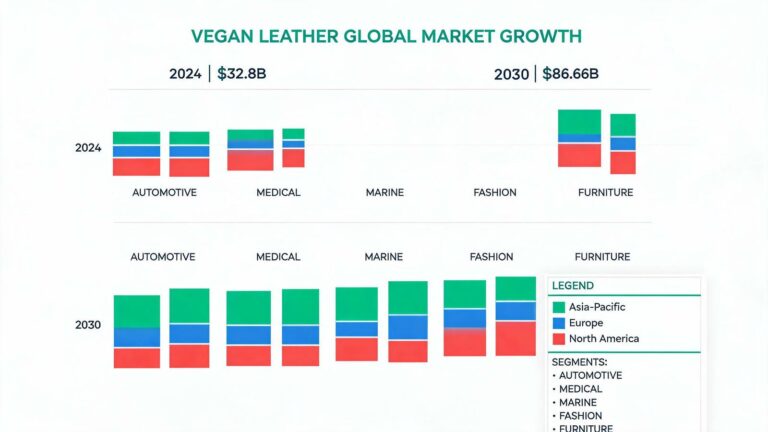
The vegan leather industry was valued at $32.8 billion in 2026 and is projected to reach $86.66 billion by 2035 at an 11.40% CAGR. Those headline numbers appear in every investor deck and supplier pitch — but they obscure where the actual value sits. The vegan leather industry is not a monolith. It’s a fragmented value chain where raw material chemistry, manufacturing geography, regulatory compliance, and end-use segmentation create dramatically different economics for each participant. A $3-per-meter PU leather producer in Dongguan and a $12-per-meter silicone leather manufacturer operate in the same “vegan leather industry” but serve fundamentally different markets with different risk profiles.
This analysis breaks the vegan leather industry into its value chain layers and identifies where margins, growth, and competitive moats actually concentrate — data that matters when choosing a leather supplier for long-term B2B sourcing.
Layer 1: Raw Material Chemistry — Where the Industry Divides
The vegan leather industry splits at the raw material layer into four chemistry families. Each family has different cost structures, performance ceilings, and regulatory trajectories:
| Chemistry | 2026 Market Share | Cost ($/m²) | Growth Driver |
|---|---|---|---|
| PU (polyurethane) | ~55% | $2.50-$6.00 | Fashion, low-cost furniture |
| PVC (polyvinyl chloride) | ~25% | $1.50-$3.50 | Declining — regulatory pressure |
| Silicone | ~8% | $8.00-$15.00 | Automotive, medical, infant |
| Bio-based (plant, mycelium) | ~12% | $10.00-$25.00 | Luxury fashion, premium branding |
PU dominates volume but faces structural pressure: REACH restrictions on DMF, California’s PFAS ban, and EU microplastics legislation are narrowing the chemistry’s regulatory runway. PVC is in secular decline across the EU and North America. Silicone leather is the fastest-growing chemistry in performance-critical applications (14.0% CAGR per QYR Research), while bio-based materials command premium positioning but struggle with scale and consistency.

Raw materials lifecycle display — silicone leather from silica sand to finished product, showing the complete value chain.
Layer 2: Manufacturing Geography — Who Actually Makes It
The vegan leather industry’s manufacturing base is concentrated in Asia, with China accounting for approximately 65% of global PU and PVC leather production. The geographic distribution matters because it determines lead times, quality consistency, and regulatory exposure:
- China (Dongguan, Wenzhou, Yancheng): Dominates PU/PVC volume production. Increasing shift toward silicone and waterborne PU as environmental regulations tighten. Wenzhou cluster specializes in synthetic leather for footwear; Dongguan cluster serves furniture and automotive.
- India (Kanpur, Chennai): Growing base for PU leather production, primarily serving domestic automotive and footwear markets. Lower labor costs but smaller scale.
- South Korea and Japan: Premium PU and silicone leather for automotive OEM specifications. Higher quality control but 30-50% cost premium over Chinese equivalents.
- Mexico and Brazil: Regional PU leather production serving North American and LATAM furniture and automotive supply chains. Tariff advantage for US-bound shipments under USMCA.
- Europe (Italy, Germany): Limited domestic production; primarily bio-based and premium silicone leather for luxury fashion and automotive. High cost, low volume.
For B2B buyers, the manufacturing geography determines three things: unit cost (labor and energy arbitrage), lead time (7-15 days from China vs 3-5 days from Mexico for US buyers), and regulatory compliance exposure (Chinese PU leather producers face the most scrutiny on DMF and VOC compliance).

Coating production line — scale and automation level determine cost position and quality consistency.
Layer 3: End-Use Segmentation — Where Demand Growth Concentrates
The vegan leather industry’s 11.40% CAGR is not evenly distributed. Growth concentrates in segments where performance requirements — not just price — drive material specification:
| Segment | 2026 Size | CAGR | Preferred Chemistry |
|---|---|---|---|
| Automotive / EV interiors | $4.8B | 14.2% | Silicone, high-perf PU |
| Furniture & upholstery | $8.2B | 8.5% | PU, PVC (price-driven) |
| Fashion & accessories | $7.1B | 12.8% | Bio-based, PU |
| Medical & healthcare | $1.9B | 16.5% | Silicone |
| Footwear | $5.6B | 9.2% | PU |
| Marine / outdoor | $1.2B | 15.8% | Silicone |
The highest growth rates — medical (16.5%), marine (15.8%), automotive (14.2%) — are segments where durability, biocompatibility, and environmental resistance override price. These are the segments driving silicone leather adoption, and they’re the segments where the vegan leather industry’s $87B future actually materializes.
Layer 4: Regulatory Pressure Points Reshaping the Industry
Three regulatory developments are actively restructuring the vegan leather industry’s chemistry mix:
- EU REACH DMF restrictions (effective 2024-2026 phase-in): Solvent-based PU producers must either switch to waterborne technology (higher cost, lower performance) or exit the EU market. This is pushing 15-20% of Chinese PU capacity toward either upgrade or shutdown.
- California PFAS ban (AB 1200, effective 2025): Eliminates PFAS-coated synthetic leather from the largest US state market. Brands selling into California must verify PFAS-free certifications — a barrier that benefits silicone leather (inherently PFAS-free) and disadvantages treated PU.
- EU microplastics restriction (REACH Annex XVII): Targets intentionally added microplastics in products. Polyurethane and PVC leather shed microplastic particles through surface degradation, creating future compliance risk for these chemistries.
These regulations create a structural shift: PU and PVC capacity is being constrained at the same time that demand for vegan alternatives is growing. The gap is being filled by silicone leather in performance segments and bio-based materials in premium fashion.

Quality inspection at a Chinese leather manufacturing facility — compliance with EU and US regulations drives production standards.

Supplier evaluation — B2B buyers must assess manufacturing geography, chemistry mix, and regulatory compliance together.
Market outlook for silicone leather within the broader vegan leather industry — growth segments and chemistry shift.

Quality control checkpoint — where raw material becomes certified, compliance-ready finished leather.
About TOPSUN
TOPSUN operates at the intersection of the vegan leather industry’s fastest-growing chemistry (silicone) and highest-growth segments (automotive, medical, marine). With 60,000+ m² across three Chinese manufacturing facilities in Dongguan, Yichang, and Xiangyang, we produce 500,000+ meters monthly using solvent-free dry coating technology. Our silicone leather is PFAS-free, DMF-free, and inherently compliant with EU REACH, California AB 1200, and all current and proposed microplastics legislation. We serve 100+ brand partners across automotive OEMs, furniture manufacturers, medical device companies, and consumer electronics brands in 30+ countries.
Procurement Implications: How to Position Your Sourcing
Based on the industry value chain analysis above, B2B buyers should position their vegan leather sourcing strategy around three principles:
- If your product targets EU or California markets → prioritize PFAS-free, DMF-free chemistry now. PU sourcing decisions made today will face compliance costs within 2-3 years.
- If your product serves automotive, medical, or marine segments → silicone leather’s 14-16% segment CAGR means supply will tighten as demand outpaces capacity. Lock in supplier relationships before the demand curve steepens.
- If your product is price-driven consumer goods → waterborne PU is the transition chemistry. It extends PU’s regulatory runway while keeping cost manageable. Plan a silicone upgrade path for premium SKUs within the same product line.
- If your product has a warranty exceeding 3 years → only silicone leather’s 10+ year service life supports the warranty without excessive claim rates.
- If you’re sourcing from China → verify the manufacturer’s environmental compliance status. Chinese PU producers without waterborne technology or solvent recovery systems face shutdown risk under tightening enforcement.
The vegan leather industry will reach $87 billion by 2035. The question for every B2B buyer is not whether to participate in that growth — it’s which layer of the value chain your supplier sits in, and whether that position is durable enough to support your product’s entire lifecycle.
Sourcing silicone leather from a manufacturer positioned in the industry’s highest-growth layer? Request factory audit scheduling, compliance documentation, and free A4 swatch samples from TOPSUN. Contact info@topsunsiliconeleather.com or WhatsApp +44 744 461 7933.