In material testing, I’ve pulled apart enough polyester faux leather samples to know one thing: the base fabric gets all the credit for strength, but the coating takes all the blame for failure. A 1000D polyester backing can hold 500N of tensile force—yet when the PU coating cracks at 20,000 Martindale cycles, nobody asks what’s underneath. That distinction matters for every B2B buyer specifying faux leather, and it’s the difference between a 3-year throwaway and a 10-year investment.
Polyester Faux Leather: What’s Actually in It
Here’s what most spec sheets won’t tell you: polyester faux leather isn’t a single material. It’s two—a woven polyester base fabric coated with a synthetic polymer layer. The global synthetic leather market reached $48.13 billion in 2025, and polyester-backed constructions account for the majority of that volume. Polyester (typically 600D or 1000D denier) provides tensile strength, flexibility, and dimensional stability. The coating—usually polyurethane (PU) or polyvinyl chloride (PVC)—delivers the leather-like appearance, water resistance, and surface feel.
The problem? Most buyers focus on the coating and ignore the substrate. Understanding what is polyester faux leather made of means understanding both layers independently—because they fail independently, and at different rates.

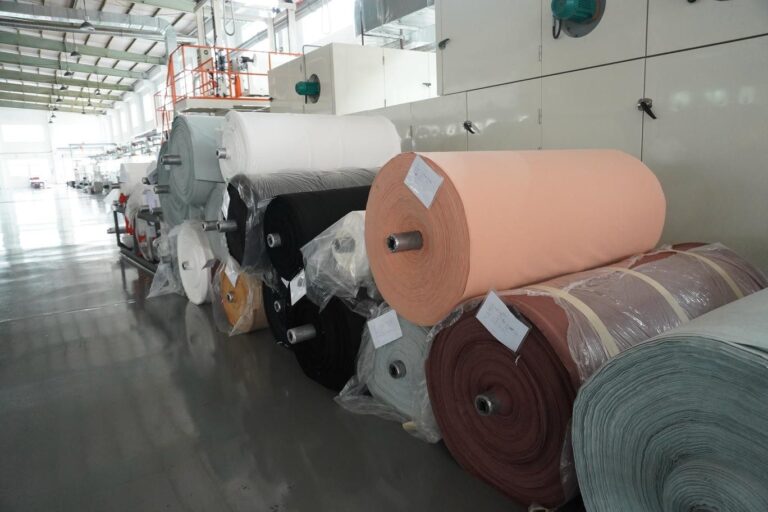
Polyester base fabric rolls staged before the coating line — the substrate that determines tensile performance
Why Polyester Backing Outperforms Cotton and Microfiber
Not all base fabrics perform equally. Polyester commands 52.3% of the faux suede market share, and the reasons come down to measurable engineering properties. Polyester fibers resist moisture absorption (hydrophobic by nature), hold dye uniformly under UV exposure, and maintain dimensional stability across temperature swings that would cause cotton to warp.
In our lab, we’ve tested cotton-canvas blends that absorb 8–12% of their weight in moisture—enough to cause mildew and substrate distortion in humid environments. Polyester stays under 0.4%. Microfiber substrates feel plusher and work well for premium segments, but they cost 2–3× more and lack the tear resistance of a woven 1000D polyester. For furniture and sofa applications, polyester backing hits the sweet spot between cost, durability, and processability.
| Material Combo | Martindale Cycles | UV Resistance | Service Life | VOC Emission |
|---|---|---|---|---|
| Polyester + PU | 20,000–30,000 | Poor (1–2 yrs) | 3–5 years | Contains solvents |
| Polyester + PVC | 15,000–25,000 | Poor (1–2 yrs) | 2–3 years | High plasticizers |
| Polyester + Silicone | 200,000+ | Excellent (1,000+ hrs) | 10+ years | Zero VOC |
The Coating Problem: When Polyester Faux Leather Fails
Polyester faux leather doesn’t fail because the base fabric tears. It fails because the coating cracks. PU and PVC coatings contain plasticizers—chemical additives that keep the surface flexible. Over time, these plasticizers evaporate. The coating becomes brittle, develops micro-cracks at stress points, and eventually peels away from the polyester substrate. This isn’t an “if”—it’s a “when.”
In our Martindale abrasion testing, standard PU-coated polyester faux leather shows visible surface degradation at 20,000–30,000 cycles. Polyester faux leather cracking starts at flex points—seat edges, armrests, cushion seams—within 3–5 years of regular use. The material structure comparison between synthetic and PU leather reveals why: the PU coating is chemically bonded to the surface, not integrated into it. Once that bond breaks down, no amount of base fabric strength can save the material.

White polyester base fabric unwinding before coating — the substrate quality determines finished product consistency
See how different coatings perform on the same polyester base — and why one outlasts the others by 5×
Silicone-Coated Polyester: The Next-Gen Substrate
The coating failure problem has a solution—and it doesn’t require changing the base fabric. Silicone-coated polyester keeps the proven tensile strength of a 1000D woven substrate while replacing the failure-prone PU or PVC layer with a chemically inert silicone polymer. Because silicone doesn’t rely on plasticizers for flexibility, there’s nothing to evaporate. No evaporation means no embrittlement, no cracking, and no 3-year replacement cycle.
The numbers speak for themselves. In our SGS-verified testing, silicone-coated polyester achieves 200,000+ Martindale abrasion cycles—that’s nearly 10× the standard PU performance on the same base fabric. UV resistance holds for 1,000+ hours with zero yellowing. Service life extends past 10 years. And unlike PU alternatives profiled in our PU leather furniture upholstery analysis, silicone coating emits zero VOCs throughout its lifecycle.

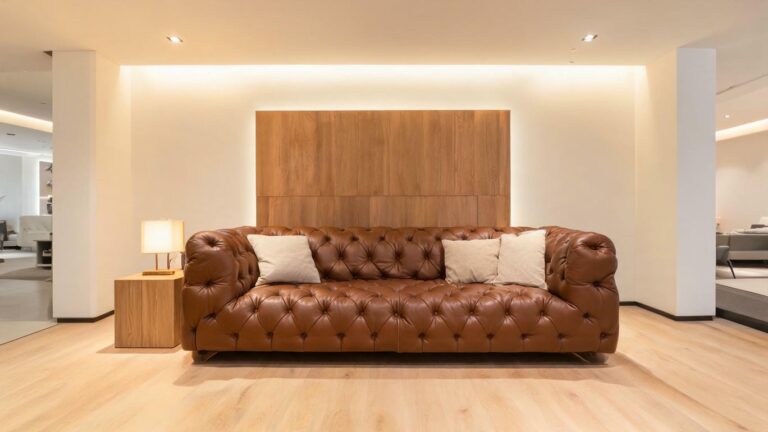
Furniture upholstery in polyester-backed faux leather — coating choice determines whether this sofa lasts 3 or 10 years

Cross-section comparison: how silicone, PU, and PVC coatings bond to the same polyester substrate
Bottom line: The polyester base fabric is the constant. The coating is the variable. When you compare polyester faux leather vs PU leather, you’re really comparing coatings—and the silicone vs PU performance gap is where the 10-year lifespan difference lives.
Frequently Asked Questions
Is polyester faux leather the same as PU leather?
No. Polyester refers to the base fabric substrate. PU (polyurethane) refers to the coating applied on top. Most PU leather uses a polyester backing—but the two terms describe different layers of the same material. The coating, not the substrate, determines durability and chemical safety.
How long does polyester faux leather last before cracking?
It depends entirely on the coating. PU-coated polyester typically cracks within 3–5 years as plasticizers evaporate. PVC-coated versions fail even sooner at 2–3 years. Silicone-coated polyester lasts 10+ years because silicone flexibility is intrinsic to the polymer—not dependent on additives that evaporate.
The Coating Is the Question; Polyester Is the Answer
Polyester faux leather isn’t going anywhere—it’s the backbone of a $48 billion industry. But the coating you choose for that polyester substrate determines whether your product lasts 3 years or 10. PU and PVC will always fail because their flexibility depends on chemicals that evaporate. Silicone doesn’t. For a deeper technical breakdown, see our introduction to silicone leather. When you specify polyester faux leather for your next project, ask the one question that actually matters: what’s on top of the fabric?
About TOPSUN
TOPSUN engineers silicone-coated polyester leather for furniture, automotive interiors, and fashion applications where substrate strength and coating durability must work as a single system.
Our materials achieve 200,000+ Martindale abrasion cycles, zero VOC emissions, and 10+ year service life — verified by SGS and Intertek testing across 30+ countries.