A furniture brand returned an entire container of dining chairs last autumn. The armrests had cracked along the fold line within eight months. The spec sheet said the same thing every failed batch says: faux leather material, 1.2 mm, black. That line hides every decision that actually matters. Two rolls with identical labels can differ by three years of service life.
This guide gives buyers four questions that surface those hidden decisions before the purchase order. Ask them in sequence, and the weak stock identifies itself.
| Question | Ask For | Pass Signal | Red Flag |
|---|---|---|---|
| 1. Backing fabric | Base cloth type and weight | Named fabric, gram weight stated | “Textile backing” with no detail |
| 2. Coating weight | Surface layer thickness | Coating share of total gram weight disclosed | Only total thickness quoted |
| 3. Smell and plasticizers | VOC and additive data | Chamber test with numeric result | “Odor-free” as a verbal claim |
| 4. Paperwork | Test reports per claim | Reports named, dated, batch-linked | One generic certificate PDF |
What Faux Leather Material Actually Is: Two Chemistries, One Label
Faux leather material is a coated textile, not a leather. A base fabric carries a polymer surface layer, and the label says nothing about either part. The market keeps growing anyway. The global faux leather market reached $37.59 billion in 2025 and is projected to hit $70.54 billion by 2034, at a 7.66% compound rate.
Two chemistries dominate that volume. PVC versions coat the fabric with polyvinyl chloride softened by plasticizers. PU versions coat it with polyurethane, which feels softer and drapes closer to real leather. A third route uses silicone, which skips plasticizers entirely. Industry comparisons rate PVC highest for abrasion and chemical resistance, PU best for handle, and silicone strongest for outdoor, marine and healthcare use.

Questions 1 and 2: Backing Fabric and Coating Weight
The backing fabric decides how the roll behaves on your cutting table and on the customer’s furniture. Woven polyester holds dimension and resists tearing. Knit bases stretch and cost less but relax over time. Microfiber backings cost more and deliver the tightest surface uniformity. None of this appears on a label that just says faux leather.
Coating weight is the second hidden variable. Two rolls can both measure 1.2 mm total while one carries a thin surface layer on thick foam. The thin-coating roll wins the sample touch test and loses the wear test. Ask what share of the gram weight the surface layer represents. A supplier who answers in one sentence owns the line. A supplier who answers with a brochure does not.
Questions 3 and 4: Smell, Plasticizers and Paperwork
Smell is data. A sharp chemical odor means solvent residue or migrating plasticizers, and it grows stronger in a sealed car cabin or a warm showroom. PVC formulations carry the highest plasticizer load, which is why phthalate-free claims matter on any PVC-based faux leather material. PU versions smell less but hydrolyze faster in humid climates. Silicone versions carry no plasticizers and hold a stable temperature range.
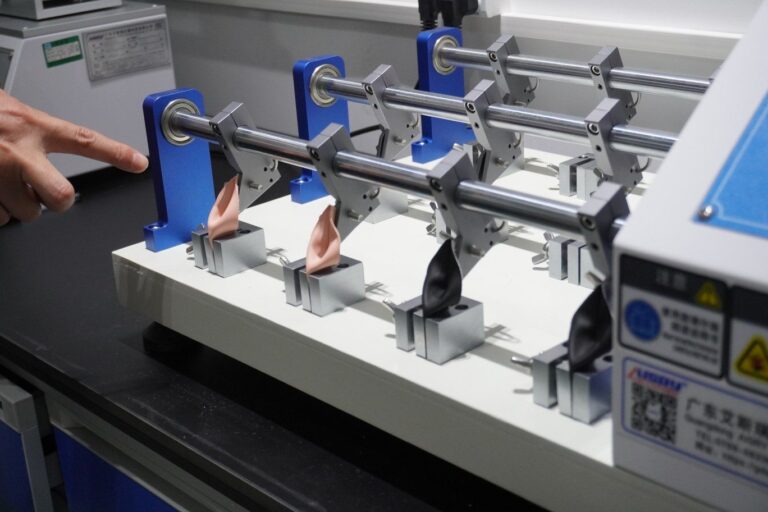
Side-by-side material comparison: surface, feel and flex behavior.
Paperwork converts claims into evidence. Every property you care about should arrive as a dated report tied to a batch number: abrasion cycles, flex endurance, VOC chamber results, and flame class where relevant. The returned chairs in our opening story failed at question one. The certificate in the file covered a different batch entirely.
Apply the Four Questions to Your Next Faux Leather Material Order

Run the four questions against your current supplier and score the answers honestly. Backing named and weighed? Coating share disclosed? VOC numbers on paper? Reports batch-linked? Four passes mean you can negotiate on price alone. Three or fewer mean you are buying a label, and the returns warehouse will eventually invoice you for it.

Quality faux leather material is specified, not discovered. The questions above take one email to send and one sample cycle to verify. If your application demands a plasticizer-free surface with verified low VOC output, our eco-friendly silicone leather documents every answer in writing. For premium hand-feel projects, silicone microfiber leather pairs a microfiber base with a solvent-free surface.
TOPSUN manufactures silicone leather with zero solvent input and non-detect VOC results under ISO 16000-6. Certificates include B117 1000-hour salt spray, ISO 10993 biocompatibility and REACH compliance.
Monthly capacity runs at 500,000 meters with a 500-meter MOQ, serving buyers in 30+ countries for eight years.
Ask About Faux Leather Alternatives
References
- https://www.fortunebusinessinsights.com/faux-le… — Global faux leather market size: $37.59B (2025) to $70.54B (2034), CAGR 7.66%, North America 32.19% share.
- https://www.kothea.com/2026/04/06/faux-leather-… — Professional comparison of PVC, PU and silicone faux leather for upholstery specification.
- https://sablabs.net/what-is-faux-leather-fabric… — Composition of faux leather fabric: base fabric, PU or PVC coating, pigments and finishing chemicals.