Every designer knows the launch-day photograph. The lounge chair is styled, lit, and shot in golden light, and the poly leather upholstery reads like Italian aniline. What nobody photographs is the same chair at year three — armrests micro-cracked, seat edges flaking, the surface gone matte where hands land. As specifiers, we inherit the year-three photo, not the launch-day one, because the client calls us when the material fails. That asymmetry is the whole problem with poly leather: it is at its absolute best on the day it’s newest, and the curve only goes one direction from there. This article is about reading that curve in advance — what poly leather is, how it genuinely compares to hide, and how to specify it in projects where its weaknesses won’t become your liabilities.
What “Poly Leather” Actually Means on a Spec Sheet
Poly leather is shorthand for polymer-coated fabric — almost always polyurethane (PU) spread over a textile base, occasionally a PU-PVC blend, embossed with a grain pattern to imitate hide. It is not leather in any legal or material sense; there’s no hide content, no natural grain, and no capacity to develop the patina that makes aged leather desirable. When a supplier writes “poly leather” on a quote, they are describing a whole family of constructions whose performance can vary fivefold — the term specifies chemistry roughly, quality not at all. For the full picture of how PU construction works and what its spec sheet should contain, our guide to PU leather covers the layer structure in detail. What matters from a design standpoint is simpler: poly leather gives you perfect color consistency, exact pattern repeatability, and a cost point hide can’t touch. Every one of those advantages is a surface-layer advantage — which means every one of them expires when the surface does.

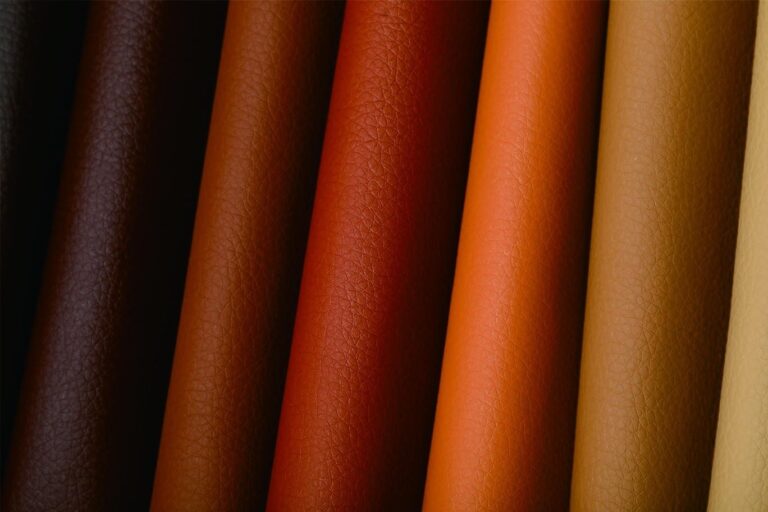
Drape and softness are poly leather’s genuine strengths — the question is how long the surface that delivers them survives
Poly Leather vs Genuine Leather: The Aging Curves
Put the two materials side by side over time and they don’t just age differently — they age in opposite directions. Genuine hide, reasonably maintained, runs 10–15 years of service: it scratches, yes, but scratches are repairable, and the material develops depth of color and sheen that designers deliberately showcase. Poly leather runs the reverse curve. The surface is flawless at delivery, stays flawless for a while, then fails suddenly and irreversibly — because the failure isn’t wear, it’s chemistry. Once the polymer layer starts breaking down, there is no patch, re-dye, or conditioner that restores it. A comparative durability study across leather types found synthetic and PVC-based leathers consistently at the bottom of abrasion and tensile rankings, with statistically significant gaps against natural hides. For buyers weighing the full trade-off set, our breakdown of the real vs faux leather difference covers cost, feel, and compliance dimensions.
| Aging attribute | Genuine leather | Poly leather (PU) | Silicone leather |
|---|---|---|---|
| Visual trajectory | Develops patina, gains character | Holds until failure, then peels | Holds; UV-stable 1,000+ hrs |
| Typical service life | 10–15 years | 2–5 years, climate-dependent | 10+ years tested |
| Damage response | Repairable — stitch, patch, re-dye | Not repairable once peeling starts | Scratch-resistant surface, panel-replaceable |
| Color consistency at order | Varies hide to hide | Excellent, batch to batch | Pantone-matched, ΔE ≤ 1.0 |

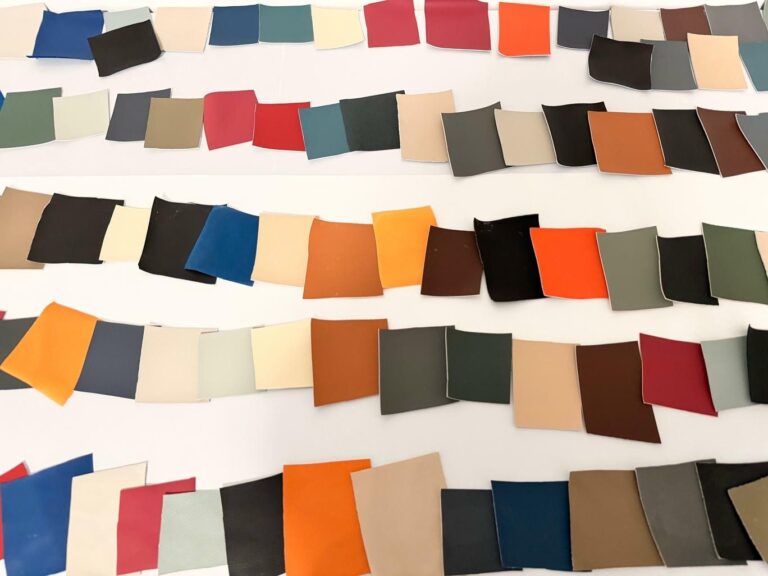
Color range is where coated materials beat hide — specify it with the same rigor you apply to durability
Why Poly Leather Peels: Hydrolysis Runs on Your Climate
The peeling that ends every poly leather story has a name: hydrolysis. Atmospheric moisture slowly reacts with the polyurethane polymer, cleaving the chains that keep the coating flexible. The material stiffens, then micro-cracks at every flex point, then flakes. Heat accelerates the reaction, which is why the same chair survives a dry Nordic office for six years and fails in a tropical lobby in two. The chemistry grades matter too — polycarbonate-based PU retains over 85% of its tensile strength after six weeks of jungle-condition exposure, while standard polyether PU drops below 40%. Most quotes don’t tell you which one you’re buying. In our own accelerated aging runs, the spread is even starker: under sustained heat and humidity, conventional PU samples delaminate within weeks, while silicone-coated structures hold with no layer separation for several times longer. Silicone’s inorganic backbone simply has no polymer chain for water to attack — the difference between a material that resists hydrolysis and one that merely postpones it. Our technical page on hydrolysis-resistant silicone leather publishes the test data behind that claim.
Spec rule of thumb: divide the supplier’s “lifespan” claim by your humidity. A 5-year poly leather warranty is a coastal-lab number — in a tropical or marine environment, plan around half of it.
Specifying Poly Leather Where It Won’t Bite You
None of this makes poly leather a wrong choice — it makes it a scoped one. The specification logic we use in our own projects: poly leather earns its place where product life is short by design, duty is light, and climate is controlled. Think seasonal retail furniture, trade-show builds, showroom mock-ups, hospitality refresh cycles under three years. It fails as a specification wherever the product must outlive the surface — residential seating, marine interiors, anything sweating under glass facades. When the brief demands the aesthetic durability that PU chemistry can’t structurally deliver, specify upward: premium microfiber PU stretches the timeline, and silicone leather removes the hydrolysis question entirely while keeping the color and texture control designers actually want from coated materials. Our full vs semi silicone leather comparison is worth reading before that conversation with a supplier, because the two constructions age very differently.
One more tier worth decoding before you sign: the word “premium.” In coated-fabric categories it is applied as freely to marketing decks as to material grades, and the two rarely align. Our look at premium PU leather positioning separates the tiers so you can see which one your quote is actually pricing.

Grain and tone options have never been the constraint — durability chemistry is
Surface finishes that hold their look: see the texture options that survive the aging curve
Frequently Asked Questions
Is poly leather real leather?
No. Poly leather is polyurethane (or PU-PVC blend) coated onto a fabric base, with an embossed grain imitating hide. It contains no animal hide, cannot develop patina, and is typically marketed alongside terms like faux leather, vegan leather, or leatherette — all describing the same coated-fabric family.
How long does poly leather last?
In dry, temperate, low-use environments, a well-made PU surface can hold five years or more. In humid or tropical climates, hydrolysis commonly starts degrading the surface within two to five years. Chemistry grade matters: polycarbonate-based PU grades age far slower than standard polyether PU, though few quotes disclose which you’re getting.
Can peeling poly leather be repaired?
Not meaningfully. Once the polymer layer is hydrolyzed, fillers and recoloring kits buy months at best because the substrate itself has lost integrity. The economic repair is panel replacement — which is why material selection at specification matters more than any later intervention.
Design for the Year-Three Photograph
The materials you specify get photographed twice: once at launch and once when the client is deciding whether to rehire you. Poly leather is a strong answer when the product’s whole life fits inside its surface life — and a liability the moment the brief outlives the coating. Match the material to the aging curve, not the launch-day sample, and the year-three photograph takes care of itself. That’s the standard we hold our own fashion and sports applications to, and it’s the filter worth applying to every coated-fabric quote on your desk.
About TOPSUN
TOPSUN produces designer-grade silicone leather for studios and brands that need coated-material aesthetics with long-horizon durability — spanning furniture collections, fashion pieces, and transport interiors.
Unlimited Pantone and RAL matching with ΔE ≤ 1.0 · 100+ embossed textures, custom rollers in 7–10 days · 1,000+ hour UV stability verified · Free A4 swatches shipped worldwide.