When a leather stitched product fails, the failure rarely starts at the leather. It starts at the seam. The thread snaps, the stitch perforation propagates into a tear, the corner puckers into a hole — and the entire product becomes a warranty claim. In B2B leather manufacturing, seam failure is the leading contributor to returns, complaints, and brand-damaging quality issues across furniture, automotive, bags, and footwear.
The variables that determine whether your leather stitched seam holds for two years or ten are surprisingly few: thread material, stitch density, and seam construction type. Yet most procurement specs treat stitching as an afterthought — a line item that says “stitched” without specifying thread type, SPI count, or seam classification. This gap is where 80% of warranty-claim seams originate.
This article provides the technical specification framework for leather stitched products — covering stitch types, thread performance, SPI standards, seam construction, reinforcement strategies, and the AQL quality control protocol that catches stitching defects before they ship.
Key Takeaway: Three variables predict leather seam lifespan: (1) Thread material — polyester outlasts nylon under UV by 3-5x. (2) Stitch density — 7-10 SPI for furniture, 8-10 SPI for bags, 6-8 SPI for automotive. (3) Seam type — lapped seams outperform superimposed seams by 20-30% in tensile testing. Get all three right, and your seam outlasts the leather.
The 3 Stitch Types: Lock, Saddle, and Double-Needle — When to Use Each
The stitch type used in leather stitched products determines both structural integrity and repairability. Each type has a specific engineering purpose — using the wrong one for the application creates a weak point that will fail under stress.
Lock Stitch (Class 301)
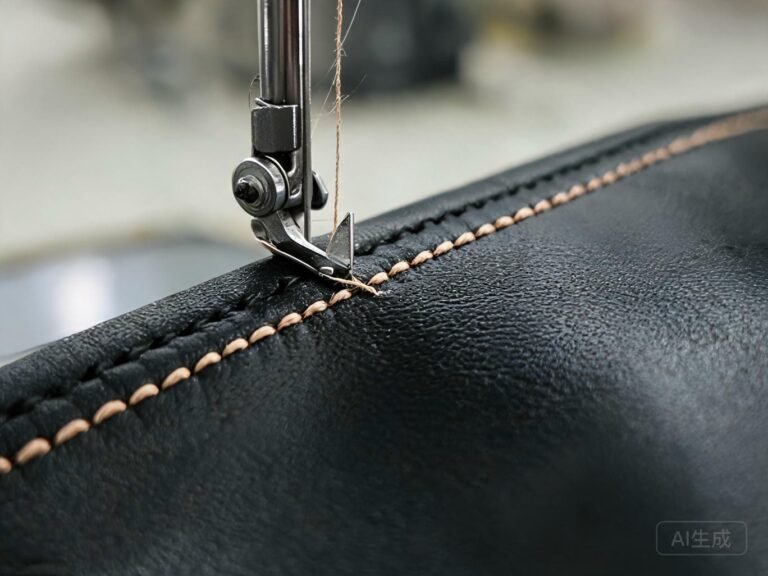
The workhorse of industrial leather sewing. A needle thread interlocks with a bobbin thread on the underside, creating a strong, uniform seam. Used in most machine-sewn leather goods — furniture upholstery, automotive interiors, bags, footwear. Lock stitch provides excellent mechanical strength and consistent appearance, but has a weakness: if the thread breaks at any point, the seam can unravel from that break forward. For high-stress applications, lock stitch should be reinforced with back-tacking at start and end points.
Saddle Stitch (Hand-Sewn)
Two needles work from opposite sides, threading through the same hole to create interlocking stitches on both sides. No bobbin thread. The critical advantage: if one thread breaks, the seam doesn’t unravel — the interlocking structure holds. This makes saddle-stitched leather stitched products significantly more repairable and durable than machine lock-stitched alternatives. Used in premium bags, wallets, belts, and heritage leather goods. The trade-off is cost — hand stitching is 5-10x slower than machine stitching.
Double-Needle Stitching
Two parallel needles mounted on a single machine, each with its own thread path, producing two parallel rows of stitching simultaneously. Double-needle stitching is the go-to method for leather stitching techniques for furniture and high-stress bag reinforcements — handle bases, shoulder strap anchors, bottom seams. Cylinder bed double-needle machines are specifically designed for three-dimensional items like bags and automotive interiors, allowing stitching around curves and corners with consistent tension on both rows.

Thread Showdown: Polyester vs Nylon vs Waxed for Seam Integrity
Thread material is the single highest-impact variable in thread strength for leather sewing. The wrong thread choice can undermine an otherwise perfect stitch — a beautiful saddle stitch with UV-sensitive nylon thread will fail in an automotive interior within 3-5 years, while the same stitch with polyester thread holds for 10+.
| Property | Polyester | Nylon | Waxed Polyester |
|---|---|---|---|
| UV Resistance | High — stable under prolonged sunlight | Medium — degrades under UV over time | High — polyester base + wax protection |
| Elasticity | Low — minimal stretch | Medium — absorbs tension and shock | Low — minimal stretch |
| Durability | Very High | High | Very High |
| Mildew Resistance | Resistant | Moderate | Resistant (wax adds barrier) |
| Machine Compatible | Yes — excellent for machine work | Yes — bonded nylon for high-speed | No — wax damages machine mechanisms |
| Temperature Limit | High — maintains integrity | Becomes brittle above 70°C | Beeswax degrades above 42°C; synthetic wax holds to 75°C |
| Best Application | Automotive, furniture, outdoor, marine | Straps, footwear, shock-absorbing seams | Hand-stitched luxury goods, wallets, belts |
For automotive interiors, outdoor furniture, and marine applications, bonded polyester is the only correct choice. Its UV stability means the thread maintains tensile strength for 10+ years under direct sunlight through windows or outdoor exposure. Nylon thread, while slightly more elastic, degrades under UV — becoming brittle and snapping within 3-5 years in automotive interiors exposed to regular sunlight.
For hand-stitched premium goods, waxed polyester combines the UV stability of polyester with the handling advantages of wax — the coating helps the thread slide through leather, maintains tension, and partially seals the stitch hole against moisture. However, waxed thread is not suitable for machine sewing — the wax can damage machine mechanisms and interfere with tension systems.
Thread size selection should match leather weight and application:
| Leather Type | Thread Size | Needle Size | Typical SPI |
|---|---|---|---|
| Fine (wallets, watch straps) | Tex 70 / 40s/3 | Small — fine point | 10-12 SPI |
| Medium (bags, belts, shoes) | Tex 135 / 210D/3 | #23-#24 | 8-10 SPI |
| Heavy (upholstery, saddlery) | Tex 210 / 420D/3 | #24-#25 | 5.5-7 SPI |

SPI Matters: How Stitch Density Predicts Seam Failure
SPI (Stitches Per Inch) is the stitch density specification leather variable that most directly correlates with seam performance. Too few stitches, and each stitch carries too much load — a single thread break creates a cascading failure. Too many stitches, and the perforation line becomes a zipper — the leather tears along the stitch holes under stress.
Industry-standard SPI ranges by application:
| Application | Standard SPI Range | Notes |
|---|---|---|
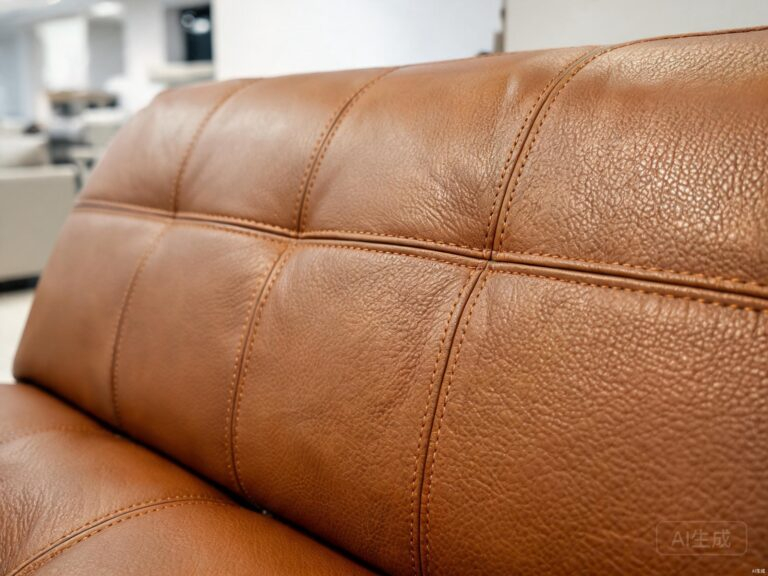
| Furniture / Upholstery (full-grain leather) | 7-9 SPI | Balances strength with leather integrity |
| Furniture / Upholstery (semi-aniline leather) | 8-10 SPI | Slightly denser — softer leather allows closer stitches |
| Automotive | 6-10 SPI | Depends on leather thickness, tanning method, flex requirements |
| Bags (boutique quality) | 8-10 SPI | All exterior and visible interior seams |
| Bags (ultra-luxury) | 11-14 SPI | Significant labor cost impact — reserved for premium positioning |
| Footwear (single needle, visible) | 7-9 stitches per 25mm | Visible seams and binding |
| Footwear (double needle, reinforced) | 8-10 stitches per needle | Reinforced seams and decorative stitching |
The relationship between SPI and seam strength is non-linear. At very low SPI (below 5), each stitch carries excessive load and the thread cuts through the leather under stress. At very high SPI (above 14), the perforation density creates a line of weakness — the leather tears along the stitch holes like a perforated paper edge. The sweet spot (7-10 SPI for most applications) balances load distribution with leather integrity.
Engineering Note: Each stitch leaves a permanent perforation in the leather. A quantitative study on shoe upper leathers found that needle holes render the leather unsuitable for reuse — contributing to material waste and higher production costs. Minimizing needle size (while matching thread diameter) and controlling stitch spacing are the two primary methods for limiting perforation damage.

Seam Construction: Lapped, Flat-Felled, and Abutted Performance
For stitched leather upholstery quality standards, the seam type is as important as the stitch type. A quantitative assessment of seam strength across various types in shoe upper leathers found that seam construction method significantly affects tensile performance — with lapped seams consistently outperforming superimposed seams by 20-30%.
Lapped Seam — Highest Strength
Two leather edges overlap, and stitching runs through both layers in the overlap zone. This construction distributes stress across a wider material area, making it the strongest standard seam type. The quantitative study confirmed lapped seams performed highest in seam strength for both calf and goat upper leathers. Use for high-stress applications — bag straps, furniture load-bearing seams, footwear construction.
Flat-Felled Seam — Enclosed and Protected
One seam allowance folds over the other, enclosing raw edges in a flat, reinforced finish. The Coats Seam Types reference describes the lap-felled type as involving one stitching operation that produces a strong seam protecting edges from fraying. Use for heavy-duty leather goods where raw edge protection and structural integrity are both required.
Abutted Seam — Low Profile
Leather edges meet without overlap and are stitched through both edges. This minimizes material bulk compared to lapped seams — useful for visible seams where profile matters. However, it relies on precise alignment and adequate stitch density to maintain strength. Use for applications where seam thickness must be minimized but load requirements are moderate.
Superimposed Seam — Standard but Weaker
Two layers overlap and are stitched through both. The simplest and most common construction — but the quantitative study found it performed acceptably without matching the structural integrity of lapped seams. Use for less critical seams where thickness reduction is a priority over maximum strength.

Reinforcement: Bar Tacks, Box Stitches, and Corner Strategies
Even with the right thread, SPI, and seam type, high-stress points need targeted reinforcement. Bar tack reinforcement leather bags and furniture is the difference between a strap that holds 50kg and one that tears at 15kg.
Bar Tacks
A short, heavy-duty reinforcement stitch that packs high-density stitching into a small rectangular area. Industrial bar-tack machines use lockstitch technology and build density in two stages — an initial row of stitches, then a second set of covering stitches perpendicular to the first. Applied at: handle base attachments, shoulder strap anchor points (including D-rings, swivel hooks, sewn loops), zipper top and bottom stops, and hardware attachment zones.
Box Stitch
Forms a reinforced square or rectangular pattern at stress points. Used on premium bags to reinforce strap, handle, and hardware attachment areas. Box stitches distribute load across a wider area than bar tacks but require more space and precise execution.
Corner Reinforcement
Corners are the most common failure point in leather stitched products. Repeated bending and pressure cause puckering — known as “bird-nesting” in QC terminology — which weakens the corner and creates tear initiation points. Mitigation: additional stitching rows at corners, careful corner alignment during cutting, higher SPI at high-stress corner zones, and double-needle reinforcement at corner turns.
Double Stitching at Stress Points
Used in handle bases, strap anchors, bottom seams, and corner zones to distribute load and reduce single-point failure risk. Double-needle machines produce parallel reinforcement stitching efficiently — the go-to method for high-stress areas in bags, furniture, and automotive interiors.

QC Protocol: The AQL Inspection Framework for Stitched Leather
For leather AQL inspection stitching criteria, the Acceptance Quality Limit framework provides the industry-standard method for batch acceptance or rejection. AQL sampling uses statistical thresholds to determine whether a production lot meets quality standards — typically at AQL 2.5 for major defects and AQL 4.0 for minor defects.
| Defect Category | Major Defect (Shipment Rejection) | Minor Defect (Acceptable Within AQL) |
|---|---|---|
| Stitching | Broken or skipped stitches; unraveling thread; loose seam; wrong stitch color | Slight temporary puckering; loose thread end |
| Corner Turns | Puckering or “bird-nesting” that weakens corner; potential hole formation | Minor visual irregularity not affecting strength |
| Thread Ending | Loose tails or visible knots; risk of unraveling | Small visible knot not affecting seam strength |
| Stitch Path | Wavy or crooked lines indicating poor operator skill or alignment | Slight deviation within tolerance |
| Thread Tension | Loops on underside; significantly reduces seam strength | Minor tension variation not affecting durability |
QC audits should be performed at fixed intervals during production — not only at the final stage. For high-volume orders, inspect at three checkpoints: (1) After the first 100 units to catch systematic issues early. (2) At 50% completion to verify consistency. (3) Pre-shipment for final AQL sampling. Key inspection points include SPI count verification, seam allowance measurement, tension consistency, back-tacking quality, and stress-point reinforcement verification.
For seam strength testing, ASTM D1683 (Standard Test Method for Failure Resistance of Sewn Seams) applies force perpendicular to the seam and measures failure resistance. ISO 13935 (Parts 1 and 2) determines maximum force to seam rupture using the strip and grab methods respectively. While these standards are primarily designed for woven fabrics, they serve as reference methods for upholstered product seam testing. For leather-specific applications, supplement these tests with flex testing (SAE J2452 for automotive) and UV aging (ISO 11341) to simulate real-world seam performance.
topsun-silicone-leather-factory-quality-control-intro
Automated vs. Hand Stitching: The Cost-Quality Decision
The choice between machine and hand stitching in leather stitched manufacturing is a cost-quality-repairability decision that should be made at the specification stage, not the production stage.
| Factor | Machine Stitching | Hand Stitching (Saddle) |
|---|---|---|
| Speed | Very high — supports production scale | Slow — 5-10x more labor time |
| Consistency | High — uniform stitch length and tension | Variable — depends on craftsman skill |
| Strength | Strong — but single break can unravel | Stronger — interlocking structure holds after single break |
| Repairability | Lower — lockstitch unravel risk | Higher — repairable without full seam failure |
| Unit Cost | Low — efficient production | High — skilled labor premium |
| Best For | Production-scale goods, furniture, automotive | Premium, luxury, heritage leather goods |
For B2B procurement, the decision framework is straightforward: if the product is positioned as premium or luxury with repairability as a selling point, specify hand-stitched saddle stitch at high-stress seams. If the product is production-scale commercial goods where cost efficiency matters, specify machine lock stitch with bonded polyester thread, appropriate SPI, and bar-tack reinforcement at stress points. Both can deliver 10-year seam life when specified correctly — the failure mode is not the method but the specification gap.
For deeper specification guidance, see our upholstery materials selection playbook and leather fabric quality and custom production guide. For application-specific stitching requirements, explore our leather sofa upholstery materials guide, recliner chair upholstery specifications, and handbag leather material guide.
For automotive stitching applications, see our automotive leather OEM guide and car seat leather material specifications. For quality-focused sourcing, our quality leather goods B2B guide and imitation leather quality guide cover broader QC frameworks.
FAQ: Leather Stitched
What stitch type is strongest for leather products?
For hand-sewn products, the saddle stitch is the strongest option — two needles interlock from opposite sides, so if one thread breaks, the seam doesn’t unravel. For machine-sewn products, the lock stitch provides excellent strength when combined with back-tacking at start/end points. For high-stress areas, double-needle stitching produces two parallel rows that distribute load. The strongest overall configuration is a lapped seam with double-needle lock stitching, bar-tack reinforcement at stress points, and bonded polyester thread at 7-9 SPI.
What thread material should I specify for outdoor leather applications?
Bonded polyester is the only correct choice for outdoor, automotive, and marine leather applications. Polyester has high UV resistance — it maintains tensile strength under prolonged sunlight exposure. Nylon thread, while slightly more elastic, degrades under UV and becomes brittle within 3-5 years in sun-exposed automotive interiors. For hand-stitched outdoor goods, waxed polyester combines UV stability with handling advantages — but is not suitable for machine sewing.
How many stitches per inch should leather upholstery have?
For furniture upholstery: 7-9 SPI for full-grain leather, 8-10 SPI for semi-aniline leather. For automotive: 6-10 SPI depending on leather thickness, tanning method, and flex requirements. For boutique-quality bags: 8-10 SPI on all visible seams. For ultra-luxury bags: 11-14 SPI. The key is balance — too few stitches overload each thread point; too many create a perforation line that tears under stress. The 7-10 SPI range is the industry sweet spot for most applications.
What is the AQL standard for leather stitching inspection?
The standard AQL for leather stitching inspection uses AQL 2.5 for major defects (broken or skipped stitches, unraveling thread, loose seams, wrong stitch color) and AQL 4.0 for minor defects (slight puckering, loose thread ends, minor path deviation). Inspections should occur at three checkpoints during production: after the first 100 units, at 50% completion, and pre-shipment. Key inspection points include SPI count, seam allowance, tension consistency, back-tacking quality, and stress-point reinforcement verification.
How does stitching affect leather product warranty claims?
Stitching quality is a leading contributor to warranty claims in leather goods. Common warranty-triggering stitching failures include seam separation, thread unraveling, corner stress failure, and low stitch density leading to tear propagation. Standard B2B warranties typically cover manufacturing defects including seam separation and stitching failure under normal use for 6-12 months. Premium warranties may extend to several years. Specifying the correct thread material (polyester for UV-exposed applications), appropriate SPI (7-10 for most uses), lapped seam construction, and bar-tack reinforcement at stress points prevents the majority of stitching-related warranty claims.
About TOPSUN
TOPSUN manufactures silicone synthetic leather engineered for superior stitching performance. Our material achieves 35N+ tear strength and 400N tensile force at break — providing a stable substrate that holds stitch perforations without propagation. The silicone polymer matrix resists UV degradation, maintaining leather integrity around stitch lines for 10+ years, even in automotive and outdoor applications where conventional PU leather cracks and fails at the seam.
We support B2B manufacturing teams with stitching specification guidance — thread recommendations, SPI targets, seam type selection, and reinforcement placement — tailored to each application. Our quality control process includes AQL-compliant stitching inspection, seam strength testing, and flex performance verification. Request a stitching specification consultation and material sample to begin your evaluation.
Related Reading:
- Upholstery Materials Selection Playbook
- Leather Fabric Quality and Custom Production
- Leather Sofa Upholstery Materials
- Recliner Chair Upholstery Material
- Automotive Leather Manufacturer OEM Guide
- Quality Leather Goods B2B Guide
- Handbag Leather Material Guide
- Imitation Leather Material Quality Guide
External Resources: