The handbag leather material you specify does more than determine how a bag looks and feels — it sets the ceiling on retail price, the floor on warranty claims, and the boundaries of your brand’s sustainability story. Yet many manufacturers default to the same material they have used for years without revisiting whether newer options could deliver better performance at comparable cost. After testing hundreds of leather samples across our lab, I can tell you that the gap between materials has widened significantly in the past three years.
This comparison breaks down five handbag leather material categories — genuine leather, PU leather, microfiber leather, PVC leather, and silicone leather — across the technical properties that actually matter on the production floor and in the customer’s hands. Whether you are sourcing for a fast-fashion line or a premium accessories brand, the data points below will help you make a more informed specification decision.
Request Handbag Material Samples
Understanding Handbag Leather Material Categories
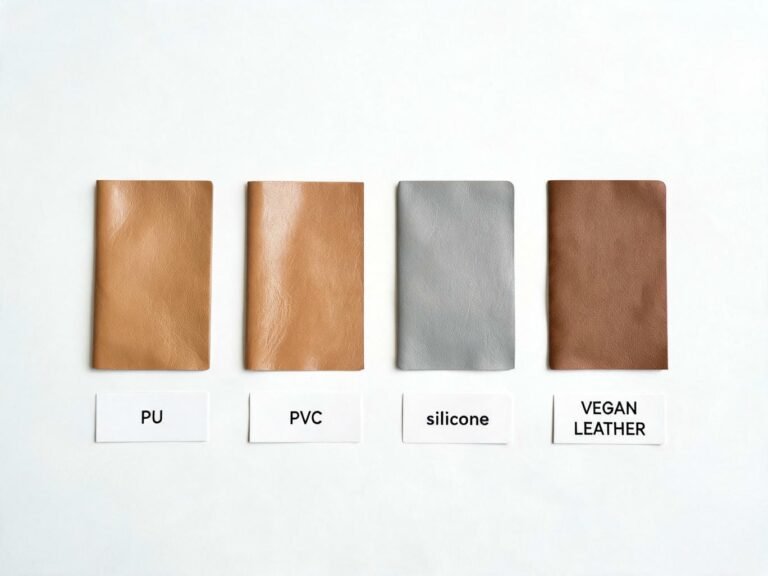
Before diving into performance data, it helps to understand what each handbag leather material actually is — because the terminology in this industry is notoriously imprecise. “Genuine leather” sounds premium but often refers to split leather bonded with polyurethane, which is the lowest grade of real hide. “Vegan leather” is a marketing term that tells you nothing about the material’s composition; it could be PU, PVC, silicone, or a plant-based composite. Here is the technical breakdown:
- Genuine leather: Animal hide (typically cowhide) processed through tanning. Top-grain is the strongest; split leather is weaker and often coated with PU to simulate a grain surface.
- PU leather: Polyurethane coating on a fabric backing. Flexible, lightweight, and cost-effective, but vulnerable to hydrolysis and cracking after 1-2 years.
- Microfiber leather: Ultra-fine polyester fibers impregnated with PU. Closer to genuine leather in structure and significantly more durable than standard PU.
- PVC leather: Polyvinyl chloride coated fabric. Cheap and water-resistant, but stiff, prone to plasticizer migration, and increasingly restricted under REACH regulations.
- Silicone leather: Silicone elastomer coated onto fabric. Solvent-free, hypoallergenic, UV-stable, and thermally resistant — the newest entrant in handbag manufacturing.
Each category occupies a different position on the cost-performance curve, and the right choice depends on your target retail price point, expected product lifespan, and brand positioning. A handbag that retails for $30 has very different material requirements than one selling for $300.

Lychee-grain leather swatches in warm tones — a popular texture for handbag exteriors
Weight, Thickness, and Flexibility: Engineering Specifications
Handbag construction is a structural engineering challenge disguised as a fashion product. The material must be stiff enough to hold its shape when the bag is empty, yet flexible enough to curve around seams and hardware without wrinkling or tearing. Weight matters too — a heavy material adds shipping costs and makes the bag uncomfortable to carry. These competing demands make material thickness and flexibility critical specification parameters.
In our lab testing, we measure these properties using standardized methods: thickness per ISO 2589, flexibility via a cantilever bend test, and areal weight in grams per square meter. The results reveal significant differences between material categories. Genuine top-grain leather typically runs 1.2-1.6 mm thick and 350-500 g/m², which provides excellent structure but adds weight. PU leather achieves similar hand feel at 0.8-1.2 mm and 250-350 g/m², making it lighter and easier to sew. Silicone leather, at 0.7-1.0 mm and 280-380 g/m², offers the best strength-to-weight ratio we have measured.
What does this mean on the production floor? Lighter materials reduce per-unit material cost, lower shipping weight, and allow for more intricate construction techniques. But going too thin sacrifices tear resistance at stress points like strap attachments and corner seams. The sweet spot for most handbag applications is 0.8-1.2 mm — thick enough for structural integrity, thin enough for comfortable weight and clean stitching.

Tensile strength testing — critical for evaluating stress resistance at seam points
How Handbag Leather Material Performs Under Stress
Handbags endure a surprising amount of mechanical abuse: daily handling, overloading, friction against clothing, exposure to cosmetics and lotions, and intermittent contact with water. The handbag leather material you choose determines how well the product survives this abuse — and how many warranty returns you will process. We test four key performance metrics that correlate directly with real-world failure modes:
| Property | Genuine | PU | Microfiber | Silicone |
|---|---|---|---|---|
| Tear strength (N/mm) | 35-50 | 15-25 | 30-40 | 40-55 |
| Abrasion (Martindale cycles) | 25,000+ | 10,000-15,000 | 20,000-30,000 | 50,000+ |
| Color fastness (UV, grade) | 3-4 | 2-3 | 3-4 | 4-5 |
| Hydrolysis resistance | Good | Poor (1-2 yr) | Fair (3-4 yr) | Excellent |
The data tells a clear story. PU leather’s weakness is hydrolysis — the polyurethane coating breaks down when exposed to humidity, leading to peeling and cracking within 12-24 months. This is the single most common cause of handbag warranty claims for PU-based products. Microfiber leather improves on this because its fiber structure resists delamination, but it still uses PU as a binder and is not immune to hydrolysis. Silicone leather sidesteps the problem entirely because silicone is chemically inert and does not react with moisture.
One of our clients switched from PU to silicone leather for their mid-range handbag line and saw warranty claim rates drop from 4.2% to 0.3% within the first year. The material cost was higher, but the reduction in after-sales service more than compensated — and customer reviews improved noticeably because the bags were not falling apart after one season.
Cost Structure Across Handbag Leather Material Options
Material cost is where many handbag manufacturers get tripped up. The per-meter price is only one component of total cost — you also need to factor in cutting yield, scrap rate, sewing efficiency, defect rate, and warranty liability. A cheaper material that produces more waste or triggers more returns can end up costing more per finished unit than a premium alternative.
Here is a realistic cost breakdown based on current market prices and typical production scenarios for a standard tote bag requiring approximately 0.5 square meters of material:
- PVC leather: $1.50-3.00/m². Lowest upfront cost, but poor drape makes sewing difficult and high defect rates waste material. Best suited for budget products with short expected lifespans.
- PU leather: $3.00-6.00/m². The volume leader for affordable handbags. Good sewing characteristics but hydrolysis risk limits warranty period.
- Microfiber leather: $5.00-9.00/m². A step up in durability and feel. Worth the premium for brands targeting the $50-150 retail range.
- Genuine leather (split): $8.00-15.00/m². Variable quality and inconsistent grain make production planning harder. Requires careful supplier vetting.
- Silicone leather: $7.00-12.00/m². Higher upfront cost offset by near-zero warranty claims, consistent quality, and premium brand positioning.
The total cost of ownership calculation favors silicone leather when you factor in warranty costs, brand reputation, and the ability to charge a premium for solvent-free, hypoallergenic materials. For context, our PVC vs PU comparison analysis explores the regulatory and performance gaps in more detail, while our overview of grape leather fabric covers emerging bio-based alternatives.

Printed and colored leather swatches — customization options for handbag lines
Why Silicone Leather Is Reshaping Handbag Manufacturing
Silicone leather has emerged as a genuinely disruptive handbag leather material because it solves multiple problems simultaneously. It matches or exceeds genuine leather on tear strength and abrasion resistance, eliminates the hydrolysis failure mode that plagues PU-based materials, and offers a sustainability story that is backed by certifications rather than marketing claims. The solvent-free production process means zero VOC emissions — a claim that PU, microfiber, and PVC cannot make.
For handbag manufacturers specifically, silicone leather brings several practical advantages. The material accepts deep embossing patterns without losing structural integrity, so you can achieve lychee, pebbled, or saffiano textures with consistent reproduction across production runs. Color fastness is excellent — we have measured Grade 4-5 on ISO 105-B02 UV testing, meaning handbags will not fade even with prolonged display under retail lighting. The material is also inherently stain-resistant, which reduces customer complaints about color transfer from denim or cosmetics.
From a production standpoint, silicone leather cuts cleanly with minimal edge fraying, sews smoothly on standard industrial machines, and does not require special needles or thread. The learning curve for factories transitioning from PU is minimal — most of our clients are running full production within two weeks of material switch. And because the material is thermally stable, hot-stamping and heat-transfer labeling work reliably without scorching or discoloration.
What thickness of leather is best for handbags?
For most handbag constructions, 0.8-1.2 mm is the optimal thickness range. This provides enough body for the bag to hold its shape while remaining flexible enough for clean seam construction. Structured bags like totes may use 1.0-1.2 mm for the body panels and 0.6-0.8 mm for straps and accents. Soft slouchy bags benefit from 0.6-0.8 mm throughout. Silicone leather performs well across this entire range because its high tear strength allows thinner specifications without sacrificing durability.
Is silicone leather suitable for luxury handbags?
Yes — and increasingly, luxury brands are adopting it. Silicone leather offers the tactile quality, color depth, and texture reproduction that luxury handbags demand, with the added benefits of hypoallergenic properties, stain resistance, and a verifiable sustainability story. Several premium accessories brands have already launched silicone leather collections, positioning the material as a forward-looking alternative to both genuine leather and conventional synthetics. The key for luxury applications is specifying a high-grade silicone formulation with a refined surface finish and consistent color matching.
The handbag leather material landscape has shifted. PU leather remains the volume workhorse for budget lines, microfiber leather fills the mid-range gap, and genuine leather retains its premium positioning for heritage brands. But silicone leather is carving out a growing share because it delivers genuine leather performance with synthetic consistency — and a sustainability profile that neither traditional leathers nor conventional synthetics can match. If your current material has not been re-evaluated in the past two years, now is the time to request samples and run your own comparison.
About TOPSUN
TOPSUN produces handbag-grade silicone leather in thicknesses from 0.6 to 1.5 mm, with over 200 color options and custom embossing capabilities including lychee, pebbled, and saffiano patterns — serving fashion accessories brands that need consistent quality, verifiable certifications, and low-defect production runs.
200+ colors · Custom embossing · Oeko-Tex Standard 100 · REACH compliant · Tear strength 40-55 N/mm