Stitching faux leather is a production-critical process where material chemistry directly determines sewing parameters. Unlike woven fabrics, faux leather cannot self-heal around needle punctures — every hole is permanent. This means needle selection, stitch length, thread type, and tension settings all affect not just aesthetic quality but structural seam integrity. For B2B manufacturers producing upholstered goods — furniture, automotive interiors, marine seating — getting these parameters wrong leads to seam failure, warranty claims, and production waste. This guide covers the technical specifications that procurement and production teams need to standardize before cutting begins.
Request Stitching Specification Sheet
Needle Selection for Faux Leather Stitching
Needle selection is the single most important variable in faux leather stitching. The wrong needle system creates perforation lines that weaken the material along the seam. Genuine leather needles feature a wedge point designed to cut through animal hide — but for faux leather with a fabric backing, these can actually damage the surface coating and weaken the seam. Microtex or universal needles are recommended for fabric-backed faux leather, while denim needles (size 90/14 or 80/12) with their deeper scarf and acute point work well for vinyl and PVC-based materials.
Academic research published in Materials (MDPI) tested needle sizes 90 and 100 with point types R (round) and LR on upholstery faux leather. The study found that stitches should be made in the direction of warp yarns for maximum joint strength — a cutting plan consideration that directly affects production yield and seam performance. Replace needles every 6–8 hours of sewing time; a bent or dull needle causes skipped stitches and material damage that compounds across a production run. For broader material context, refer to our faux leather guide.

Tensile strength tester — used to validate seam integrity under load before approving production parameters.
Thread Types and Tension Settings
Thread selection for faux leather demands synthetic fibers with high tensile strength. Cotton thread is explicitly not recommended — it breaks under the tension that faux leather seams require. The three primary thread options for industrial production are bonded nylon (highest strength, preferred for automotive and heavy upholstery), polyester size 40–30 (UV-resistant, versatile for general applications), and Nymo size D (premium specialty thread). Thread and needle size must be matched: a thread too thick for the needle eye creates drag, wrinkling, and gathering along the seam line.
| Thread Type | Recommended For | Notes |
|---|---|---|
| Bonded nylon | Automotive, heavy upholstery | Highest strength; UV-sensitive |
| Polyester (size 40–30) | General faux leather sewing | UV-resistant; versatile |
| Nymo size D | Specialty applications | Premium strength; higher cost |
| Cotton | Not recommended | Breaks under tension |
Tension settings should be reduced from standard fabric settings by 1–2 numbers. The goal is a knot that sits mid-layer between the faux leather pieces — too tight and the thread cuts through the coating, causing puckering and seam failure. Top tension should be verified on scrap material before every production run, as batch-to-batch material variation can shift the optimal setting.

Inspection area — where material batch consistency is verified before sewing parameters are locked in.
Stitch Length and Seam Strength: What the Data Shows
Stitch length is where many production teams default to standard fabric settings — and where the most preventable failures originate. Research published in Materials (MDPI) tested stitch lengths of 4 mm and 5 mm on upholstery faux leather and found that 4 mm produces the strongest seams for PU-based faux leather in both warp and weft directions. Stitches at 3 mm or shorter create too many needle holes, effectively perforating the material like a stamp and causing it to tear along the seam line.

Flexibility testing — evaluates how stitched seams perform under repeated bending, critical for seating applications.
Key findings from the study include: 4 mm stitch length is optimal for PU faux leather, 5 mm is acceptable but yields slightly lower joint strength, and stitches made in the warp direction produce higher fabric and joint strength than weft-direction stitches. For production planning, this means cutting patterns should be oriented so primary seams run parallel to the warp yarns whenever possible. This material specification decision affects the cutting plan, not just the sewing operation — and is particularly relevant for office chair upholstery where curved seams are common.
Common Stitching Defects and How to Prevent Them
Five defects account for the majority of faux leather stitching failures in production environments. Standardizing prevention protocols for each eliminates the trial-and-error that drives waste rates:
- Seam puckering — Cause: tension too tight or stitch length too short. Fix: increase stitch length to 3.5–4 mm, reduce presser foot pressure, loosen upper tension by 1–2 settings.
- Permanent pin holes — Cause: using pins to hold pieces together. Fix: use sewing clips or temporary adhesive. Every pin hole in faux leather is permanent and visible on the finished product.
- Skipped stitches — Cause: dull or bent needle, incorrect needle orientation. Fix: replace needle (every 6–8 hours), verify needle system matches material type, check machine timing.
- Material drag and sticking — Cause: faux leather surface friction against machine bed. Fix: install a Teflon presser foot and apply adhesive-backed Teflon film to the machine table.
- Seam slippage — Cause: fabric backing delaminates from coating under tension. PU fails by weft yarn separation; PVC fails by warp yarn rupture. Fix: verify material quality and use minimum 10 mm seam allowances for upholstery.

Finished sofa upholstery — where stitch quality directly determines product lifespan and warranty exposure.
Never backstitch faux leather to secure seams. Each needle hole is permanent, and backstitching creates a perforation cluster that weakens the seam. Use a lockstitch or tie-off method instead. For large-scale upholstery projects such as hotel upholstery applications, these defect prevention protocols should be documented in the production SOP before cutting begins.
Material-Specific Stitching: PU vs PVC vs Silicone

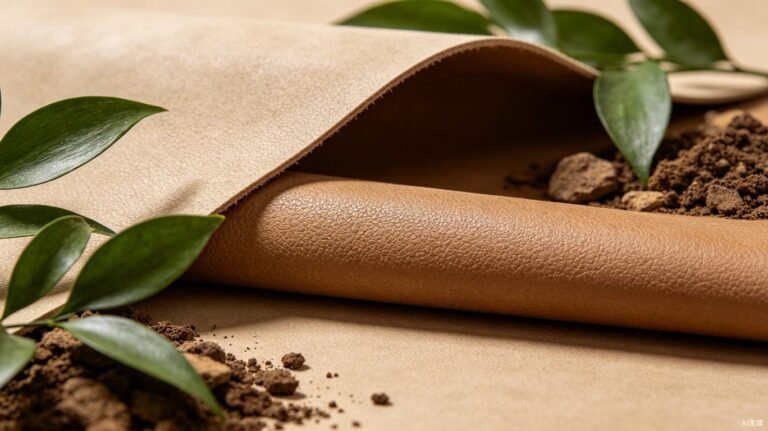
Texture samples — different faux leather chemistries require different stitching parameters.
Different faux leather chemistries demand different stitching approaches. The table below summarizes the production-critical parameters for each material type:
| Material | Needle | Thread | Stitch Length | Key Risk |
|---|---|---|---|---|
| PU faux leather | Microtex 90/14 | Bonded nylon | 4 mm | Weft yarn slippage |
| PVC faux leather | Denim 90/14 | Polyester | 4 mm | Warp yarn rupture |
| Silicone leather | Microtex 80/12 | Polyester | 3.5–4 mm | Surface tackiness |
Silicone leather presents a unique stitching profile. Its surface tackiness requires a Teflon presser foot and reduced presser foot pressure. However, its exceptional flexibility and tear resistance (200,000+ Martindale cycles) means seams fail less often — the material around the stitch holds up better than PU or PVC alternatives. For restaurant booth seating and other high-traffic upholstery applications, silicone leather’s seam performance is a significant advantage.
Flexing test — demonstrates how silicone leather maintains seam integrity under repeated bending stress.
The Bottom Line on Faux Leather Stitching
Stitching faux leather successfully is a function of matching needle, thread, and machine settings to the material’s specific chemistry. PU and PVC require different approaches; silicone leather offers a third profile with superior seam performance. Standardizing these parameters in your technical data sheets eliminates trial-and-error setup time and reduces defect rates across production runs. The data is clear: 4 mm stitch length, synthetic thread, and correct needle geometry are non-negotiable for production-quality seams.
Get Stitching Specification Sheet
About TOPSUN
TOPSUN manufactures silicone leather engineered for production efficiency as well as end-use performance. Our material’s flexibility and tear resistance translate directly into fewer stitching defects, lower waste rates, and stronger seams across automotive, furniture, and marine applications. We provide technical data sheets that include stitching parameters — needle recommendations, thread compatibility, and tested seam strength values — so production teams can standardize settings before the first cut.
ISO 10993 biocompatibility certified | REACH 247 SVHC compliant | FDA food-contact safe | PAHs certified | ISO 12947-2 abrasion tested