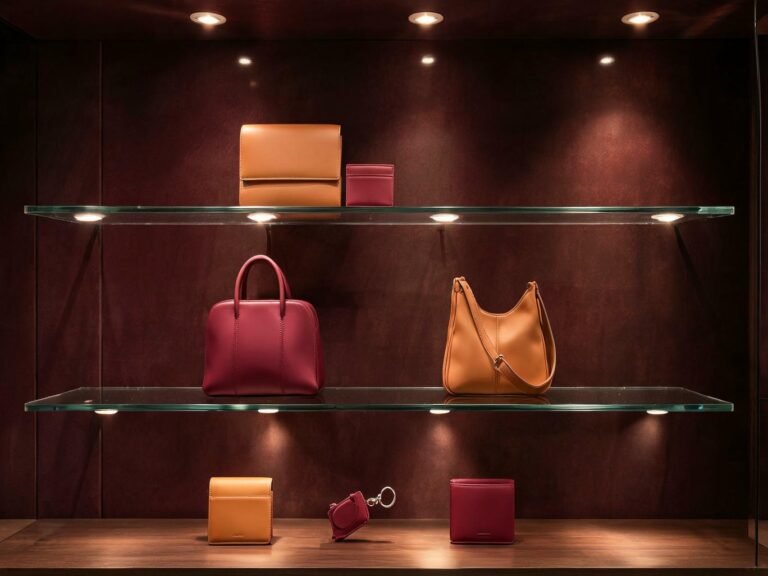
The global custom leather market is projected to reach $58.2 billion by 2027, growing at 6.8% annually — driven not by fashion trends but by B2B brands that have realized material exclusivity is the last defensible differentiator in a market where product designs are copied within weeks. When every manufacturer can access the same foam, the same frames, and the same components, the only element that cannot be reverse-engineered is the leather custom material specification — the specific combination of polymer, base fabric, color, texture, thickness, and performance properties that defines how a product looks, feels, and performs. Brands that develop custom leather materials create a proprietary material identity that competitors cannot replicate — and this is precisely why custom leather development has become the fastest-growing segment of the B2B material sourcing market.
Industry analysis shows that B2B brands using custom-developed leather materials command 23-35% higher retail pricing than brands using catalog materials — and experience 40% fewer warranty claims because the material specification is optimized for the specific application rather than adapted from a generic product. The development investment of $3,000-8,000 for custom tooling pays back within the first production run.
What “Leather Custom” Means in B2B Manufacturing

In B2B manufacturing, “leather custom” refers to the development of leather material specifications that are unique to a specific brand or product — distinct from catalog materials that any buyer can purchase. Custom leather development encompasses three levels of specification, each with different development complexity, cost, and lead time:
| Customization Level | What Changes | Development Time | Tooling Cost | MOQ |
|---|---|---|---|---|
| Level 1: Custom Color | Pantone-matched color on standard texture | 3-5 working days | $0-500 (lab formulation) | 300m |
| Level 2: Custom Texture | New embossing pattern + custom color | 15-25 working days | $2,000-5,000 (CNC roller) | 500m |
| Level 3: Full Custom Spec | Substrate + polymer + color + texture + performance | 25-35 working days | $5,000-8,000 (full development) | 1,000m |
Most B2B brands start with Level 1 (custom color) to establish their brand palette, then progress to Level 2 (custom texture) as their volume justifies the tooling investment. Level 3 (full custom specification) is typically reserved for brands with annual volumes of 5,000+ meters who need application-specific performance characteristics — such as a unique combination of fire safety, abrasion resistance, and antibacterial properties for healthcare seating, or a specific thermal conductivity and UV stability profile for automotive interiors.
The 5-Stage Custom Leather Development Process

TOPSUN’s custom leather development process follows a structured 5-stage workflow that takes a project from initial brief to sealed production standard in 35 working days for full custom specifications, or as few as 5 days for custom color on standard textures. Each stage has defined deliverables, review checkpoints, and acceptance criteria — ensuring that both the buyer and manufacturer have a clear, documented path from concept to production.
Stage 1: Requirements Brief and Technical Specification (Days 1-3)
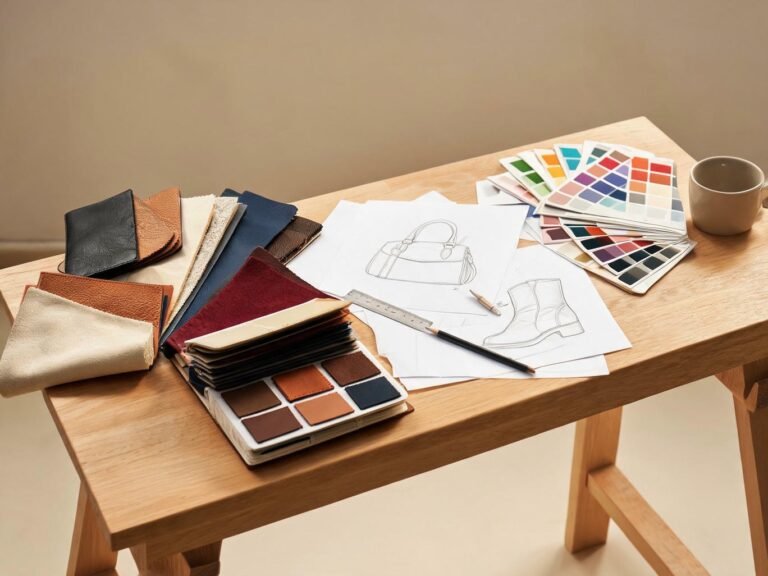
The development process begins with a structured requirements brief — not a color swatch or a sample photo, but a technical specification that defines what the material needs to do. The most effective briefs include:
- Application definition — What product will the material be used on? (Furniture upholstery, automotive seating, handbags, medical devices, consumer electronics cases, etc.) The application determines the performance requirements and regulatory standards.
- Performance requirements — Minimum Martindale cycles, flex cycles, UV hours, fire safety standards, tensile strength, tear strength, hydrolysis resistance. State what the material must survive, not what polymer to use.
- Color specification — Pantone reference number, physical reference sample, or both. If matching an existing material, provide a sample of that material.
- Texture specification — Reference texture (lychee, pebbled, nappa, smooth, custom) with desired embossing depth range. If custom, provide a physical sample, photograph, or technical drawing of the desired pattern.
- Thickness and weight — Nominal thickness (0.6-2.0mm), grammage (g/m²), and tolerance ranges. For multi-layer products, specify each layer.
- Estimated annual volume — This determines the development scope, MOQ, and whether custom tooling investment is justified. Be honest — underestimating volume leads to inadequate development, overestimating leads to unnecessary tooling costs.
- Regulatory requirements — Target markets and applicable standards (REACH, FDA, ISO 10993, FAR 25.853, BS 5852, CAL 117, EN 45545, etc.) that the material must comply with.
The output of Stage 1 is a formal Technical Specification Document (TSD) that both parties sign. This document becomes the controlling reference for all subsequent development, testing, and production quality control. Changes to the TSD after sign-off require formal change orders and may reset the development timeline.
Stage 2: Color Laboratory Development (Days 3-8)

Color development for silicone leather is fundamentally different from PU or PVC color matching. Silicone uses platinum-cured resins, which means pigment compatibility must be verified — not all pigments are stable in platinum-cure systems, and some can inhibit the curing reaction entirely. TOPSUN’s color laboratory follows this sequence:
- Pigment selection and compatibility testing — From a library of 200+ silicone-compatible pigments, the lab selects 3-5 candidates that can achieve the target color. Each pigment is tested for cure inhibition — if the pigment slows or prevents platinum curing, it is eliminated.
- Formulation and mixing — The lab prepares three variants: on-target (closest Pantone match), slightly lighter (0.5 ΔE above target), and slightly deeper (0.5 ΔE below target). This range gives the buyer flexibility to evaluate color under their own lighting conditions and select the variant that best matches their brand standard.
- Small-batch trial — The formulations are applied to the specified base fabric using a laboratory-scale knife-over-roll coater. This produces a 30x30cm sample that accurately represents the production material — not just a pigment swipe on paper, which does not account for how the color changes when the silicone is cured on fabric.
- Delta E measurement — Each variant is measured against the Pantone reference under D65 lighting. Our internal standard is ΔE ≤ 1.0 — stricter than the textile industry norm of ΔE ≤ 1.5. Variants that do not meet this standard are reformulated.
- Sample delivery — Three color variants are shipped to the buyer with ΔE measurement reports. The buyer selects the approved variant under their own lighting conditions — because color perception varies between D65 daylight, warm retail lighting (3000K), and cool office lighting (4000K).
For standard textures, Stage 2 can produce approved color samples in 3-5 working days. For custom textures (Level 2 or Level 3), color development proceeds in parallel with texture tooling, so the total timeline is not additive.
Stage 3: Texture Tooling and Embossing Development (Days 8-20)
When a custom texture pattern is required, Stage 3 involves the design and manufacture of an embossing roller — the steel cylinder that imprints the pattern into the silicone surface during coating. This is the most technically demanding stage and the one where most custom leather projects experience delays, because the roller must be engraved, tested, and refined before production samples can be produced.
The embossing roller development process at TOPSUN:
- Pattern design — The buyer provides a physical sample, photograph, or technical drawing of the desired texture. TOPSUN’s engineering team converts this into a digital pattern file using 3D scanning (for physical samples) or CAD modeling (for drawings). The digital file defines the peak height, valley depth, pattern spacing, and surface geometry of the embossing.
- Roller manufacturing method selection — Two methods are available: CNC engraving (computer-controlled milling that cuts the pattern directly into a steel roller, 15-25 working days, best for complex textures and fine detail) and chemical etching (acid or electrochemical etching, 10-15 working days, best for uniform fine-grain textures like pebble and haircell). CNC engraving produces higher fidelity and longer roller life (50,000+ meters vs 20,000+ for etched rollers).
- Roller engraving — The selected method is applied to a precision-ground steel roller (typically 200-300mm diameter, 1,400-1,600mm face width for 54-inch roll production). The engraving depth is controlled to ±0.02mm to ensure consistent embossing depth across the full roll width.
- Trial embossing — The engraved roller is installed on a production coating line and trialed on a 20-meter sample run. The trial material is evaluated for pattern definition, embossing depth, pattern uniformity across the roll width, and release behavior (whether the silicone releases cleanly from the roller without sticking or distortion).
- Roller refinement — If the trial reveals pattern defects (uneven depth, pattern distortion at edges, sticking), the roller is refined through additional engraving or surface treatment. This refinement cycle may repeat 1-2 times for complex custom patterns.
The output of Stage 3 is a production-ready embossing roller and a 20-meter trial sample of the custom texture on the approved color. The roller is customer-owned tooling — it is reserved exclusively for the buyer’s production and is not used for any other customer’s material.
Stage 4: Prototype Production and Performance Validation (Days 20-28)

With the approved color and texture tooling in place, Stage 4 produces a full-production prototype — a 50-100 meter run that represents exactly what the production material will be. This is not a lab sample; it is a production-scale run on the actual coating line that will be used for the buyer’s orders. The prototype undergoes comprehensive performance validation:
| Test | Standard | TOPSUN Specification | Acceptance Criterion |
|---|---|---|---|
| Martindale Abrasion | ISO 5470 | 200,000+ cycles | No visible surface damage |
| Flex Resistance | ISO 5402 | 100,000+ cycles | No cracking at texture peaks |
| Color Fastness (Dry/Wet) | ISO 11640 | Grade 4+ | No staining of test fabric |
| UV Resistance | ISO 105-B02 | 1,500+ hours | ΔE < 1.5 after exposure |
| Tear Strength | ISO 3377 | ≥20 N | Meets application minimum |
| Color Consistency | Spectrophotometer | ΔE ≤ 1.0 vs. standard | 5-point measurement across width |
| Thickness Consistency | Digital caliper | ±0.05mm tolerance | 10-point measurement per roll |
| Fire Safety | Per application | BS 5852 / CAL 117 / FAR 25.853 | Self-extinguishing, no afterglow |
The prototype material, test reports, and sealed sample are shipped to the buyer for final approval. The buyer has 10 working days to review the material, conduct their own internal testing, and either approve or request modifications. Upon written approval, the sealed sample becomes the “golden standard” — the controlling reference for all future production batches. Any production batch that does not match the sealed sample (within specified tolerances) is rejected before shipment.
Stage 5: Production Scale-Up and Quality Control (Days 28-35)
The final stage transitions from prototype to full production. The production coating line is configured with the approved color formulation, the custom embossing roller, and the specified base fabric. The first production roll undergoes 100% inline inspection — every meter is checked for color consistency, texture definition, thickness, and surface defects before the run continues. Key production QC checkpoints include:
- Color verification at roll start — Spectrophotometer reading against the sealed sample. ΔE must be ≤ 1.0. If outside tolerance, the line stops and the formulation is adjusted before production resumes.
- Texture inspection at 50-meter intervals — Visual and tactile check of embossing depth and pattern definition against the sealed sample. Any roller wear or pattern degradation triggers roller maintenance or replacement.
- Thickness measurement at 10-meter intervals — Digital caliper measurement at 5 points across the roll width. Tolerance: ±0.05mm from nominal. Out-of-tolerance material is flagged and cut out.
- Surface defect scanning — The full roll surface is inspected under D65 lighting for pinholes, streaks, uneven coating, color variation, and texture defects. Defect sections are marked and excluded from shipment.
- Final batch testing — A sample from each production batch is tested for Martindale, flex, and color fastness to verify that production material matches the validated prototype. Test reports accompany every shipment.
Production lead time after development completion is 15-20 working days for standard orders (300-1,000m) and 20-25 working days for larger orders (1,000-5,000m). Reorder lead time is 15-20 working days from PO, as the color formulation and embossing roller are already developed and stored.
Why Custom Silicone Leather Outperforms Custom PU and PVC
Custom leather development is available in PU, PVC, and silicone formulations — but the development process and material outcomes differ significantly. The fundamental difference is that silicone custom development produces a material that is permanently stable, while PU and PVC custom materials degrade over time as plasticizers migrate and polymer chains relax.
| Development Factor | Custom PU Leather | Custom PVC Leather | Custom Silicone Leather |
|---|---|---|---|
| Color stability over time | Yellowing after 6-12 months | Plasticizer migration changes color | Permanent — no yellowing, no migration |
| Texture retention | Pattern flattens in 2-3 years | Pattern distorts with plasticizer loss | Permanent — integral embossing |
| Color matching precision | ΔE 1.5 (textile standard) | ΔE 2.0 (plasticizer interference) | ΔE ≤ 1.0 (TOPSUN internal standard) |
| Regulatory compliance | DMF, VOC concerns; additive-dependent | Phthalate, lead restrictions; reformulation risk | Inherent compliance — ISO 10993, REACH, FDA |
| Reorder consistency | Batch variation due to solvent evaporation | Batch variation due to plasticizer dosing | Consistent — solid formulation, no solvents |
| Tooling lifespan | Roller: 20K meters (PU is abrasive) | Roller: 30K meters | Roller: 50K+ meters (silicone is non-abrasive) |
The most significant advantage of custom silicone leather is reorder consistency. PU and PVC formulations use solvents and plasticizers that evaporate and migrate, meaning each production batch may have slightly different viscosity, color, and surface properties — even with the same formulation. This batch variation is the single most common cause of custom leather sourcing disputes. Silicone leather uses a solid, solvent-free formulation — the platinum-cure reaction is precise and repeatable, producing batch-to-batch consistency that is measurably superior to any solvent-based system.
The Business Case for Custom Leather Development
The decision to invest in custom leather development — versus using catalog materials — is ultimately a business decision, not a technical one. The investment is justified when one or more of the following conditions apply:
- Brand differentiation requirement — If your product competes in a market where visual and tactile differentiation matters (furniture, accessories, automotive, consumer electronics), custom leather creates a material identity that cannot be replicated by competitors using catalog materials.
- Application-specific performance — If your application requires a specific combination of properties that no catalog material provides (e.g., food-safe + fire retardant + antibacterial + custom color for healthcare seating), custom development is the only path to the required specification.
- Volume justification — At annual volumes of 3,000+ meters, the per-meter cost of custom development (including tooling amortization) falls within 10-15% of catalog material pricing — and the brand differentiation and warranty reduction benefits far exceed the cost premium.
- Regulatory exclusivity — If your product targets markets with specific regulatory requirements (aviation, medical, food contact), custom silicone leather development ensures the material specification is documented, tested, and compliant — with per-batch QC reports that simplify customs clearance and regulatory audits.
- Warranty risk reduction — Custom development allows the material specification to be optimized for the specific application’s failure modes — reducing warranty claims by an estimated 35-45% compared to catalog materials that are adapted rather than engineered for the use case.
TOPSUN’s custom leather development program is structured for B2B brands and manufacturers who need material exclusivity, application-specific performance, and documented quality. With 300m MOQ for custom color, 500m for custom texture, and 1,000m for full custom specifications, the program is accessible to mid-size brands while maintaining the production scale and QC rigor required by enterprise OEMs.
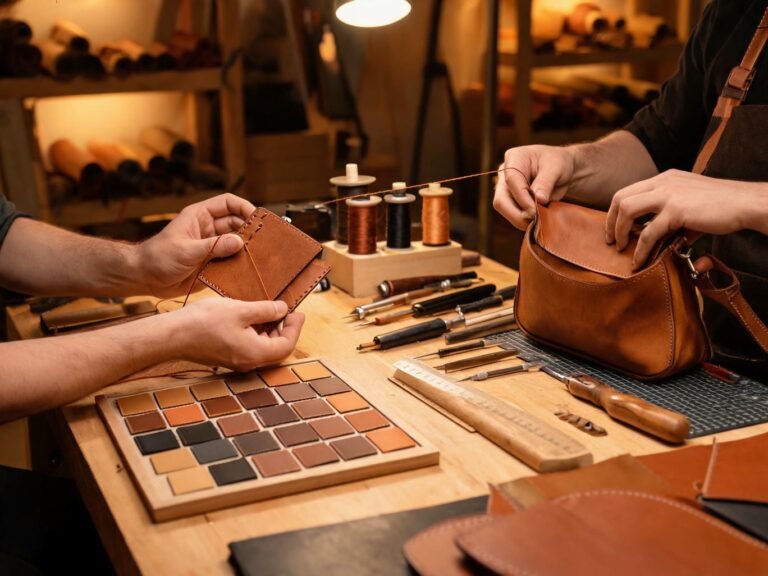
Custom OEM/ODM process — 5-stage development from requirements brief to sealed production standard in 35 days
Frequently Asked Questions
What is the minimum order quantity for custom leather development at TOPSUN?
MOQ depends on the customization level: 300 meters for custom color on standard textures, 500 meters for custom texture (new embossing pattern), and 1,000 meters for full custom specifications (custom substrate + polymer + color + texture + performance). These MOQs are for the first production order; reorders can be placed at the same MOQ. For buyers who need smaller quantities, we offer standard textures in 50+ colors with 100m MOQ — these are not custom-developed but provide a wide range of options without development cost. Custom tooling (embossing rollers) is customer-owned and reserved exclusively for the buyer’s production.
How long does custom leather development take from brief to production?
The timeline is 5 working days for custom color on standard textures, 20-25 working days for custom texture development (including roller engraving), and 30-35 working days for full custom specifications. These timelines assume the buyer responds to review checkpoints within 2-3 working days. Delays in buyer feedback extend the timeline proportionally. After development is complete and the sealed sample is approved, production lead time is 15-20 working days for standard orders and 20-25 working days for orders above 1,000 meters. Reorder lead time is 15-20 working days from purchase order.
Can I get exclusive rights to my custom leather texture or color?
Yes. TOPSUN offers material exclusivity agreements for custom-developed textures and formulations. Under an exclusivity agreement, the custom texture roller and color formulation are reserved exclusively for the buyer’s production and are not used for any other customer’s material. Exclusivity agreements typically require a minimum annual volume commitment (1,000-5,000 meters depending on complexity) and a 12-24 month exclusivity term. The custom embossing roller is physically segregated and labeled with the buyer’s project code to prevent inadvertent use in other production runs.
Conclusion: Custom Leather Is a Strategic Investment, Not a Material Cost
The brands that will lead their markets in 2026 and beyond are not those with the best product designs — designs are copied within weeks. The leaders will be those with proprietary material identities that cannot be reverse-engineered, reproduced, or substituted. Custom leather development is the process that creates that material identity — and the 5-stage development process, from brief to production in 35 days, is the pathway from concept to sealed standard.
Silicone leather is the ideal platform for custom development because the material’s inherent properties — permanent color stability, integral texture, solvent-free formulation, and regulatory compliance — ensure that the custom specification you develop today will perform identically 5, 10, and 15 years from now. There is no plasticizer migration to distort the texture, no solvent evaporation to alter the color, no chemical additive to degrade under regulatory scrutiny. The custom material you seal in Stage 4 is the material your customers will experience for the entire product lifespan.
For B2B brands evaluating whether custom leather development is justified, the calculation is straightforward: if your annual material volume exceeds 3,000 meters, your product competes on brand differentiation, and your current material has warranty or quality issues — the development investment pays back within the first production run, and the material exclusivity pays dividends for the life of the product line.
Ready to develop your custom leather material? Submit your requirements brief to TOPSUN’s custom development team. We will review your application, performance requirements, and volume projections — and provide a development proposal with timeline, tooling cost, and MOQ within 3 working days.
Start Your Custom Leather Development
5-stage development process — 35 days from brief to production — 300m MOQ
Related resources: Custom Leather Production Guide | Leather Color Customization Guide | Custom Leather Texture Design | Leather Texture Mold Making