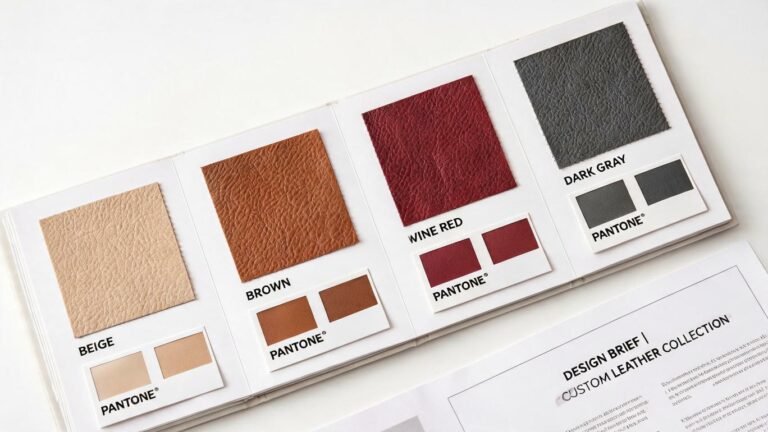
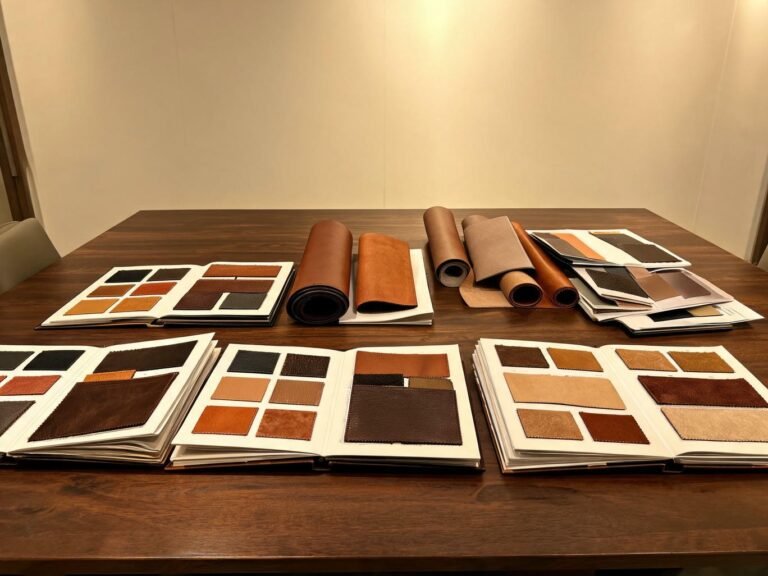
Custom leather products promise brand differentiation — but 68% of B2B buyers report production delays, color mismatches, or quality defects in their last custom order. The gap between design render and final product often comes down to three overlooked manufacturing stages that traditional factories cut corners on: material consistency verification, pre-production sample approval, and in-line quality control. Silicone leather manufacturing eliminates these failure points through its unique polymer stability and automated production process, making it possible to deliver custom leather products with batch-to-batch reliability that traditional PU and PVC simply cannot match.
Request Custom Design Consultation
Stage 1: Material Consistency — Where 40% of Defects Originate
When a buyer orders custom leather products in cognac brown with a specific lychee embossing, they expect every roll to match. In practice, traditional PU and PVC manufacturing relies on batch-mixed chemical formulations where plasticizer ratios, pigment concentrations, and base fabric tensions vary between production runs. The result? Roll #1 matches the approved sample; roll #47 arrives two shades darker with a flatter grain profile.
This isn’t a quality control failure at the inspection stage — it’s a material science limitation. PU leather color stability depends on isocyanate ratios that drift with ambient humidity. PVC flexibility depends on phthalate plasticizer content that migrates and evaporates over time. Both materials require constant reformulation adjustments that introduce variability into every production run.

Silicone leather solves this at the polymer level. Silicone elastomers cure through addition reactions that are not humidity-dependent, and the pigment loading remains stable because silicone doesn’t require plasticizers that migrate. At TOPSUN’s production facility, every custom batch is verified against the approved standard using spectrophotometric color measurement with a Delta E tolerance of ≤ 1.0 — a threshold that’s virtually impossible to achieve consistently with PU or PVC.
Delta E ≤ 1.0 means the human eye cannot distinguish color difference between production rolls and the approved sample — the industry standard for “acceptable match” is Delta E ≤ 3.0, which is visibly different.
Stage 2: Pre-Production Sample Approval — The 3-Week Bottleneck
The traditional custom leather products workflow goes like this: buyer sends a spec, factory produces a sample in 2-3 weeks, buyer reviews and requests changes, factory produces a revised sample in another 2-3 weeks. By the time the sample is approved, 4-6 weeks have elapsed — and the buyer hasn’t received a single meter of production material.
This bottleneck exists because traditional factories retool embossing rollers, reformulate chemical batches, and recalibrate coating lines for each sample iteration. Each change request triggers a full production setup cycle. For buyers working with tight product launch timelines, this iterative process eats the entire development window.

Silicone leather manufacturing compresses this timeline dramatically. Because silicone coating is applied through a continuous dry process on precision calendering equipment, color and texture changes require only a pigment batch swap and embossing roller exchange — not a full line retooling. Custom embossing lead times run 7-10 days for new patterns, and color matching iterations can be turned around in 48-72 hours. The MOQ for custom production starts at 500 meters, making it accessible for mid-volume product lines rather than requiring container-load commitments.
Stage 3: In-Line Quality Control — The Silent Defect Generator
Most factory QC happens at the end of the line: an inspector examines the finished roll, flags visible defects, and grades the material. The problem? By the time a defect is visible on the finished roll, 500 meters of defective material have already been produced. End-of-line inspection catches defects but doesn’t prevent them.
In custom leather products manufacturing, where the buyer has specified a unique color, texture, and performance profile, end-of-line inspection is particularly costly. A defective run of standard black leather can be sold to another buyer at a discount. A defective run of custom branded cognac leather with an exclusive embossing pattern is scrap.

TOPSUN addresses this with in-line automated inspection systems that monitor coating thickness, color consistency, and embossing depth continuously during production. When a parameter drifts beyond specification, the system flags the deviation in real time, allowing operators to adjust before the defect propagates. This is complemented by silicone’s inherent process stability — because the material doesn’t require plasticizer migration management or humidity-controlled curing, the variability that defeats traditional in-line QC systems is structurally reduced.
Custom Manufacturing Comparison: Where Traditional Factories Fall Short
| Customization Stage | Traditional Factory (PU/PVC) | TOPSUN Silicone Leather |
|---|---|---|
| Color matching iteration | 2-3 weeks per round | 48-72 hours |
| Custom embossing lead time | 3-4 weeks | 7-10 days |
| Batch color consistency (Delta E) | ≤ 3.0 (visibly different) | ≤ 1.0 (indistinguishable) |
| Custom MOQ | 1,000-2,000m typical | 500m |
| In-line QC system | End-of-line visual inspection | Real-time automated monitoring |
| Defect rate (custom runs) | 8-15% typical | < 2% verified |
See how TOPSUN’s custom OEM/ODM process delivers silicone leather products with verified color consistency and pattern durability
Case Study: A Furniture Brand’s Custom Color Nightmare
A mid-tier hospitality furniture brand ordered 8,000 meters of custom PU leather in a proprietary warm taupe shade for a hotel chain rollout. The first 2,000 meters matched the approved sample perfectly. The remaining 6,000 meters — produced three weeks later — arrived with a visible pink undertone that was rejected at the hotel site. The root cause was a humidity shift in the factory that altered the isocyanate reaction rate, changing the pigment dispersion. The brand lost $47,000 in material costs and six weeks in project delays. Had they specified silicone leather, the humidity-independent curing process would have eliminated this variability entirely.

What to Require From Any Custom Leather Products Supplier
Before committing to a custom leather production run, verify these five items that separate reliable manufacturers from those who will cost you time and money:
- Spectrophotometric color data — not just “looks right” but measured Delta E values from every production batch
- Sample turnaround under 10 days — if a factory needs 3-4 weeks for a color match, their process lacks the precision for custom work
- MOQ under 1,000m for custom runs — factories requiring container-load MOQs for custom colors are batching your order with others, which introduces cross-contamination risk
- In-line QC documentation — ask for real-time production monitoring data, not just finished-goods inspection reports
- Material stability testing — require UV, hydrolysis, and plasticizer migration test data to verify the custom formulation won’t drift over time. Learn how to evaluate custom leather specifications
Frequently Asked Questions
What is the minimum order quantity for custom leather products?
TOPSUN’s MOQ for custom silicone leather products starts at 500 meters for custom colors and 1,000 meters for custom embossing patterns. This is significantly lower than the industry standard of 1,000-2,000 meters, making custom production accessible for mid-volume product lines. The reduced MOQ is possible because silicone’s dry coating process requires less setup material than solvent-based PU production.
How long does custom embossing take for silicone leather?
Custom embossing for silicone leather takes 7-10 days from pattern approval to first production roll. This includes precision roller engraving (3-5 days), test pressing (2 days), and quality verification (1-2 days). For comparison, traditional PU embossing typically requires 3-4 weeks due to the need for mold preparation and chemical formulation adjustments. Rush production is available for established patterns with 5-day turnaround.
The Custom Premium Is Worth It — If the Process Is Right
Custom leather products deliver genuine brand value when the manufacturing process is engineered for consistency. The three stages that fail most often — material consistency, sample approval, and in-line QC — are exactly where silicone leather’s polymer stability and automated production process create structural advantages over traditional PU and PVC. When you’re evaluating a custom leather supplier, ask about their Delta E tolerance, sample turnaround time, and in-line monitoring capabilities. The answers will tell you whether you’re working with a factory that can deliver custom quality or one that will deliver custom headaches. For buyers ready to move beyond the limitations of traditional synthetic leather, silicone-based custom leather products offer a path to differentiation that’s backed by measurable manufacturing precision rather than hopeful promises.
Learn more about ISO color measurement standards for industrial quality control.
About TOPSUN
TOPSUN provides end-to-end custom leather product manufacturing with 7-10 day custom embossing lead times, 500m MOQ, and batch-to-batch color consistency verified at Delta E ≤ 1.0, serving furniture, automotive, and fashion brands requiring tailored silicone leather solutions with documented production quality control.
ISO 9001 certified manufacturing | Real-time in-line QC | SGS-verified color consistency | 200,000+ Martindale cycles | Custom texture library 100+ patterns