Brand managers send us custom leather goods briefs every week — sketches, mood boards, Pantone references, hardware specs. In our OEM onboarding process, we’ve guided 100+ brands through custom leather goods development, and the same five specification gaps appear in roughly 80% of initial briefs we receive. Most buyers focus on aesthetics and unit price. Few verify the material-level specs that determine whether a production run ships on time or gets held for a 6-week rework cycle. The factories that quietly skip these checkpoints aren’t cutting corners maliciously — they just don’t test for them. Here are the five specifications that separate reliable custom leather goods manufacturers from risky ones, and why material selection at the briefing stage determines everything downstream.
5 Specifications That Separate Reliable Custom Leather Goods Factories from Risky Ones
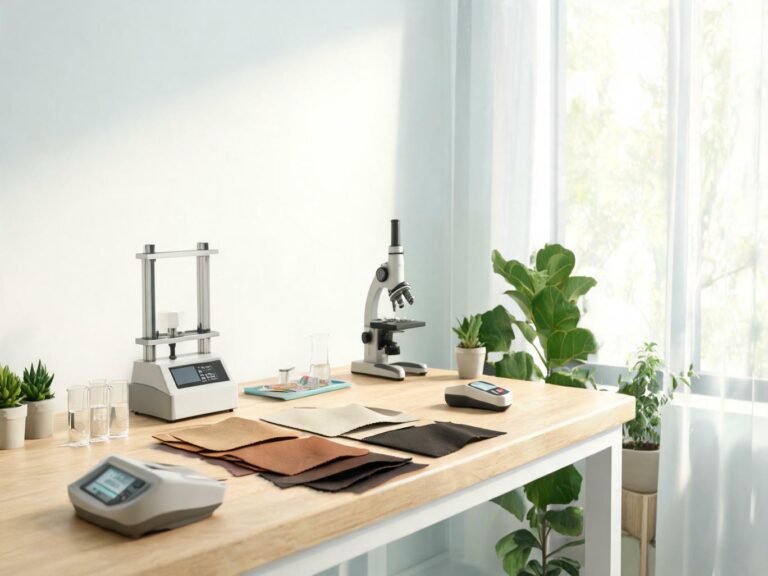
When we run pre-production material inspections for custom orders, the color consistency check alone catches deviations in 1 of every 4 batches from non-silicone suppliers. That’s not a statistic from a trade publication — it’s from our incoming QC logs. The five specs below are where most factory audits fail, and they’re the ones most buyers never think to request.

Metallic and solid-color swatches — the reference library your factory should match against before cutting bulk material.
1. Color consistency (Delta E measurement). Most factories hand you a swatch and say “we’ll match this.” Reliable factories hand you a spectrophotometer report showing Delta E ≤ 1.0 against your Pantone reference. Anything above 2.0 means visible color drift between production batches — a problem that doesn’t surface until your customer unboxes a wallet next to a bag from a different lot and the leathers don’t match. If you’re sourcing custom leather texture and color specifications, demand Delta E data up front.
2. Abrasion resistance (Martindale cycles). A factory that can’t tell you their material’s Martindale rating is a factory that hasn’t tested it. For custom leather goods subject to daily wear — bags, wallets, tech sleeves — anything below 50,000 cycles will show scuffing within 6 months. Premium silicone leather tests at 200,000+ cycles. The gap between “looks fine at delivery” and “looks fine after 18 months of use” is this number.
3. Hydrolysis resistance. PU leather degrades when exposed to moisture over time — it’s a chemical inevitability, not a quality control issue. If your custom leather goods will ship to humid climates (Southeast Asia, the US Gulf Coast, Northern Europe), ask for hydrolysis test data. Factories that shrug at this question are selling you material with a built-in expiration date.

Color fastness testing — the machine your factory should run on every custom color before approving bulk production.
4. Color fastness to light (ISO 105-B06). That rich burgundy you specified? If the dye isn’t lightfast, it fades to a muddy brown after 200 hours of UV exposure — roughly 3 months on a retail display shelf near a window. Ask for ISO 105-B06 grade ratings. Grade 4–5 means negligible fading. Grade 3 or below means your product looks different in the store than it did in the factory.
5. VOC and chemical compliance. EU REACH, California Prop 65, and RoHS aren’t optional if your goods ship to those markets. A factory that says “don’t worry, it’s compliant” without providing third-party test reports is asking you to absorb their compliance risk. ISO 9001-certified factories maintain documented compliance files — request them before placing a PO.
Key takeaway: If a factory can’t produce test data for all 5 specs within 48 hours of your request, they haven’t been testing — and you’ll be the one discovering why that matters.
| Specification | What to Verify | Red Flag | Silicone Leather Status |
|---|---|---|---|
| Color consistency | Delta E ≤ 1.0 spectrophotometer report | “We’ll match it visually” — no data | Delta E ≤ 1.0 verified per batch |
| Abrasion resistance | Martindale ≥ 50,000 cycles (ISO 12947-2) | “It’s durable” — no cycle count | 200,000+ cycles certified |
| Hydrolysis resistance | ISO 11507 test data | Silence or “not applicable” | Hydrolysis-proof by chemistry |
| Light fastness | ISO 105-B06 Grade 4–5 | Grade 3 or no test performed | Grade 4–5 confirmed |
| VOC & compliance | REACH, Prop 65, RoHS test reports | “Trust us” — no documentation | Zero-VOC, full compliance file |
The OEM Development Cycle: From Concept Sketch to Bulk Order
A structured OEM/ODM process isn’t a luxury — it’s the difference between a 6-week prototype-to-production timeline and a 6-month one. The cycle should move through five stages, each with a concrete deliverable.
Stage 1 — Brief intake: You provide sketches, dimensions, material references, and target retail price. The factory responds with a feasibility assessment, not a quote. If they skip straight to pricing, they haven’t understood your product. Our team at TOPSUN uses a structured intake form that covers application, thickness range (0.23–2.0 mm), texture preference, color standard, and compliance requirements. Learn more about our silicone leather material properties to inform your brief.
Stage 2 — Material sampling: The factory ships physical A4 swatches in your specified color and texture. This is where you verify the five specs above. Free swatch programs exist — use them. Never approve a bulk order based on digital images alone.
Stage 3 — Prototype development: Custom embossing tooling takes 7–10 days. Color matching with Pantone or RAL references adds 3–5 days. The prototype should arrive with a spec sheet documenting thickness, weight, Martindale rating, and color fastness grade — not just a sample in a box. For a deeper look at how this works in practice, see our overview of leather goods manufacturing processes.

Lamination stage — where coating thickness and adhesion quality are set for the entire production run.
Stage 4 — Pilot run: A small-batch run (typically 100–500m) validates that the material performs under production conditions. This is your last chance to adjust color, texture, or thickness before committing to bulk. Skip this stage and you’re betting the entire order on unvalidated specifications.
Stage 5 — Bulk production: With a 500m MOQ and 7–15 day lead time, bulk production should be a repeat of the pilot run — not a new experiment. Every roll should ship with a QC report matching the approved prototype. For brands exploring fashion and sports applications, this stage determines whether your launch date holds.
Watch how TOPSUN’s OEM/ODM process works — from brief intake to bulk shipment.
Why Silicone Leather Changes the Custom Leather Goods Equation
Material selection at the briefing stage ripples through every downstream decision — durability, compliance, cleaning protocol, warranty exposure, and retail price positioning. PU leather is the default choice for most custom leather goods because it’s cheap and looks acceptable at delivery. But PU carries hidden costs that surface 12–18 months into the product lifecycle: hydrolysis-driven cracking in humid markets, UV fading on retail shelves, and compliance gaps that emerge when regulations tighten.

Custom texture samples — embossed patterns, grain structures, and surface finishes available for OEM specification.
Silicone leather eliminates these failure modes at the chemistry level. The coating is inherently hydrolysis-resistant — not treated to resist it, but chemically immune. UV stability comes from the silicone polymer backbone, not from additives that deplete over time. VOC emissions are zero because the coating process is solvent-free. For brands developing premium custom leather goods with luxury positioning, this means your material specification doesn’t become a liability 18 months after launch.
The customization capabilities match or exceed traditional materials. Pantone matching with Delta E ≤ 1.0 accuracy, 100+ embossing patterns from cowhide to custom designs, metallic and pearlescent finishes, and thickness options from 0.23 mm for wearables to 2.0 mm for bags and cases. Custom embossing rollers are ready in 7–10 days. See how this compares to other materials in our silicone vs PU comparison.
Quality Control Checkpoints Every Brand Manager Should Demand
A factory’s QC process tells you more about their reliability than any certification wall. The four-stage inspection model — IQC (incoming), IPQC (in-process), FQC (final), and OQC (outgoing) — is industry standard, but execution varies wildly. Here’s what to verify at each stage before you commit.
At IQC, confirm the factory tests raw material thickness, color, and tensile strength against your approved spec sheet — not just visually inspects rolls. At IPQC, ask whether they check coating weight and adhesion at set intervals during production, or only at the end. A factory that only tests finished goods can’t tell you where in the process a deviation occurred. At FQC, verify they perform 100% inspection, not AQL sampling, for custom orders under 1,000m. And at OQC, request that random audits include photography of the actual shipping cartons, not just the material rolls.
Our production floor runs all four stages with documented defect protocols and corrective action logs. Every custom order ships with a QC report matching the approved prototype spec sheet. For brands that want to see the process firsthand, we offer factory production tours at our 60,000+ m² facility in Dongguan.
Frequently Asked Questions
What MOQ should I expect for custom leather goods production?
For roll goods (material supply), TOPSUN’s MOQ is 500 meters per color/texture combination. For finished goods manufacturing, MOQs vary by product type — typically 100–300 pieces per design. The 500m material MOQ generally supports 500–2,000 finished units depending on pattern efficiency. Compare this to traditional leather goods factories that often require 300+ piece minimums per design with less material flexibility.
Can silicone leather be custom-embossed and color-matched like genuine leather?
Yes — and with greater precision. Silicone leather supports 100+ standard embossing patterns (cowhide, pigskin, sheepskin, and custom designs), Pantone and RAL color matching with Delta E ≤ 1.0 accuracy, and metallic/pearlescent finishes. Custom embossing rollers take 7–10 days to produce. Unlike genuine leather, which has natural grain variation that makes batch-to-batch consistency difficult, silicone leather delivers identical texture and color across every roll in the production run.
The Specification Gap Closes at Material Selection
Custom leather goods succeed or fail at the material specification stage — not at the factory floor. When brand managers verify color consistency, abrasion resistance, hydrolysis resistance, light fastness, and compliance documentation before signing a PO, they eliminate the failure modes that cause launch delays, warranty claims, and customer returns. Silicone leather passes all five checkpoints by chemistry, not by luck. If your next custom leather goods project needs material that won’t become a liability, start with a spec sheet that includes third-party test data — and a factory that can produce it within 48 hours of your request.
About TOPSUN
TOPSUN manufactures custom silicone leather for OEM/ODM leather goods production — including bags, wallets, tech accessories, and fashion items — with Pantone-matched color accuracy, 100+ custom embossing patterns, and 500m MOQ backed by ISO 9001 quality management.
Pantone Delta E ≤ 1.0 color matching · 7–10 day custom embossing tooling · 200,000+ Martindale cycles · Zero-VOC solvent-free coating · Free A4 swatches shipped worldwide via DHL/FedEx