As a materials specifier, I’ve watched premium black leather samples turn brownish-gray in showroom windows within 18 months. The problem isn’t poor quality leather — it’s physics. Black pigment absorbs up to 93% of incident UV-A and UV-B radiation, concentrating energy that breaks down polymer bonds faster than any other leather color. Here’s the data behind why black black leather fades first, and what material actually holds its color past year 5.
Why Black Black Leather Absorbs 93% of UV Radiation
The physics are straightforward: darker pigments absorb more wavelengths of visible and ultraviolet light. Black pigment — typically carbon black or iron oxide black — absorbs approximately 93% of incident UV radiation. Brown absorbs about 70%, gray around 55%, and beige roughly 40%.
This absorbed energy doesn’t disappear. It converts to heat at the material surface, accelerating the breakdown of polyurethane polymer chains in PU and PVC leather. The result: black leather surfaces reach embrittlement thresholds 40–60% faster than equivalent brown leather under identical UV exposure — a black leather fading UV resistance problem that pigment quality alone can’t solve.
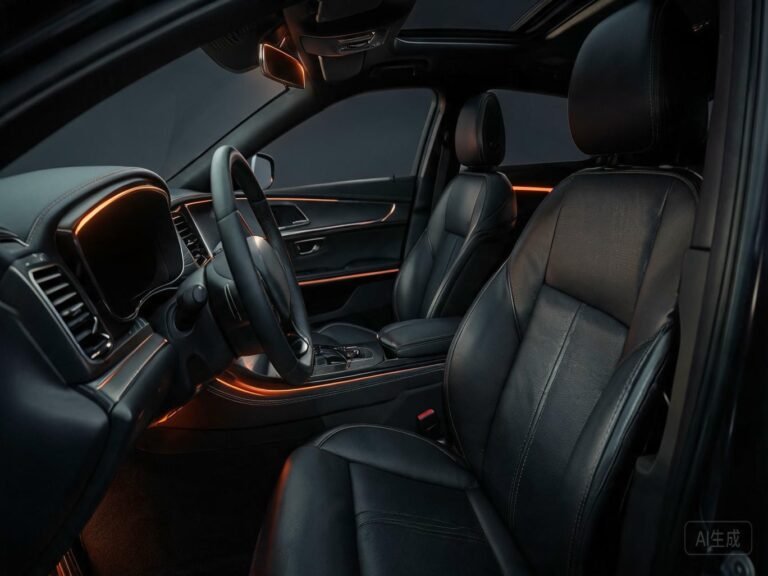
For designers specifying black leather upholstery, this means the material that looks most dramatic in the showroom degrades fastest in real-world conditions. The black leather that anchors a furniture collection or automotive interior often shows first signs of fading — a brownish or grayish cast — within 500 UV hours, equivalent to 2–3 years of indirect sunlight.

Color fastness tester — xenon arc UV exposure chamber measuring ΔE color shift per ISO 105-B02
The Color Fastness Gap: Black vs Brown Leather Durability
Silicone leather color fastness test — watch how black silicone holds its color under accelerated UV
In black leather color fastness testing per ISO 105-B02 (xenon arc), we measure color shift using ΔE (CIELAB color difference). A ΔE of 1.0 is barely perceptible; ΔE of 3.0 is clearly visible to the human eye; ΔE above 5.0 means the color has fundamentally changed.
Here’s how different leather colors perform under accelerated UV testing:
| Leather Color | UV Absorption | Visible Fade (hrs) | ΔE After 1,500 hrs | Real-World Timeline |
|---|---|---|---|---|
| Black (PU/PVC) | 93% | 300–500 | 4.5–7.0 | 2–3 years |
| Brown (PU/PVC) | 70% | 500–800 | 2.5–4.0 | 4–5 years |
| Gray (PU/PVC) | 55% | 700–1000 | 1.5–3.0 | 5–7 years |
| Beige (PU/PVC) | 40% | 1000–1500 | 1.0–2.0 | 7–10 years |
| Black (Silicone) | 93%* | 1,500+ | < 1.5 | 10+ years |
*UV absorption is similar, but silicone’s Si-O polymer backbone is inherently UV-stable — absorbed energy doesn’t break molecular bonds. Test data per AATCC and ISO 105-B02 standards.
Key insight: The gap between black and brown leather isn’t about pigment quality — it’s about how much UV energy each color converts into destructive heat. Black leather fading isn’t a quality issue; it’s a chemistry issue. No amount of protective coating changes the physics.
Silicone Black Black Leather: 1,500+ UV Hours, Zero Fade
This is where silicone leather changes the equation for black leather specifications. Unlike PU and PVC leather, where UV energy breaks down the polymer matrix, silicone (PDMS) is inherently UV-stable. The silicone polymer’s Si-O backbone resists photodegradation — the same chemistry that makes silicone sealants last 20+ years in outdoor construction applications.
In our testing, black silicone leather maintains ΔE < 1.5 after 1,500 xenon arc UV hours — the equivalent of 8–10 years of indoor UV exposure. Compare that to PU black leather at ΔE 4.5–7.0 after the same exposure: the material has visibly changed color. This is why black leather cracking prevention starts at the molecular level, not with surface treatments.

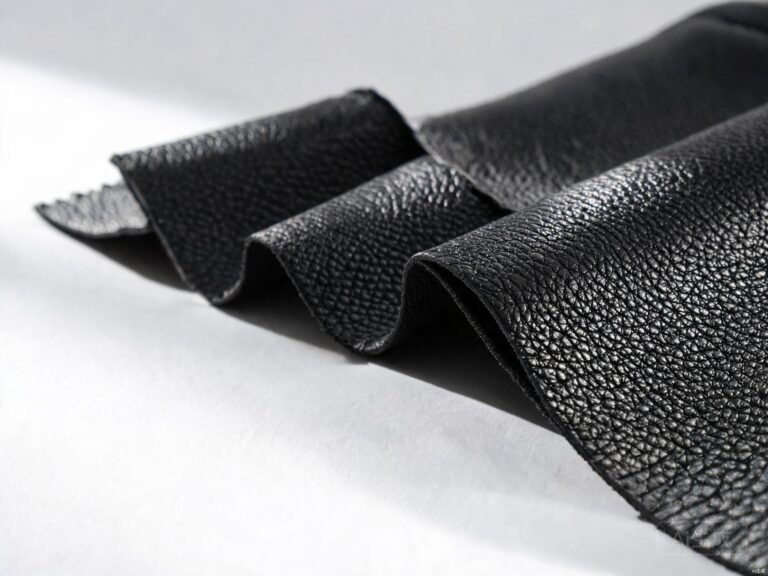
Black silicone leather — lychee texture macro showing consistent pigment depth and surface quality
Key advantages for designers specifying black silicone leather for automotive interiors or furniture:
- Color stability: ΔE < 1.5 after 1,500+ UV hours — no brownish cast developing
- No plasticizer migration: surface stays supple, never becomes sticky or brittle
- Temperature tolerance: -40°C to 250°C — black surfaces run hotter in sunlight, but silicone handles the heat
- Stain resistance: Level 5 — black surfaces show dust and oils, but silicone wipes clean with water
- Inherent flame retardancy: meets EN 13773 and FAR 25.853 without additives that degrade color
For automotive interior designers, where black is the dominant leather color choice, switching to silicone leather eliminates the #1 warranty complaint: fading and discoloration within 3 years. Per SAE J2412 automotive UV testing standards, silicone black leather passes 1,500+ hours with minimal color shift — a threshold PU leather typically fails by 500 hours.
Spec Verification: 5 Tests for Black Leather Procurement
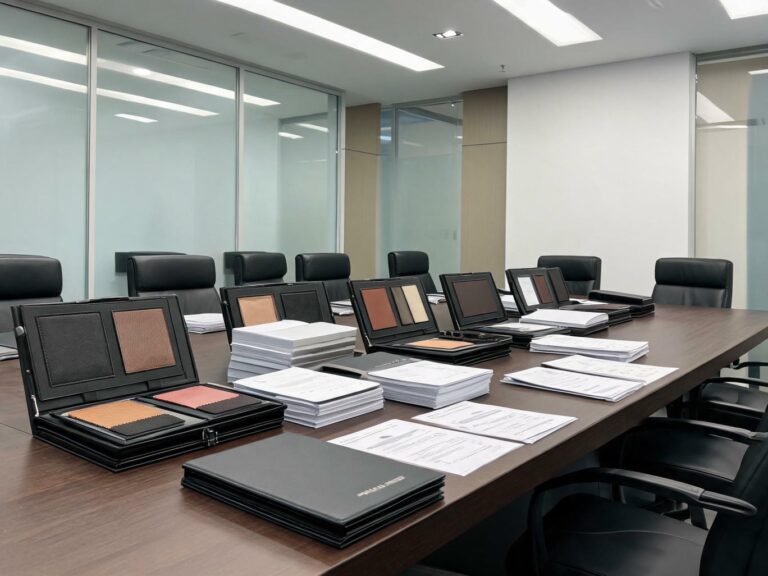
When sourcing black leather for B2B applications, standard material specs aren’t enough. Black leather’s UV vulnerability means you need color-specific test data — black leather grade specification without UV data is incomplete. Here are the 5 tests to verify before placing an order:
- Xenon arc UV test (ISO 105-B02) — request ΔE data after 1,500 hours minimum. If the supplier only offers 300-hour data, the material will fade in real-world use.
- Crocking test (ISO 11640) — black dye transfer is a major issue in automotive and furniture. Minimum Grade 4 (gray scale) for dry and wet crocking.
- Light fastness (ISO 105-B01) — the blue wool scale rating. Minimum Grade 5 for commercial applications. Grade 3 or below means visible fading within 12 months.
- Heat aging (ASTM D573) — black surfaces absorb heat; test at 70°C for 168 hours and measure color shift. Materials that fail will discolor in sun-exposed interiors.
- Full vs semi-silicone verification — request FTIR spectroscopy. Semi-silicone uses a PU adhesive layer that fades despite the silicone surface. Only full silicone maintains true color stability.

Black leather comparison — silicone (left) vs PU (right) after 1,500 UV hours of accelerated weathering
For projects requiring eco-friendly materials, also verify VOC emissions — black pigments in PU leather can contain restricted aromatic amines that off-gas over time, especially as the surface degrades under UV.
What Holds Its Color
The pattern is clear: black black leather made from PU or PVC will fade faster than any other color — not because of quality, but because of physics. The 93% UV absorption rate concentrates destructive energy at the material surface, breaking down polymer bonds that no protective coating can fully block. Silicone leather solves this at the molecular level — the Si-O backbone doesn’t photodegrade. For designers and specifiers, the question isn’t whether black leather looks good in the showroom. It’s whether it will still look black in year 5.
Frequently Asked Questions
Does black leather always fade faster than lighter colors?
Yes, for PU and PVC leather. Black pigment absorbs 93% of UV radiation, converting it to heat that breaks down polymer bonds. Lighter colors absorb less UV and degrade slower. However, silicone leather is exempt from this rule — its polymer backbone is inherently UV-stable, so black silicone leather maintains color (ΔE < 1.5) even after 1,500+ UV hours of xenon arc testing.
Can I specify UV-stable black leather for outdoor furniture?
Yes, but only with silicone leather. PU and PVC black leather will fade within 2–3 years of outdoor exposure. Silicone leather rated for 1,500+ xenon arc UV hours (equivalent to 8–10 years outdoors) is the only synthetic leather that maintains black color stability in sun-exposed applications. Always request ISO 105-B02 test data with ΔE results before ordering for outdoor use.
About TOPSUN
TOPSUN produces black silicone leather for automotive interiors, designer furniture, and fashion accessories where color stability under UV exposure is a non-negotiable specification for high-visibility design applications.
1,500+ xenon arc UV hours verified, ΔE < 1.5 color stability, ISO 105-B02 certified, with custom black shade matching across 50,000m+ production runs.