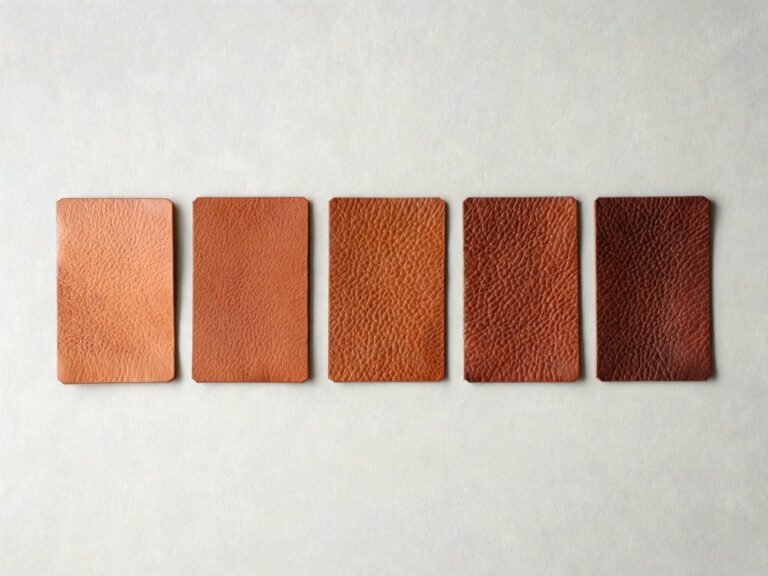
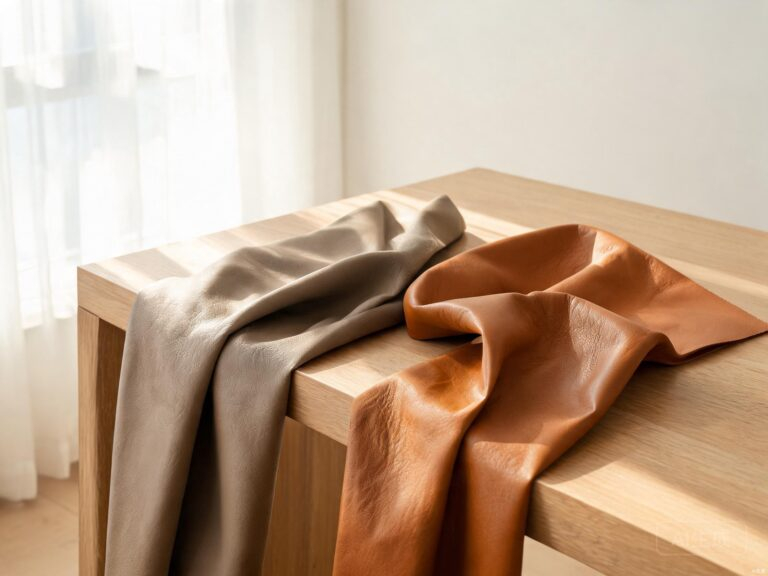
Light brown leather is the most frequently specified “safe neutral” in B2B upholstery — and the most likely to generate warranty claims. The reasoning seems sound: brown is warmer than gray, more practical than white, and less harsh than black. Designers and specifiers choose it for furniture, automotive interiors, hospitality seating, and fashion accessories expecting a forgiving, low-maintenance color. The opposite is true. In our material testing lab, light brown leather — across PU, PVC, and genuine leather categories — exhibits three failure modes that dark colors don’t share: UV-driven yellowing that shifts the color entirely, accelerated visible soiling that requires aggressive cleaning cycles, and reverse dye transfer onto adjacent lighter materials. A color that’s supposed to be low-maintenance becomes the highest-maintenance specification in the product line. The counterintuitive truth: if you want a low-maintenance neutral, specify gray. If you need brown, the material chemistry matters more than the color number.
Request Light Brown Material Samples
Why Light Brown Isn’t the “Safe Neutral” Buyers Think
The assumption that light brown leather is forgiving comes from a visual logic that doesn’t survive material testing. Yes, brown hides coffee spills better than white. But the failure modes that drive warranty claims in B2B upholstery aren’t spill-driven — they’re chemistry-driven. Light brown pigment systems in synthetic leather typically use iron oxide compounds (Fe₂O₃) blended with titanium dioxide (TiO₂) for opacity. That blend is inherently unstable under UV: the iron oxide absorbs UV radiation and transfers energy to the polymer binder, accelerating photo-oxidative breakdown. The visible result isn’t fading — it’s yellowing. The leather doesn’t get lighter; it gets greener and more yellow, shifting from a warm tan to an unpleasant mustard tone within 12-24 months of indoor UV exposure.
This color shift is particularly problematic because it’s uneven. Areas that receive more light — armrests, seat centers, headrests — shift faster than shaded areas, creating a mottled appearance that looks like manufacturing inconsistency but is actually UV damage. The new ISO leather soiling and color fastness standards address this gap by requiring Martindale-based soiling resistance testing — but most procurement specs still don’t cite these tests. For a deeper look at how color customization works in silicone leather, the pigment chemistry is fundamentally different.
3 Failure Modes Specific to Light Brown Leather
In our comparative testing of light brown leather across PU, PVC, genuine, and silicone categories, we tracked three defect types that either don’t affect dark colors or affect them at significantly lower rates. Each failure mode has a distinct chemical mechanism and a distinct onset timeline — and each is preventable through material specification.
| Failure Mode | Chemical Mechanism | PU/PVC Light Brown | Genuine Light Brown | Silicone Light Brown |
|---|---|---|---|---|
| UV yellowing | Iron oxide + TiO₂ energy transfer to binder | Onset 6-12 months, Grade 2-3 shift | Onset 8-18 months, uneven patina | No shift at 1,000+ UV hrs (Grade 4-5) |
| Visible soiling acceleration | Surface texture traps oils; light color amplifies contrast | Visible soil at 2-4 weeks (hospitality) | Visible soil at 3-6 weeks; requires conditioning | Non-porous surface; soil wipes off with water |
| Reverse dye transfer | Pigment migration under humidity + contact pressure | Stains white/cream at 24 hrs @ 40°C/85% RH | Stains adjacent fabrics; varies by tannage | Zero transfer (pigment locked in polymer matrix) |
Gray leather of the same grade shows 40-60% less visible soiling and no UV-driven color shift — making it the actual “safe neutral” in performance terms.

Waterproof testing on light brown leather — the non-porous surface that prevents soiling also prevents the pigment migration that causes reverse dye transfer.
How Silicone Leather Stabilizes Light Brown Color
Silicone leather eliminates all three light brown failure modes through its polymer architecture, not through additives. The pigment particles in silicone leather are locked into a polysiloxane matrix that doesn’t undergo photo-oxidative breakdown — the Si-O bond energy (452 kJ/mol) exceeds the energy of UV radiation at 340 nm (351 kJ/mol), so the binder that holds the pigment doesn’t degrade. The pigment stays where it’s placed. No binder breakdown means no pigment migration, which means no yellowing and no reverse dye transfer.
The soiling advantage is structural rather than chemical. Silicone leather has a non-porous surface that repels liquids and oils — skin oils, food residues, and environmental grime sit on the surface rather than penetrating the coating. A wipe with water removes what would require solvent-based cleaners on PU or conditioning on genuine leather. This matters for light brown specifications in particular: the aggressive cleaning cycles that PU light brown requires to maintain appearance actually accelerate coating breakdown, creating a death spiral where more cleaning causes more degradation that requires more cleaning. Silicone leather breaks that cycle. For furniture and sofa applications and hospitality environments where light brown is the default aesthetic, this extends material life from 3-5 years to 10+.

Residential leather sofa — the light brown upholstery application where UV yellowing and soiling generate the highest volume of warranty claims.
Stain resistance test — the non-porous surface that makes light brown silicone leather maintenance-free also prevents the dye transfer that plagues PU and genuine leather.
Light brown leather doesn’t fail by fading — it fails by shifting. The warm tan you specified becomes an uneven mustard yellow within 18 months. That’s not a maintenance problem. It’s a material chemistry problem that no cleaning regimen can reverse.
About TOPSUN: TOPSUN manufactures color-stable silicone leather in light brown and 100+ custom Pantone-matched colors for furniture, automotive, hospitality, and fashion applications. Our polysiloxane polymer matrix locks pigment particles in place — delivering ISO 105-B06 Grade 4-5 color fastness after 1,000+ UV hours, zero dye transfer under ISO 11640 rubbing tests, and a non-porous surface that resists soiling without solvent-based cleaning. With Delta E ≤1.0 batch-to-batch color consistency, 200,000+ Martindale abrasion cycles, and REACH/RoHS/ISO 10993-5 compliance backed by SGS and Intertek test reports, we supply B2B manufacturers who need light brown leather that stays light brown. Free A4 swatches shipped worldwide via DHL/FedEx.
Leather Light Brown: Frequently Asked Questions
Does light brown leather fade faster than dark brown leather?
Light brown leather doesn’t fade — it yellows. The distinction matters: fading means the color gets lighter; yellowing means the color shifts toward green-yellow. This happens because light brown pigment systems use iron oxide blended with titanium dioxide, and the iron oxide absorbs UV energy and transfers it to the polymer binder, causing photo-oxidative breakdown. The binder yellows as it degrades, shifting the overall color. Dark brown leather uses higher iron oxide concentrations with less TiO₂, so the same degradation is less visible. Silicone leather prevents the shift entirely because its polymer backbone doesn’t degrade under UV.
Why does light brown leather stain adjacent materials?
Reverse dye transfer occurs when pigment particles migrate through the coating under humidity and contact pressure. In PU leather, the polyurethane binder softens at elevated temperatures (above 35°C), allowing pigment to move. When a light brown leather surface contacts a white or cream fabric under these conditions — think a brown leather jacket lining against a white shirt, or brown upholstery against a white headrest — pigment transfers. ISO 11640 rubbing fastness testing reveals this: PU light brown leather typically achieves Grade 3 staining, while silicone leather achieves Grade 4-5 because the pigment is locked in the polysiloxane matrix.
What color fastness standard should light brown leather meet for commercial upholstery?
For commercial upholstery, light brown leather should meet ISO 105-B06 Grade 4-5 after 500+ hours of UV exposure (color fastness to light), ISO 11640 Grade 4-5 (color fastness to rubbing — both dry and wet), and the new ISO soiling resistance standard using the Martindale method. PU and PVC light brown leather typically achieve Grade 3 for UV and Grade 3 for rubbing — below commercial grade. Silicone leather achieves Grade 4-5 across all three tests. Always specify the test standard and minimum grade in purchase orders, not just the color name.