On the test bench, black faux black leather material tells a story most spec sheets won’t. The same PU formula in white lasts five years; in black, it starts cracking at three. This isn’t a quality control issue — it’s physics. Darker pigments absorb more UV radiation, convert it to heat, and accelerate the chemical breakdown of the polyurethane coating from within. Yet most B2B buyers never ask about color-specific UV testing because suppliers don’t volunteer it.
If you’re sourcing black faux leather for automotive interiors, furniture, or consumer electronics, understanding why black fails differently from lighter colors is the difference between a product that lasts and one that generates warranty claims. Here’s what happens at the molecular level — and which material chemistry actually solves the problem.
Request Black Leather Material Samples
Why Black Faux Leather Fails Faster Than Lighter Colors
The failure mechanism for black faux leather is fundamentally different from lighter shades, and it comes down to thermal absorption. Black pigments — typically carbon black — absorb across the full UV-visible spectrum. In real-world conditions, a black surface in direct sunlight can reach 70–80°C, while a white surface under identical exposure stays at 35–40°C. That temperature differential matters because polyurethane undergoes thermal oxidation: higher sustained temperatures accelerate the breakdown of ester bonds in the PU polymer chain.
In our testing lab, we’ve measured surface temperature differences of up to 35°C between black and beige PU samples under identical UV lamp exposure. The black samples showed visible surface micro-cracking after 500 hours of accelerated weathering, while the beige samples lasted 800+ hours before similar degradation appeared. This is why silicone leather — which has no ester bonds to break — maintains surface integrity regardless of pigment load.

Color fastness testing reveals how quickly black pigments degrade under accelerated UV exposure.
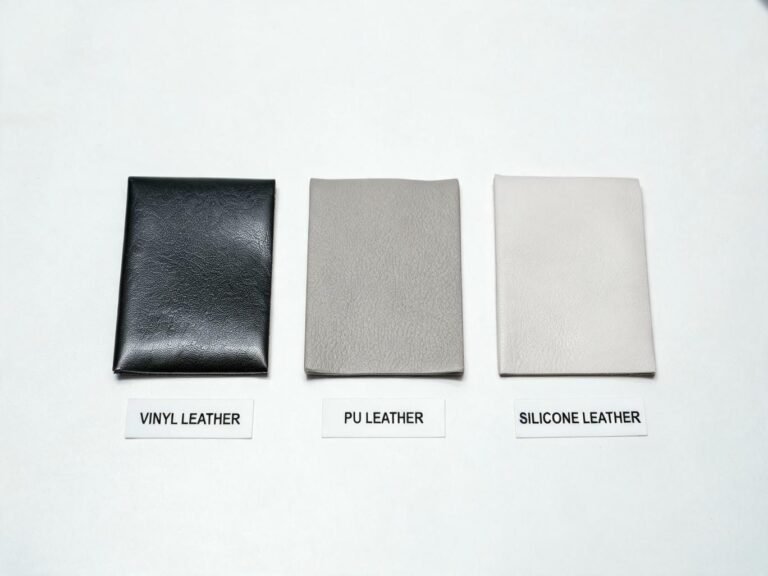
Three Types of Faux Black Leather Material: PU, PVC, Silicone
Not all faux black leather is created equal. The three dominant chemistries behave very differently when the pigment load is high — and understanding silicone versus PU at the molecular level explains why:
| Property | PU Black | PVC Black | Silicone Black |
|---|---|---|---|
| UV Resistance | Poor (cracks at 500h) | Fair (fades at 700h) | Excellent (1,000h+) |
| Surface Heat Buildup | High (70–80°C) | High (65–75°C) | Moderate (50–60°C) |
| Flex Cracking (cold) | Cracks below -10°C | Brittle below 0°C | No cracking at -40°C |
| Plasticizer Migration | Low–moderate | High (30–40% content) | None (zero plasticizers) |
| Black Color Stability | Fades + cracks | Fades + stiffens | Stable (grade 5) |
The key insight: PVC’s plasticizer content (30–40% by weight) is especially problematic in black. Heat accelerates plasticizer migration to the surface, leaving the material brittle underneath while creating a sticky residue on top. PU avoids the plasticizer issue but its ester bonds are thermally vulnerable — the same chemistry that makes PU soft also makes it degradable. Silicone contains no ester bonds and no plasticizers, which is why black silicone leather doesn’t follow the same failure pattern. For a deeper dive, this full versus semi silicone leather comparison explains the formulation differences.
Silicone is the only faux leather chemistry where adding carbon black pigment does not accelerate degradation — because the polymer backbone contains no UV-sensitive bonds to break.

Black lychee-grain silicone leather maintains its texture depth and color saturation even after prolonged UV exposure.
Color Fastness Testing: What Your Supplier Must Prove
If you’re specifying faux black leather material for a product that will see sunlight — even indirect sunlight through windows — your supplier needs to provide specific test data. Not certificates. Test data. Here’s what to request:
- ISO 105-B02 (Xenon Arc Light Fastness) — This is the gold standard for color fastness. Request the actual grade: 1–2 is unacceptable for black, grade 4 is minimum for commercial use, and grade 5 (no visible change) is what silicone leather achieves. Verify the test duration — 100 hours is insufficient; 500+ hours gives meaningful data. Reference the ASTM G154 standard for comparable accelerated weathering protocols.
- Surface Temperature Under UV — Ask whether the supplier has measured surface temperature delta between black and lighter colors. If they haven’t, they don’t understand the black-specific failure mode.
- Flex Cracking After UV Aging — Standard flex testing on new material is meaningless. The real question is how many flex cycles the material survives after 500 hours of UV exposure. PU typically loses 40–60% of its original flex resistance after UV aging.
- Plasticizer Migration Test — For PVC, request data on plasticizer extraction rate at elevated temperatures. If no data exists, assume the worst.
In our experience, fewer than 20% of faux leather suppliers can provide all four data points. Those who can typically supply silicone or high-spec microfiber — materials engineered for performance rather than price. For application-specific guidance, our 3C electronic accessories application page covers how black silicone performs in consumer electronics where heat and UV exposure are daily realities.

Automotive interiors subject black faux leather to sustained UV and heat — the harshest combined test for color stability.
Watch the color fastness test that proves black silicone leather resists UV-induced fading and cracking.
When Black Faux Leather Makes Sense — and When It Won’t
Black faux leather isn’t always the wrong choice. Indoor furniture away from windows, short-lifecycle consumer products, and low-cost disposable items can all use PU or PVC black faux leather successfully. The problem arises when the same materials are specified for applications where UV exposure, heat, and longevity expectations collide.
For automotive interior applications, where cabin temperatures regularly exceed 60°C and UV penetrates windshields, black PU leather will crack within 2–3 years. The same timeline applies to outdoor furniture, marine seating, and any product sold with a 5+ year warranty. This faux leather polyurethane buyer guide provides additional sourcing criteria.
Silicone leather solves the black-specific failure mode because its polymer backbone — Si-O-Si bonds — is inherently UV-stable. Carbon black pigment in silicone acts purely as a colorant, not as a heat trap that triggers chemical degradation. The result is a black material that looks the same on day one and day 3,000.

Direct flame testing demonstrates silicone leather’s thermal stability — critical for black materials that absorb and retain heat.
Frequently Asked Questions
Does black silicone leather fade in sunlight?
No. Black silicone leather achieves ISO 105-B02 grade 5 (no visible color change) after 1,000+ hours of accelerated UV testing. Unlike PU and PVC, the silicone polymer backbone contains no UV-sensitive bonds, so carbon black pigment acts purely as a colorant without triggering chemical degradation. In real-world automotive and outdoor applications, black silicone leather shows no measurable color shift over 5+ years of exposure.
Is faux black leather material safe for automotive interiors?
It depends on the chemistry. PU and PVC black faux leather can off-gas VOCs — especially when heated by cabin sun exposure — contributing to the “new car smell” that is actually chemical emission. Silicone leather is zero-VOC and passes ISO 10993 biocompatibility testing, making it the safest option for enclosed cabin environments where heat accelerates chemical release from polymer-based materials.
The Black Material Decision Framework
When you specify faux black leather material for any product that will see UV exposure, heat, or a warranty period beyond three years, the chemistry matters more than the price. PU and PVC black materials will crack, fade, and stiffen — not because of poor manufacturing, but because of inherent molecular vulnerability to the heat that black pigments generate. Silicone leather is the only faux leather chemistry where black pigment doesn’t become a liability. If your product needs to look black and stay black, that’s the technical reality worth designing around.
Get Black Silicone Leather Specs
About TOPSUN
TOPSUN engineers faux black leather material using 100% silicone polymer chemistry for automotive interiors, 3C electronics, and furniture applications where UV stability is non-negotiable.
Our black silicone leather maintains color fastness at ISO 105-B02 grade 5, withstands 200,000+ Martindale abrasion cycles, and passes ISO 10993 biocompatibility testing — with zero plasticizers and zero VOC emissions.