An accent chair lives or dies by its leather. Not the frame, not the foam — the leather. When a homeowner runs their hand across the armrest in a showroom, that first tactile impression determines whether the piece reads as “premium” or “disposable.” For furniture manufacturers sourcing accent chair leather in bulk rolls, translating subjective hand-feel judgment into quantifiable specifications is the real engineering challenge.
This guide covers what specifiers need to know: hand feel control parameters, stitching and seam performance criteria, bulk roll purchasing standards, and how silicone leather for furniture upholstery compares to traditional options for accent chair applications.
Request Accent Chair Leather Swatches
What Makes Accent Chair Leather Different
Accent chairs occupy a unique position in furniture design. Unlike sectional sofas that prioritize durability over tactility, or office chairs that prioritize ergonomics over aesthetics, accent chairs must deliver both. The leather on an accent chair is the focal point of a room — its texture, sheen, and color define the piece’s design language. That means the material specification carries more weight than for any other furniture category.
Three characteristics distinguish accent chair leather from general upholstery leather. First, visual texture must be consistent across the entire chair surface — any grain variation reads as a defect at close viewing distance. Second, the material must drape smoothly over curved contours without puckering at seam intersections. Third, hand feel must remain stable across temperature changes, since accent chairs are often placed near windows where sunlight heats the surface. Traditional PU faux leather struggles with the third requirement — its surface becomes tacky when warm and brittle when cold, compromising the tactile experience that defines an accent chair’s value proposition.

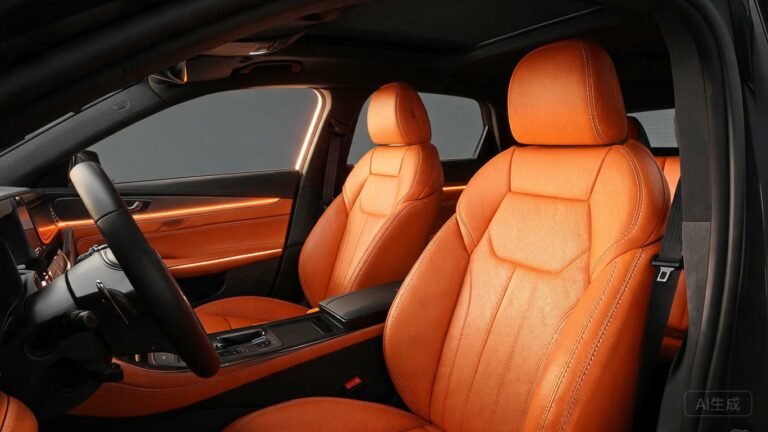
Accent chair upholstery demands consistent grain definition and smooth drape across curved contours
Hand Feel Control Parameters for Accent Chair Leather
Hand feel isn’t purely subjective — it can be measured. Furniture manufacturers who specify accent chair leather should require the following quantifiable parameters from suppliers:
| Parameter | Specification Target | Test Method |
|---|---|---|
| Softness (Niiyama) | 3.0 – 5.0 mm | Niiyama softness tester |
| Drape Flexibility | 40 – 60° drape angle | ASTM D5732 cantilever |
| Surface Friction (COF) | 0.25 – 0.45 | ASTM D1894 |
| Grain Definition | Consistent across full roll | Visual + 10x magnification |
| Thermal Tactility | No tackiness at 40°C | Conditioned surface touch test |
| Color Consistency (Delta E) | ≤ 1.0 within batch | Spectrophotometer (CIE Lab) |
In our design lab, we’ve found that silicone leather maintains these parameters more consistently than PU across production runs. The solvent-free coating process produces a more uniform surface, while the silicone polymer’s inherent thermal stability (-40°C to 250°C) eliminates the tackiness issue that plagues PU in sun-exposed placements. For designers specifying silicone leather materials, this translates to predictable hand feel from the first prototype through mass production.

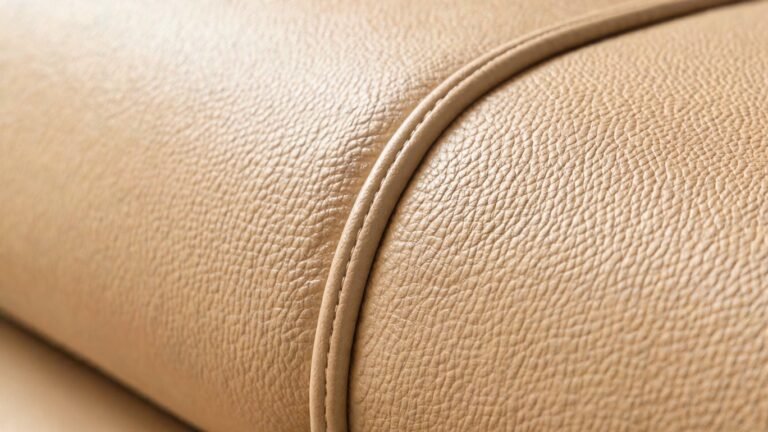
Softness fold test — accent chair leather must drape smoothly without creasing or spring-back at fold points
Stitching and Seam Performance
Accent chairs feature more complex seam patterns than sofas — curved armrests, tufted backs, and piped edges all demand leather that holds stitches without tearing. The critical parameters here are seam slippage resistance and tear propagation strength. When thread tension pulls on the leather during sewing, the material must resist yarn slippage (the tendency for stitches to pull through the material under load).
Silicone leather’s woven fabric substrate provides excellent seam strength because the textile backing distributes stitch load across a wider area than the film-only construction of some PU leathers. In our testing, silicone leather consistently achieves seam slippage values above 120N (ISO 13936-2), while budget PU leathers often fail below 80N. For accent chairs with decorative topstitching — where seam visibility is part of the design — this difference determines whether the stitching stays crisp after years of use or begins to pull and distort.
Bulk Roll Purchasing Criteria
For furniture manufacturers buying accent chair leather in bulk rolls, yield and consistency drive the real cost equation. A roll that looks good on the sample swatch but delivers inconsistent grain or color variation across 50 meters creates cutting waste and quality rejects. The following criteria should appear on every purchase order:
- Roll width specification: Standard 137cm (54″) width suits most cutting tables. Confirm tolerance of ±2mm — wider variation disrupts automated nesting software and reduces cutting yield by 3-5%.
- Roll length minimum: Specify minimum 30 meters per roll for continuous pattern matching. Shorter rolls force splicing, which is unacceptable on accent chair surfaces where seams are visible.
- Color batch matching: Require Delta E ≤ 1.0 within a production batch and ≤ 2.0 between batches. Provide a master color standard that the supplier matches against for every production run.
- Defect tolerance: Specify maximum 1 defect per 10 linear meters, with defects clearly flagged. Common defects include coating skips, grain inconsistency, and substrate wrinkles.
- Backing fabric specification: Confirm backing weight (typically 200-300 g/m² for furniture), construction type (woven vs knit), and fiber content. Backing variation affects sewing machine feed behavior and seam appearance.
- Certificate package: Require REACH compliance, color fastness grades (light: ≥4, rubbing: ≥4), and abrasion test data with each shipment.

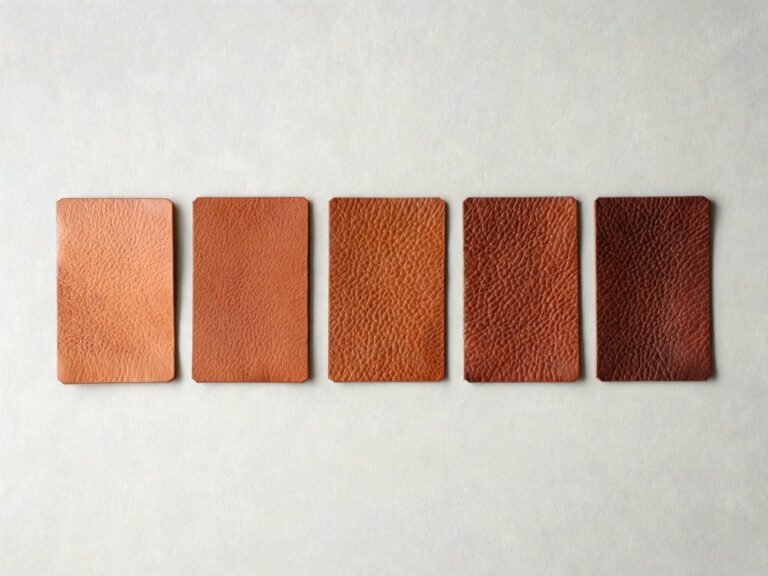
Color swatch rack — bulk roll purchases should include a matched swatch set for quality control at the cutting table
Accent Chair Leather: Silicone vs Traditional Options
When evaluating materials for accent chair production, designers typically compare genuine leather, PU faux leather, and silicone leather. Each material offers distinct advantages for accent chair applications:
Genuine leather delivers unmatched prestige and patina development, but its cost (3-5x higher than synthetics), batch inconsistency, and ethical sourcing concerns limit its use to ultra-premium accent chairs. PU faux leather offers the widest color and texture range at the lowest cost, but its 3-5 year lifespan, hydrolysis vulnerability, and VOC emissions create quality and compliance risks for commercial furniture programs.
Silicone leather occupies the middle ground — higher upfront cost than PU but with a 10-15 year lifespan, inherent stain resistance (level 5), and zero VOC emissions. For accent chairs placed in hospitality, healthcare, or residential settings where longevity and cleanability matter, silicone leather’s custom color and texture options (100+ patterns with Pantone/RAL matching) provide the design flexibility that accent chair programs demand. The material also maintains its hand feel across the full lifespan — no plasticizer migration, no surface hardening, no tackiness development.

Flexibility bending test — accent chair leather must maintain suppleness through thousands of flex cycles without surface cracking
What leather thickness is best for accent chair upholstery?
For accent chair upholstery, 0.9-1.4mm thickness is the optimal range. Below 0.9mm, the material risks tearing during tight-radius wrapping around armrests and seat edges. Above 1.4mm, the leather becomes too rigid for the curved contours that define accent chair silhouettes. Silicone leather at 1.0-1.2mm provides the ideal balance of drape, stitchability, and structural support. Thicker materials (1.4mm+) may be appropriate for accent chairs with minimalist, flat-surface designs where structural rigidity is preferred over contour draping.
Can silicone leather achieve the same hand feel as genuine leather for accent chairs?
Yes. Modern silicone leather formulations achieve a plush, supple hand feel that mirrors full-grain genuine leather. The key difference is thermal tactility — genuine leather feels cool initially then warms to body temperature, while silicone leather maintains a consistent neutral temperature. For accent chairs in climate-controlled interiors, most users cannot distinguish between premium silicone leather and genuine leather by touch alone. The visual texture, grain pattern, and sheen level can all be customized to match specific genuine leather references.
Get Custom Accent Chair Leather Quote
About TOPSUN
TOPSUN produces silicone leather engineered specifically for accent chair and furniture manufacturers who need precise control over hand feel, color consistency, and bulk roll quality. Our production capabilities include custom texture embossing across 100+ patterns, Pantone and RAL color matching with Delta E ≤ 1.0 accuracy, Martindale abrasion ratings of 100,000-200,000+ cycles, and roll-to-roll manufacturing with width tolerances of ±2mm for automated cutting lines. Every shipment includes a certificate package covering REACH compliance, color fastness data, and abrasion test results. Design teams can request matched specification swatches — including softness, drape, and grain reference samples — to evaluate material performance before committing to bulk production runs.
Related reading: Leather fabric sofa guide · Sofa upholstery commercial guide · Leather cleaning and maintenance