A hotel chain’s furniture buyer hands you a swatch that lasted 8 years in a boutique lobby and asks, “Can you match this?” The answer depends less on look and feel than on what happened inside a Martindale testing chamber before that fabric ever reached a sofa frame. Most sofa upholstery fabric failures we diagnose in our lab trace back to one missing step: nobody specified the abrasion class. This guide walks through the material categories, testing protocols, and commercial-grade thresholds that furniture manufacturers need to get right the first time.
Request Upholstery Fabric Samples
Understanding Sofa Upholstery Fabric Categories
Walk into any furniture trade show and you’ll hear “leather” used to describe everything from bonded leather scraps to full-grain hides to PU-coated polyester. That ambiguity is dangerous when you’re specifying materials for a 500-unit hotel rollout. Sofa upholstery fabric falls into four broad categories, each with drastically different performance ceilings.
Woven textiles — polyester, linen, velvet — offer design flexibility but absorb liquids and stain permanently. Coated fabrics (PU and PVC) provide a wipe-clean surface but degrade through hydrolysis, especially in humid environments. Genuine leather delivers prestige but requires conditioning and varies hide-to-hide. Silicone-coated fabrics represent the newest category: a solid silicone layer bonded to a textile backing, combining the cleanability of coated fabrics with molecular stability that woven and PU materials can’t match. For manufacturers exploring furniture and sofa applications, understanding where each material sits on the durability spectrum is the first step toward writing a defensible specification.

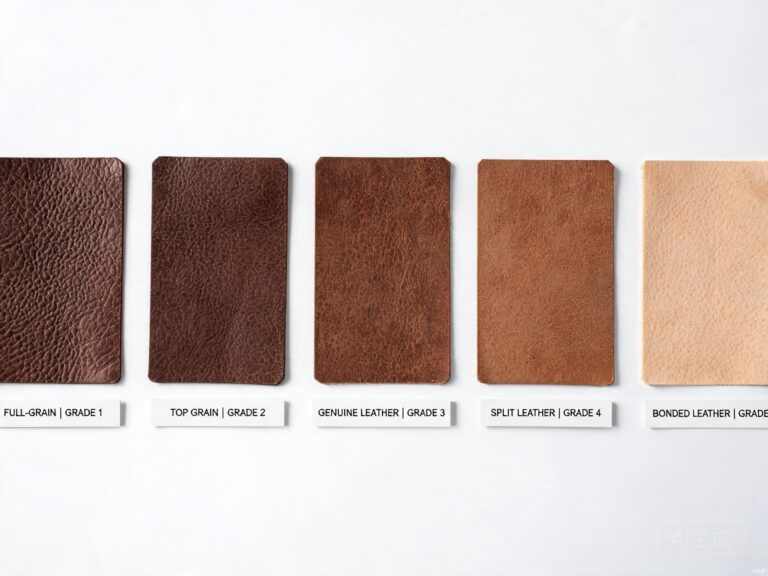
Warm-tone lychee-texture leather swatches for sofa upholstery selection
Abrasion Testing: Martindale vs Wyzenbeek Explained
Two testing methods dominate the furniture industry, and confusing them leads to costly specification errors. The Martindale test (ISO 12947) uses a circular rubbing motion with standard wool abradant, measuring cycles until two yarns break or the surface shows noticeable wear. The Wyzenbeek test (ASTM D4157) uses a back-and-forth motion with cotton duck or wire mesh, reporting “double rubs.” A material rated at 30,000 Martindale cycles is not equivalent to 30,000 Wyzenbeek double rubs — the test mechanics differ enough that cross-comparison is misleading.
In our lab, we run both protocols on every sofa upholstery fabric batch. A PU-coated polyester that passed 20,000 Martindale cycles failed at only 9,000 Wyzenbeek double rubs with wire mesh — the sharper abradant cut through the coating faster. The ASTM publishes both test standards, and we recommend specifying the test method alongside the threshold. For commercial furniture, we set internal pass marks at 25,000 Martindale cycles for general commercial use and 40,000+ for heavy-traffic environments like hotel lobbies and airport lounges.
| Performance Factor | Woven Fabric | PU Coated | Silicone Leather |
|---|---|---|---|
| Abrasion class (Martindale) | 15,000–25,000 | 20,000–30,000 | 50,000+ |
| Cleanability | Poor — absorbs liquids | Good — wipe clean | Excellent — stain-proof |
| Hydrolysis resistance | N/A (fiber-based) | 1.5–3 years | 10+ years |
| Flame retardancy | Requires treatment | Additive-dependent | Inherently flame-retardant |

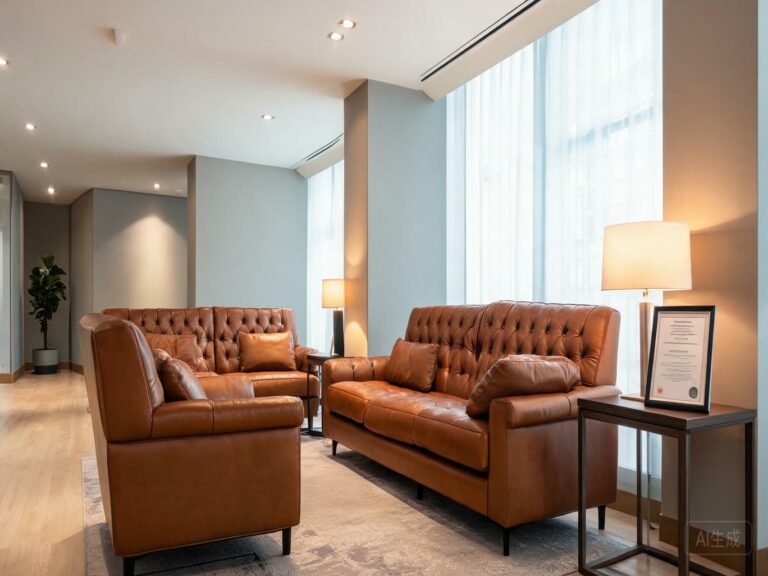
Flexibility bending test machine evaluating sofa upholstery material softness
Choosing Sofa Upholstery Fabric for Commercial Spaces
Residential sofa specs can tolerate lower abrasion thresholds because a living room sofa sees maybe 2,000 hours of use per year. A hotel lobby sofa sees that in two months. When you’re specifying sofa upholstery fabric for commercial environments, the requirements stack: abrasion resistance alone isn’t enough. You need cleanability (housekeeping staff use aggressive disinfectants), flame retardancy (building codes mandate it), and hydrolysis resistance (HVAC humidity cycles accelerate coating breakdown).
We worked with a cinema chain that had been replacing PU-upholstered seats every 14 months because the coating cracked and peeled under repeated cleaning with quaternary ammonium disinfectants. After switching to our silicone leather — which tolerates alcohol, bleach, and quat-based cleaners without surface degradation — their replacement cycle extended to 5+ years. That case taught us that commercial grade sofa upholstery material specs should always include chemical resistance testing, not just abrasion numbers. For detailed care protocols, our cleaning and maintenance guide outlines compatible disinfectants for each material type.
Talk to Our Material Engineers

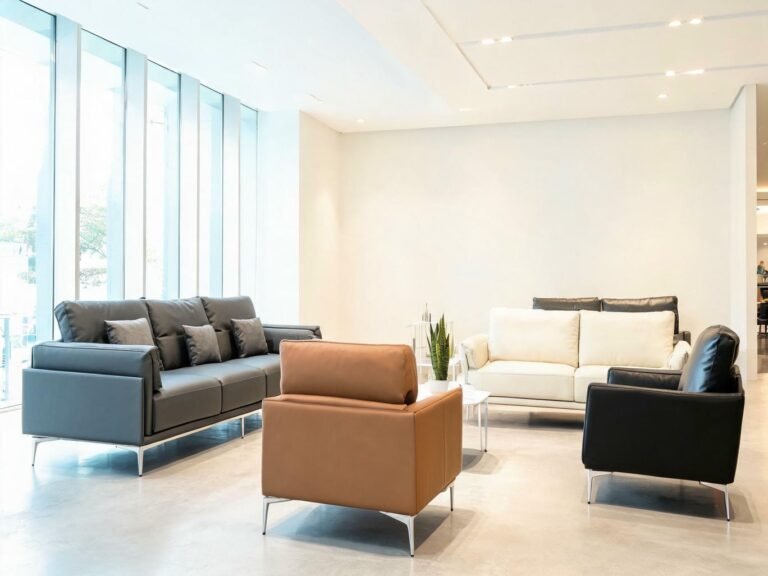
Color fastness testing equipment verifying UV stability of sofa upholstery materials
Why Silicone Leather Excels in High-Traffic Furniture
The reason silicone leather outperforms in commercial furniture comes down to one word: stability. PU coatings rely on polyurethane chemistry with ester bonds that hydrolyze when exposed to moisture. Woven fabrics absorb contaminants into their fiber matrix. Genuine leather’s collagen structure stiffens and cracks without regular conditioning. Silicone’s Si-O backbone is chemically inert — it doesn’t react with water, oxygen, or most cleaning chemicals at room temperature.
That molecular stability translates directly to longer service life in commercial furniture. Our hydrolysis-resistant silicone leather has been independently tested for 10+ years of accelerated aging with less than 5% tensile strength loss. For sofa manufacturers targeting the contract furniture market, this means warranty exposure drops dramatically — a material that doesn’t degrade eliminates the most common warranty claim categories (peeling, cracking, staining). For a deeper comparison of material options, see our sofa upholstery material guide and our analysis of commercial upholstery fabric performance benchmarks.
See how silicone leather performs in commercial sofa upholstery applications
Frequently Asked Questions
What Martindale rating do I need for a hotel lobby sofa?
For hotel lobby and other heavy-traffic commercial environments, we recommend a minimum of 40,000 Martindale cycles. General commercial use (office lounges, conference rooms) can accept 25,000–30,000 cycles. Residential applications typically need only 15,000–20,000. Always specify the test method (Martindale vs Wyzenbeek) in your purchase order — a 30,000 Wyzenbeek double-rub rating is roughly equivalent to 20,000 Martindale cycles, not the other way around.
Can silicone sofa upholstery fabric be repaired if damaged?
Minor punctures and cuts in silicone leather can be repaired using silicone-based patch kits that bond chemically with the original surface. The repair is waterproof and flexible. For larger damage, panel replacement is the standard approach — most commercial sofa frames are designed with replaceable upholstery sections. The good news is that silicone leather rarely needs repair in the first place: its abrasion and puncture resistance significantly exceed PU and woven alternatives.
Specifying With Confidence
The difference between a sofa upholstery fabric that lasts 18 months and one that lasts 8 years isn’t luck — it’s specification. When furniture manufacturers write Martindale thresholds, chemical resistance requirements, and hydrolysis ratings into their material specs, they eliminate the guesswork that leads to premature failure. Silicone leather raises the ceiling on every one of those metrics, making it the strongest candidate for commercial environments where replacement costs and brand reputation are on the line. Start with test data, end with confidence.
Order Commercial Sofa Upholstery Samples
About TOPSUN
TOPSUN produces silicone-based sofa upholstery fabric engineered for commercial furniture manufacturers requiring verified abrasion performance and long-term hydrolysis resistance in contract environments.
In-house Martindale and Wyzenbeek testing | 200+ UV-stable color options | flame-retardant formulations meeting EN 1021-1/2 | OEM-spec batch consistency for multi-site furniture rollouts